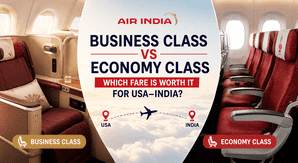
Is business class flights “worth it” on the long USA–India haul—or is economy the smarter play? In 2026, this question matters more than ever because premium travel is changing fast: airlines are pushing “unbundled” economy pricing, while business class is becoming a productivity-and-wellness product, not just a bigger seat.
According to IATA, global airline passenger demand (RPK) rose 10.4% in 2024 (IATA, 2025), and that demand has kept premium cabins crowded on key long-haul routes like USA–India.
This guide breaks down Air India business class USA India versus economy with practical decision rules, a clear table comparison, and how Air India fare types can change the real value of each cabin. You’ll also learn when upgrades make financial sense, how to avoid common booking mistakes, and what’s different in 2026.
What You’re Really Buying on USA–India: Time, Sleep, and Risk Reduction
USA–India flights frequently run 14–17+ hours depending on routing, winds, and connections. On trips this long, the cabin choice is less about “luxury” and more about sleep quality, jet lag management, and what your first 48 hours in India look like.
Business Class: The “Arrive Functional” Advantage
For high-income professionals and frequent flyers, the biggest value driver is arriving ready for meetings, weddings, or family responsibilities.
Research consistently links sleep loss to performance drops; for example, 17 hours of sustained wakefulness can impair performance comparable to a 0.05% BAC (Arnedt et al., 2005; often cited in fatigue research). While this is not airline-specific, it frames why lie-flat rest can matter on long-haul travel.
Economy: The “Good Enough” Value Play (When You Plan It Right)
Economy can be the better option if you optimize: choose the right fare type, manage seat selection early, use smart layovers, and protect your itinerary with flexible rules.
This is especially relevant for students, family trip planners, and travelers who’d rather spend on hotels, shopping, or domestic India add-ons.
Air India Cabin Experience in 2026: What’s Improved, What Still Varies
Air India has been modernizing rapidly since its privatization-era turnaround, and by 2026 travelers are seeing a more consistent push toward upgraded onboard soft product and refreshed aircraft on more routes.
The key is that experience can still vary by aircraft type and route, so your exact flight number matters.
What Typically Improves in Business Class
Business class generally offers enhanced comfort, additional privacy, improved dining, priority services, and better rest opportunities on long-haul flights.
What Economy Travelers Should Watch in 2026
Economy travelers should pay attention to aircraft type, seat selection policies, baggage allowances, and fare restrictions, as these factors can significantly impact overall travel experience.
Air India Fare Types: Why the Cheapest Ticket Can Be the Most Expensive
Most travelers compare only cabin price. In reality, Air India fare types determine the rules that protect (or punish) you when plans change—especially for weddings, school schedules, visa timelines, and family emergencies.
Fare-Type Checklist (Before You Click “Buy”)
- Check change and cancellation fees.
- Review baggage allowance.
- Verify seat selection policies.
- Understand refund eligibility.
- Compare flexibility between fare families.
Benchmarked Reality: U.S. DOT data shows schedule disruptions are common across the industry. In 2024, U.S. reporting carriers’ on-time arrival rate hovered around the low 80% range (Bureau of Transportation Statistics, 2025). If your itinerary includes domestic positioning flights (e.g., SFO → JFK → DEL), flexibility and buffers matter as much as cabin.
Business vs Economy Comparison: Costs, Comfort, and Total Trip Value
Use the table below as a decision framework. The “best” choice depends on your trip purpose, how tight your schedule is, and what disruption would cost you in money and stress.
| Factor |
Air India Economy (Typical) |
Air India Business (Typical) |
| Seat & Sleep |
Recline + limited rest; better with aisle/exit row |
Lie-flat (route/aircraft dependent); far higher sleep odds |
| Productivity |
Limited workspace; fatigue cost next day |
More space + rest; better for landing and working same/next day |
| Airport Time |
Standard lines and boarding groups |
Priority check-in/boarding; often faster baggage |
| Change/Cancel Value |
Varies widely by fare type; cheapest can be restrictive |
Often more flexible fare families and support options |
| Best For |
Students, families with flexible arrival, budget-led trips |
Executives, tight schedules, health/sleep needs, premium deal seekers |
A Practical ROI Way to Decide (In 2 Minutes)
Ask yourself: What is one “bad first day” worth?
If business class costs $1,800 more roundtrip and you bill $250 per hour, you’d need approximately 7–8 productive hours saved across the trip to break even.
For a wedding or important family event, the ROI may be emotional rather than financial. Arriving rested for key moments can outweigh the price difference.
When Air India Business Class Is Worth It (And When It Isn’t)
Business class usually wins when your time, health, or uncertainty costs are high.
Worth It Scenarios (Common for NRIs)
- Business meetings within 24–48 hours of arrival.
- Wedding or family events with fixed schedules.
- Travelers with sleep, health, or mobility concerns.
- Premium fare deals that narrow the price gap.
- Long work trips where productivity matters.
Economy Is Smarter When...
- Your travel dates are flexible.
- You can recover from jet lag before important activities.
- You prioritize saving money for other parts of the trip.
- You are traveling as a student or budget-conscious family.
- You can secure preferred seating and travel during lower-demand periods.
Data Point to Anchor Comfort Expectations: A 2023 meta-analysis found that long-haul air travel is associated with increased fatigue and sleep disruption and that mitigation strategies such as sleep timing and light exposure can improve outcomes (Systematic review literature; e.g., J Sleep Res, 2023). This reinforces why cabin selection and travel planning both matter.
Conclusion: the simplest way to choose the right fare
If you want a fast, expert comparison across dates and routes—and help if weather, strikes, or missed connections disrupt your trip—MyFlyYatra can source competitive premium fares and guide you to the right option. We’re here 9am–9pm (EST), 7 days, and our Emergency Travel Center is available within 24 hours of departure or while you travel: 1-888-413-5701. To start, visit the site and ask for the best available USA–India business class flights deal for your dates.
FAQs:
It’s usually worth it if you need sleep to function on arrival, have meetings or events within 24 hours, or value flexibility. If your schedule is flexible and you can plan rest days, economy can deliver better overall trip value.
Air India fare types are branded price tiers with different rules for changes, cancellations, seats, and baggage. They matter because a restrictive fare can erase savings if you need to modify dates or add services later.
Check the aircraft type and seat map before booking, and confirm the seat configuration for your exact flight number and date. If you’re booking through an agent, request a written confirmation of the cabin product (lie-flat vs. angled or older layouts).
On some itineraries, premium economy offers meaningful comfort at a smaller premium, but it won’t replace lie-flat sleep. If your main goal is arriving rested, business class still tends to be the better value.
For many travelers, 2–5 months out is a practical booking window, but peak seasons (June–August and mid-December) often require earlier planning. Use price alerts and be ready to book quickly when a fare reaches your target range.
Sometimes, but upgrade availability varies by flight demand and fare rules. During peak travel periods, upgrades may be limited or priced close to purchasing business class outright, so compare the upgrade cost before booking economy.
Choose an economy fare that allows at least one date change with reasonable fees. Also verify whether changes require only a fee or both a fee and fare difference. This is especially important for students and families whose travel plans may shift.
They don’t prevent delays, but they often provide better rebooking priority and customer support, depending on fare rules and seat availability. Since travel disruptions are common, added flexibility and support can be valuable benefits.
Many families find the best value in economy combined with smart seat selection, extra comfort items, and a recovery day after arrival. If traveling with infants or elderly parents, a mixed approach—one way in business class and one way in economy—can balance comfort and budget.
If you’re price-sensitive when booking business class, specialists can sometimes access consolidator fares, private rates, and provide hands-on support if disruptions occur. Direct booking may be simpler for straightforward itineraries, but it can cost more for premium cabins on certain travel dates.