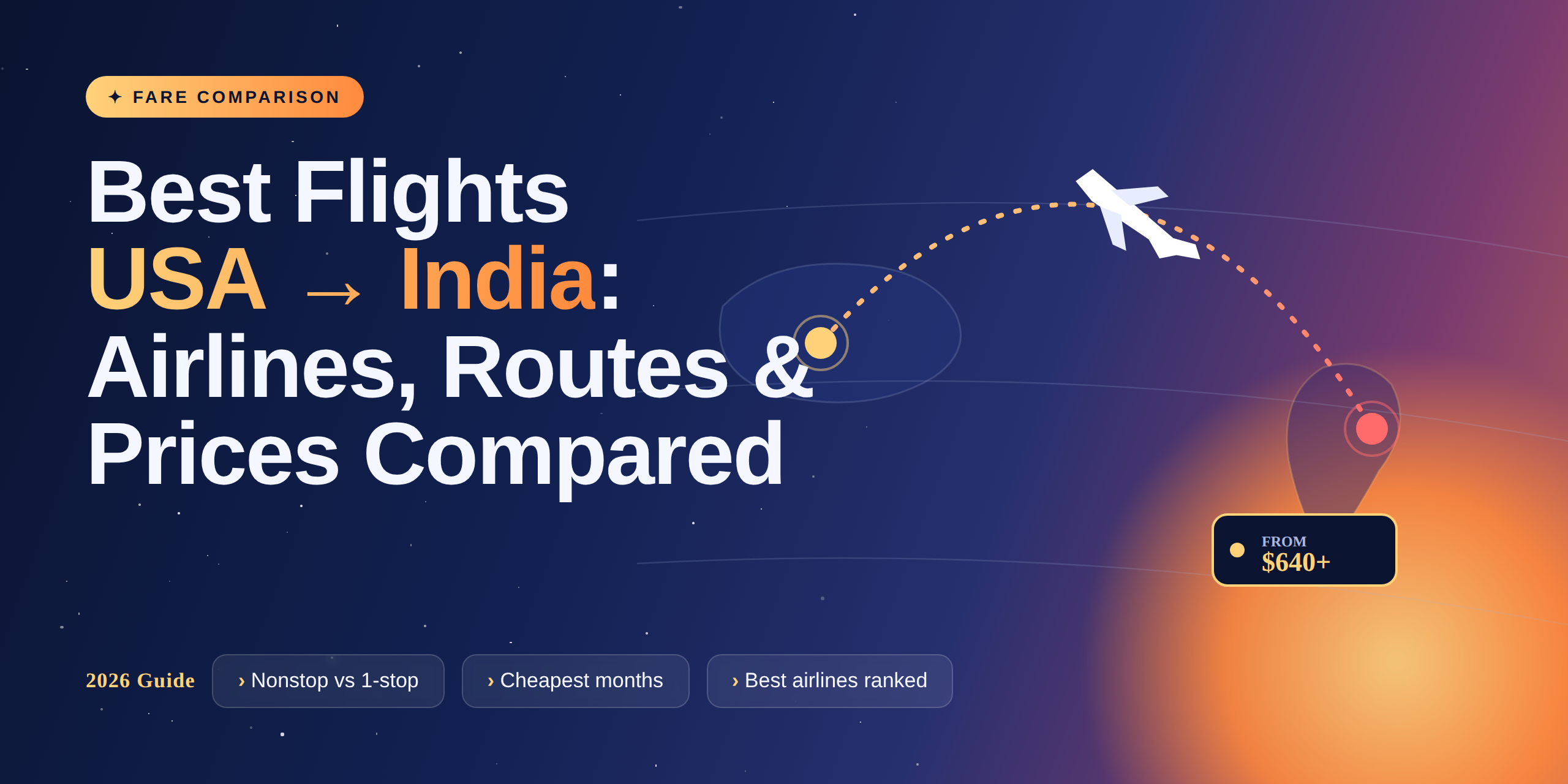
India is now one of the world’s fastest-growing long-haul travel markets—and that’s exactly why pricing from
the U.S. and Canada has become more dynamic (and confusing) in 2026. International seat capacity keeps
shifting seasonally, nonstop options are expanding from select hubs, and airline pricing algorithms adjust
fares multiple times a day. If you’re searching for the best flights USA to India,
the “best” choice depends on your home airport, your tolerance for layovers, visa/transit rules, and whether
you’re optimizing for price, comfort, or reliability.
In this guide, you’ll learn which airlines and routes consistently perform well, when cheap flights USA India
are most realistic, what price ranges to expect in 2026, and how to avoid booking mistakes that cost NRIs
and students the most.
What “best flights” really means in 2026 (price vs comfort vs reliability)
In 2026, “best” is rarely the absolute cheapest ticket. For NRIs, family planners, and frequent flyers, the
best flight is usually the one that balances total travel time, missed-connection risk, baggage rules, and
change flexibility.
Here are the benchmarks experienced travelers use:
Airlines that typically offer the best USA–India experience (and when)
Airline quality varies by route and season. For U.S.–India travel, most travelers pick from U.S. carriers,
Indian carriers, and major Gulf/European connectors.
Nonstop-focused options (fastest trips)
Nonstops are usually the “best flights USA to India” for time savings—especially for seniors, families with
kids, and business travelers. However, they price at a premium during peak windows (summer and Dec–Jan).
1-stop connectors (often best value)
For cheap flights USA India, 1-stop itineraries via the Middle East or Europe often win—especially for
students and budget-conscious travelers who can handle a layover.
Practical rule:If you’re traveling during peak demand (mid-May to mid-August, mid-Dec to mid-Jan), you’ll
often get better value by choosing a high-frequency connector and protecting the layover with a safer buffer
(2.5–4 hours) rather than gambling on tight connections.
Best routes from major U.S. cities (time, convenience, and typical trade-offs)
Routes shift by season, but these patterns remain consistent in 2026:
Prices compared in 2026: what to expect (and how to interpret “cheap”)
Airfares to India are highly seasonal. A useful reality check: global airfare levels have remained elevated
versus pre-pandemic baselines due to supply, demand, and operational costs. For example, IATA projected
industry-wide profitability returning but still tight, keeping pricing disciplined (IATA, 2024). Meanwhile,
U.S. inflation has moderated versus 2022–2023 peaks, but travel remains sensitive to holiday surges (U.S.
Bureau of Labor Statistics CPI trends, 2024–2025).
Use the table below as a planning range for 2026 (typical round-trip fares; actual prices vary by day,
baggage, and advance purchase). For deal-hunting, the key is comparing all-incost and total travel time, not
just base fare.
| Itinerary type |
Typical round-trip economy (USD) |
Typical round-trip business (USD) |
Best for |
| Nonstop (U.S. → DEL/BOM) |
$1,100–$1,800 |
$3,800–$6,500 |
Time-sensitive trips, families, and senior travelers |
| 1-stop via Middle East |
$850–$1,450 |
$2,900–$5,200 |
Best overall value with strong schedules and connectivity |
| 1-stop via Europe |
$900–$1,550 |
$3,100–$5,700 |
Travelers near major European hubs seeking flexible routing |
| 2-stop / ultra-budget routings |
$700–$1,250 |
Rare or inconsistent value |
Students and highly flexible travelers willing to accept higher risk |
Data-backed booking behavior:Google’s analysis shows airfare prices tend to be lowest roughly 21–60
daysbefore departure for many routes, with earlier windows often better for peak travel (Google, 2024). For
Thanksgiving, Christmas, and summer, you’ll usually want a longer runway (often 8–14+ weeks).
What’s changing in 2026: trends affecting USA–India flight deals
Several 2026 shifts are reshaping how travelers should book:
Pro tips and common mistakes to avoid (save money without sacrificing sanity)
Common mistakes that cost travelers the most
Real-world scenario:If you’re a Chicago-based student flying to Hyderabad for summer break, a 1-stop via
DOH/DXB with a protected connection and a baggage-inclusive fare often beats a 2-stop “deal” that saves $120
but adds 6–10 hours and far more misconnect risk.
How MyFlyYatra helps you book smarter (especially for business class)
MyFlyYatra specializes in making premium travel accessible—particularly affordable business class flights to India and
other global destinations—by leveraging technology and industry partnerships to access competitive rates.
For NRIs balancing work schedules, family commitments, and comfort, this can be the difference between
“available” and “actually worth it.”
To compare options for your exact dates, routes, and cabin preferences, visit www.myflyyatra.com.
Conclusion: choosing the best USA–India flight in 2026
If you want tailored options—especially discounted business class flights to India—compare
your route with expert help at www.myflyyatra.com. You’ll get real-time guidance, price accountability, and
support 9am–9pm (EST), 7 days a week—so if something goes wrong, we get it right or we make it right.
FAQs:
The best flights to India typically balance total travel time, reliability, comfort, and overall
price. For many travelers, a nonstop flight to Delhi (DEL) or Mumbai (BOM) offers the most
convenient experience, while a well-planned one-stop itinerary through major hubs can provide
excellent value. The ideal option depends on your departure city, travel dates, and whether
comfort
or savings is your primary goal.
Focus on single-ticket itineraries with one protected connection rather than separate bookings.
Compare fares that include baggage, monitor fare alerts, and choose connection windows that
allow
sufficient time for international transfers. Traveling during shoulder seasons can also help
reduce
airfare costs while maintaining flexible routing options.
Airfares are often lower outside peak holiday periods and summer vacation months. Late winter
and
early fall frequently offer better pricing opportunities than peak travel seasons. Booking
several
weeks in advance and maintaining flexibility with departure dates can improve your chances of
finding
lower fares.
Nonstop flights can be worthwhile for travelers seeking convenience, reduced travel time, and
fewer
opportunities for delays or missed connections. Families, business travelers, and those with
limited
vacation time often find the additional cost justified. Budget-conscious travelers may find
greater
value in a carefully selected one-stop itinerary.
Both options can work well depending on your route and schedule. Middle Eastern hubs often
provide
efficient connections and competitive fares, while European hubs may offer convenient routing
from
certain U.S. cities. Travelers should compare total travel time, layover duration, baggage
policies,
and connection reliability before booking.
Peak travel periods such as summer vacations and the December holiday season generally require
earlier booking than off-peak dates. Reserving flights several months in advance often provides
better access to preferred schedules, seating options, and fare categories before inventory
becomes
limited.
Separate-ticket itineraries can occasionally cost less, but they introduce additional risk. If
the
first flight is delayed and causes a missed connection, the second airline may not provide
protection
or rebooking assistance. For long-haul travel to India, many travelers prefer a single protected
itinerary to avoid unexpected expenses and travel disruptions.
Delhi and Mumbai generally offer the largest selection of international flights and domestic
onward
connections throughout India. Bengaluru is an excellent choice for travelers heading to South
India,
particularly for business or technology-related travel. The best airport depends on your final
destination and preferred routing.
In some cases, travel specialists may have access to negotiated fares, promotional inventory, or
bundled benefits that are not always visible through standard booking channels. When comparing
business-class options, evaluate fare flexibility, baggage allowances, seat selection policies,
and
change fees in addition to the ticket price.
Choose itineraries with reasonable connection times and multiple daily flight options whenever
possible. If a disruption occurs, contact the airline or travel provider immediately to explore
alternative routing options. Acting quickly often improves the likelihood of securing
replacement
seats, especially during busy travel periods.