


British Airways and Lufthansa Award Surcharges: Why a “Free” Business Class Ticket Can Still Cost Hundreds
Search Cheap Flights
SAVE UP TO 40%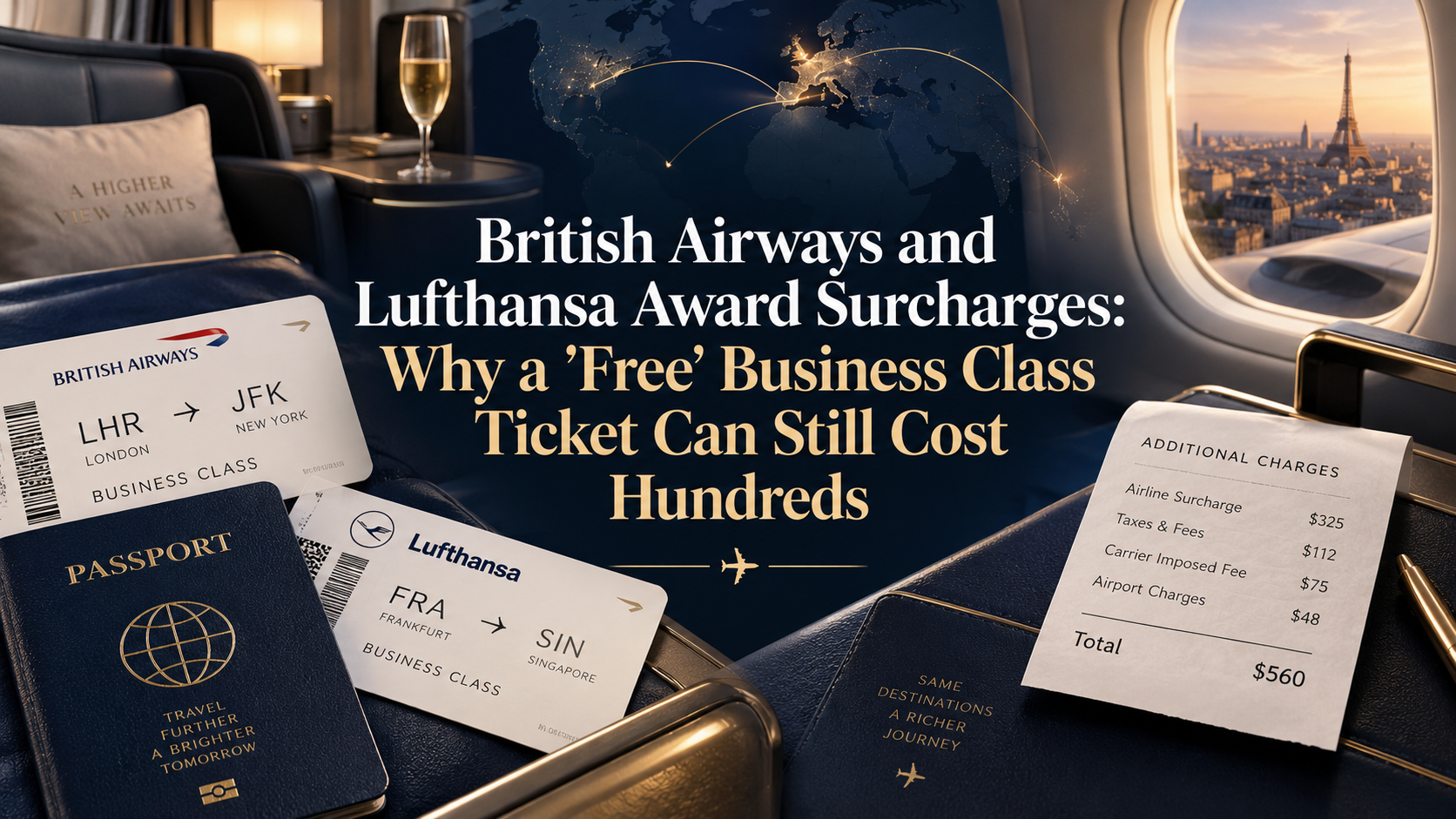
Using miles for a business class ticket sounds simple: collect enough points, find an award seat, and book the flight without paying thousands of dollars.
Then you reach the payment screen.
Your “free” business class ticket suddenly requires $500, $800, or even more in cash.
That does not necessarily mean anything went wrong. British Airways and Lufthansa award bookings can include airline-imposed charges, government taxes, airport fees, and other costs that your miles do not cover.
The important part is knowing what you are actually paying for and whether using miles still gives you better value than buying a regular business class ticket.
This matters even more when booking business class flights to India from the USA, where one itinerary may involve British Airways through London while another uses Lufthansa through Frankfurt or Munich.
Here is how the charges work, what has changed in 2026, and how to decide whether an award ticket is really worth booking.
Why Does a “Free” Business Class Award Ticket Still Cost Money?
An award ticket is better described as a ticket purchased with miles plus cash rather than a completely free ticket.
Your miles normally cover the award portion of the airfare. They do not automatically remove every tax or fee attached to the journey.
A typical award price might therefore look like this:
100,000 miles + $650 in taxes, fees, and airline charges
That $650 may contain several different charges.
| Charge | Who sets it? | Can you avoid it? |
|---|---|---|
| Carrier-imposed surcharge | Airline | Sometimes |
| Government taxes | Government | Usually not |
| Airport fees | Airport or authority | Usually not |
| Air Passenger Duty | UK government | Depends on itinerary |
| Partner booking fee | Loyalty program | Sometimes |
| Miles required | Loyalty program | Changes by program |
This distinction matters because travelers often call the entire cash amount a “fuel surcharge.”
That is not always accurate.
You may remove or reduce an airline surcharge by booking through a different loyalty program and still owe government taxes and other mandatory charges.
The better question is not simply, “How do I avoid fuel surcharges?”
It is:
What is the total cost of this award after both miles and cash are included?
Fuel Surcharge vs Carrier Charge vs Taxes: What Are You Actually Paying?
The term “fuel surcharge” has been used for years, but airlines today often describe this cost as a carrier-imposed surcharge.
You may see codes such as YQ or YR during the fare breakdown.
This charge comes from the airline. Government taxes and airport fees are separate.
British Airways, for example, describes its Reward Flights as an Avios amount plus a cash amount covering taxes, fees, and carrier charges.
That wording is important.
Suppose an award requires:
120,000 Avios + $750
It would be misleading to assume the full $750 is a British Airways fuel surcharge. Part of the amount may come from airline charges, while another part may be government or airport fees.
When comparing two award programs, always compare the final payment screen, not just whether a program claims to have low or no fuel surcharges.
How British Airways Business Class Award Charges Work in 2026
British Airways uses Avios through The British Airways Club.
When Reward Flight seats are available, you pay a combination of Avios and cash. British Airways says that its Reward Flight cash component includes taxes, fees, and carrier charges. The Avios requirement can also vary according to the date, destination, travel class, and whether you are traveling during peak or off-peak dates.
British Airways may also show more than one Avios-and-cash combination.
You might see something similar to:
Option A: Fewer Avios + more cash
Option B: More Avios + less cash
That choice can be useful, but the option requiring the least cash is not automatically the best deal.
British Airways' current U.S. Reward Flights page, for example, advertises Club World rewards starting from 176,000 Avios plus $998. That is a useful reminder that redeeming Avios does not necessarily remove a substantial cash payment. Exact pricing depends on the itinerary you select.
Is Paying More Avios to Reduce the Cash Cost Worth It?
This is where many travelers make an expensive points mistake.
Imagine British Airways gives you these two choices for the same trip:
| Option | Avios | Cash |
|---|---|---|
| A | 100,000 | $900 |
| B | 160,000 | $400 |
Option B looks attractive because you save $500 in cash.
But you are spending another 60,000 Avios to get that saving.
The value of those additional Avios would be:
$500 ÷ 60,000 = 0.83 cents per Avios
Now the decision looks different.
If you believe your Avios can deliver significantly more value on another trip, spending 60,000 of them just to save $500 may not make sense.
The lesson is simple:
Do not choose the lowest-cash award until you calculate what the additional miles are saving you.
How Lufthansa Business Class Award Pricing Works in 2026
Lufthansa award pricing has changed significantly, which makes older guides easy to misread.
For many flights involving Lufthansa, Austrian Airlines, Lufthansa City, SWISS, Discover Airlines, and Air Dolomiti, Miles & More now calculates the mileage requirement dynamically. Factors can include the route, time of booking, travel date, cabin, and fare.
This system replaced fixed mileage amounts for many eligible awards beginning June 3, 2025.
So a statement such as:
“Lufthansa business class always costs 115,000 miles”
should not be treated as a universal 2026 rule.
The mileage requirement you see when searching may change from one date or flight to another.
Miles & More also states that award travelers may still need to pay taxes, fees, airline surcharges, and applicable service charges.
For Lufthansa awards, you therefore need to check two numbers:
Miles required + cash required
A lower surcharge does not automatically make an award cheaper if the mileage requirement is much higher.
Can You Book Lufthansa Business Class Through Another Program?
Yes.
Lufthansa is a Star Alliance member, which means eligible Lufthansa award seats may also be available through partner loyalty programs.
That gives travelers another way to approach the booking.
Instead of checking only Miles & More, you may compare programs such as Aeroplan, United MileagePlus, or Avianca LifeMiles.
Aeroplan is especially useful to compare because it has a clearly defined partner-booking structure. Aeroplan currently charges CAD 39 per ticket for a flight reward containing travel on a partner airline. Taxes and other third-party charges can still apply.
The point is not that one program will always win.
The same Lufthansa seat can produce very different combinations of miles and money depending on which program you use.
A simplified comparison could look like this:
| Booking Program | Miles Needed | Cash Needed | Overall Result |
|---|---|---|---|
| Miles & More | Lower | Higher | Could work if saving miles matters |
| Partner Program A | Higher | Lower | Could work if reducing cash matters |
| Partner Program B | Different again | Lower | Depends on points balance |
Those numbers are illustrative, but the decision process is real.
Compare the complete cost before transferring any points.
Why the Same Lufthansa Seat Can Cost Different Amounts
This can feel strange the first time you see it.
Imagine Lufthansa operates the aircraft from Chicago to Frankfurt.
The seat is still a Lufthansa business class seat whether you redeem Miles & More miles, Aeroplan points, or another partner currency.
But Lufthansa does not control every part of what a partner loyalty program charges you.
Each program can have its own:
award pricing + fee policy + booking rules
That creates situations where one program requires fewer miles but more cash, while another asks for more miles and less cash.
There is another problem: award availability.
Seeing a Lufthansa award seat through Miles & More does not guarantee that Aeroplan, United, or LifeMiles can book the same seat.
Airlines decide how much award inventory to release to partners. Partner availability can also change quickly.
That means the program with the best theoretical price is useless if it cannot see the flight you want.
Can AAdvantage Miles Eliminate British Airways Surcharges?
Do not assume they will.
British Airways is an American Airlines partner, so AAdvantage miles can be redeemed for eligible British Airways flights. However, American specifically notes that some partner airlines, including British Airways and Iberia, have additional charges on award travel. Those charges depend on factors such as departure city, arrival city, destination, and cabin.
So booking British Airways through AAdvantage does not automatically turn a high-fee BA award into a low-fee one.
Always price the actual itinerary before transferring points or making a booking decision.
London Connection vs London Departure: Why the Difference Matters
You may have heard advice like:
“Never use British Airways because London taxes are too high.”
That is too broad.
The UK charges Air Passenger Duty, or APD, on qualifying journeys beginning at UK airports.
For travel from April 1, 2026, the standard APD rate for Band B destinations is £244, while Band C is £253. Business class generally falls under the standard rate rather than the reduced economy rate. India falls within the long-haul Band B distance range from London.
So beginning a business class journey in London and flying to India can create a meaningful tax cost.
But connecting through London is different.
HMRC allows international flights to qualify as connected when they meet its ticketing and timing rules. For an international onward flight, a connection of up to 24 hours can qualify, provided the journey is structured correctly on the ticket.
Consider these two trips:
Trip 1: London → Delhi
Trip 2: New York → London → Delhi
The tax treatment is not automatically the same.
A traveler connecting through London on a qualifying itinerary should not assume that they owe the same UK APD as someone beginning the journey in London.
This is why changing the origin city purely to “avoid London taxes” can sometimes solve a problem that does not actually exist.
British Airways vs Lufthansa for USA–India Award Travel
For travelers flying between the United States and India, both airlines can provide useful one-stop options.
British Airways generally connects passengers through London Heathrow.
Lufthansa commonly connects U.S.–India travelers through Frankfurt or Munich.
Examples include:
| Route | Typical Airline Routing |
|---|---|
| New York → London → Delhi | British Airways |
| New York → London → Mumbai | British Airways |
| Chicago → Frankfurt → Delhi | Lufthansa |
| San Francisco → Frankfurt → Mumbai | Lufthansa |
| Los Angeles → Frankfurt/Munich → Delhi | Lufthansa |
There is no automatic winner.
A British Airways itinerary may require fewer points but more cash. A Lufthansa seat through one Star Alliance program may have lower cash charges but need more points. Another partner may not show the seat at all.
Travel time matters too.
Saving $200 is less attractive if the cheaper award adds another connection or eight hours to your journey.
For USA–India trips, compare the complete itinerary rather than only the loyalty-program price.
Should You Take a Positioning Flight to Reduce Award Costs?
Sometimes. But calculate everything first.
Suppose you live in Indianapolis but find a much cheaper award leaving Chicago.
The Chicago departure saves $350 in award charges.
Good deal?
Maybe.
If getting to Chicago requires a $180 separate ticket, a $120 hotel, baggage expenses, and an overnight stay, your $350 saving has nearly disappeared.
A separate ticket also creates another risk.
If your Indianapolis–Chicago flight is delayed and the tickets are unrelated, the long-haul airline may not have the same responsibility to protect you as it would on one through-ticket.
Positioning can be smart when the saving is meaningful, the schedule has enough buffer, and the additional cost is low.
Do not reposition just because the award screen displays a smaller surcharge.
Award Ticket vs Paid Business Class: Run the Math First
This is the comparison travelers often skip.
Imagine you find this award:
140,000 miles + $850
At the same time, a paid business class fare is available for:
$2,450
Using the award saves you:
$2,450 − $850 = $1,600
You are therefore using 140,000 miles to avoid $1,600 of cash airfare.
That works out to approximately:
$1,600 ÷ 140,000 = 1.14 cents per mile
Whether that is a good redemption depends on how you value those miles and what else you could use them for.
You should also consider what the paid ticket provides. Depending on the airline and fare, a cash ticket may earn miles or status credit and may offer different change or cancellation conditions.
This comparison is especially relevant on USA–India routes because discounted business class flight deals can sometimes bring the cash price much closer to the true cost of an award.
As of September 2026, MyFlyYatra's published Business Class Flight Deals page lists USA–India business class from $2,299, with examples such as New York–Delhi from $2,449 on its route listings. Fares change with dates and availability, but prices at this level make it worth comparing a paid ticket with a high-surcharge award before using a large points balance.
When Does Paying Cash Make More Sense Than Using Miles?
An award is usually attractive when the paid ticket is expensive, the mileage requirement is reasonable, and the cash fees are low.
The calculation changes when the award requires a very large number of points plus hundreds of dollars.
For example, if a paid business class ticket costs $2,500 while the award requires 160,000 miles plus $900, you are using 160,000 miles to save only $1,600.
You may decide those miles are more valuable for a future trip.
Cash can also be easier when you need several business class seats together. Finding one award seat is often much easier than finding three or four on the same flight.
There is no rule that points are always better than money.
Use whichever option gives you the stronger overall value.
Before You Transfer Points, Follow This 5-Step Check
- Find the exact flight you want. Confirm the airline, date, route, cabin, and operating carrier.
- Check award availability through more than one program. Do not assume every partner can see the same seat.
- Compare the mileage requirement. A lower cash fee may come with a much higher points price.
- Check the complete cash payment. Look beyond “fuel surcharge” and include taxes, airline charges, partner fees, and any positioning costs.
- Transfer points only after confirming the award. Transfers from credit-card programs to airlines are commonly difficult or impossible to reverse, and award space can disappear.
That final step matters.
Finding an award today does not guarantee the seat will still be available after you move your points.
Common Mistakes That Make Award Business Class More Expensive
Looking Only at the Miles
An 80,000-mile award with $900 in charges is not automatically better than a 100,000-mile award with $100 in charges.
Compare both currencies.
Assuming “No Fuel Surcharge” Means No Fees
Even when carrier-imposed surcharges are reduced or absent, government taxes, airport fees, or loyalty-program fees can remain.
Transferring Points Before Finding a Seat
Search first. Transfer second.
Award availability can change quickly, and moving points without a confirmed booking plan can leave them stuck in a program you do not need.
Assuming Every Partner Has the Same Award Inventory
A seat visible to Miles & More may not appear through Aeroplan or another partner.
Always search the program you actually intend to use.
Spending Extra Avios Without Checking Their Value
Paying more Avios to save cash can be useful. Calculate how many cents of cash you save for every additional Avios spent before selecting that option.
Ignoring the Cost of a Positioning Flight
Include the positioning airfare, baggage, hotel, ground transportation, and missed-connection risk in your calculation.
British Airways or Lufthansa: Which Is Better for an Award Ticket?
Neither airline is always cheaper.
British Airways can work well when you already have a large Avios balance, find suitable Reward Flight availability, or get a sensible Avios-and-cash combination.
Lufthansa can become attractive when partner Star Alliance programs show the same seat with a better total cost.
But you should judge the booking using four things:
How many miles do I need? How much cash do I need? How good is the routing? What would the same trip cost as a paid ticket?
That gives you a much better answer than simply choosing whichever program advertises the lowest fuel surcharge.
Final Takeaway: Your Award Ticket Is Only a Deal If the Math Works
Miles can unlock business class travel for far less than the regular retail fare.
But “award ticket” does not mean “free ticket.”
British Airways can require Avios plus a meaningful cash payment. Lufthansa awards can include taxes, fees, and airline surcharges, while Miles & More mileage requirements for many Lufthansa Group flights are now dynamically calculated.
Partner programs can sometimes improve the deal, but they can have different mileage requirements, fees, and access to award seats.
Before booking, compare:
Miles used + cash charges + extra trip costs
against:
The price of a paid business class ticket
If the award still saves you meaningful money and gives you a good return on your points, use the miles.
If the award demands a large mileage balance plus hundreds of dollars while a competitive paid fare is available, keeping your points for another trip may be the smarter choice.
That is the real way to judge whether a “free” business class ticket is actually a good deal.
| Route | Typical Airline Routing |
|---|---|
| New York → London → Delhi | British Airways |
| New York → London → Mumbai | British Airways |
| Chicago → Frankfurt → Delhi | Lufthansa |
| San Francisco → Frankfurt → Mumbai | Lufthansa |
| Los Angeles → Frankfurt/Munich → Delhi | Lufthansa |
There is no automatic winner.
A British Airways itinerary may require fewer points but more cash. A Lufthansa seat through one Star Alliance program may have lower cash charges but need more points. Another partner may not show the seat at all.
Travel time matters too.
Saving $200 is less attractive if the cheaper award adds another connection or eight hours to your journey.
For USA–India trips, compare the complete itinerary rather than only the loyalty-program price.
Should You Take a Positioning Flight to Reduce Award Costs?
Sometimes. But calculate everything first.
Suppose you live in Indianapolis but find a much cheaper award leaving Chicago.
The Chicago departure saves $350 in award charges.
Good deal?
Maybe.
If getting to Chicago requires a $180 separate ticket, a $120 hotel, baggage expenses, and an overnight stay, your $350 saving has nearly disappeared.
A separate ticket also creates another risk.
If your Indianapolis–Chicago flight is delayed and the tickets are unrelated, the long-haul airline may not have the same responsibility to protect you as it would on one through-ticket.
Positioning can be smart when the saving is meaningful, the schedule has enough buffer, and the additional cost is low.
Do not reposition just because the award screen displays a smaller surcharge.
Award Ticket vs Paid Business Class: Run the Math First
This is the comparison travelers often skip.
Imagine you find this award:
140,000 miles + $850
At the same time, a paid business class fare is available for:
$2,450
Using the award saves you:
$2,450 − $850 = $1,600
You are therefore using 140,000 miles to avoid $1,600 of cash airfare.
That works out to approximately:
$1,600 ÷ 140,000 = 1.14 cents per mile
Whether that is a good redemption depends on how you value those miles and what else you could use them for.
You should also consider what the paid ticket provides. Depending on the airline and fare, a cash ticket may earn miles or status credit and may offer different change or cancellation conditions.
This comparison is especially relevant on USA–India routes because discounted business class flight deals can sometimes bring the cash price much closer to the true cost of an award.
As of September 2026, MyFlyYatra's published Business Class Flight Deals page lists USA–India business class from $2,299, with examples such as New York–Delhi from $2,449 on its route listings. Fares change with dates and availability, but prices at this level make it worth comparing a paid ticket with a high-surcharge award before using a large points balance.
When Does Paying Cash Make More Sense Than Using Miles?
An award is usually attractive when the paid ticket is expensive, the mileage requirement is reasonable, and the cash fees are low.
The calculation changes when the award requires a very large number of points plus hundreds of dollars.
For example, if a paid business class ticket costs $2,500 while the award requires 160,000 miles plus $900, you are using 160,000 miles to save only $1,600.
You may decide those miles are more valuable for a future trip.
Cash can also be easier when you need several business class seats together. Finding one award seat is often much easier than finding three or four on the same flight.
There is no rule that points are always better than money.
Use whichever option gives you the stronger overall value.
Before You Transfer Points, Follow This 5-Step Check
- Find the exact flight you want. Confirm the airline, date, route, cabin, and operating carrier.
- Check award availability through more than one program. Do not assume every partner can see the same seat.
- Compare the mileage requirement. A lower cash fee may come with a much higher points price.
- Check the complete cash payment. Look beyond “fuel surcharge” and include taxes, airline charges, partner fees, and any positioning costs.
- Transfer points only after confirming the award. Transfers from credit-card programs to airlines are commonly difficult or impossible to reverse, and award space can disappear.
That final step matters.
Finding an award today does not guarantee the seat will still be available after you move your points.
Common Mistakes That Make Award Business Class More Expensive
Looking Only at the Miles
An 80,000-mile award with $900 in charges is not automatically better than a 100,000-mile award with $100 in charges.
Compare both currencies.
Assuming “No Fuel Surcharge” Means No Fees
Even when carrier-imposed surcharges are reduced or absent, government taxes, airport fees, or loyalty-program fees can remain.
Transferring Points Before Finding a Seat
Search first. Transfer second.
Award availability can change quickly, and moving points without a confirmed booking plan can leave them stuck in a program you do not need.
Assuming Every Partner Has the Same Award Inventory
A seat visible to Miles & More may not appear through Aeroplan or another partner.
Always search the program you actually intend to use.
Spending Extra Avios Without Checking Their Value
Paying more Avios to save cash can be useful. Calculate how many cents of cash you save for every additional Avios spent before selecting that option.
Ignoring the Cost of a Positioning Flight
Include the positioning airfare, baggage, hotel, ground transportation, and missed-connection risk in your calculation.
British Airways or Lufthansa: Which Is Better for an Award Ticket?
Neither airline is always cheaper.
British Airways can work well when you already have a large Avios balance, find suitable Reward Flight availability, or get a sensible Avios-and-cash combination.
Lufthansa can become attractive when partner Star Alliance programs show the same seat with a better total cost.
But you should judge the booking using four things:
How many miles do I need? How much cash do I need? How good is the routing? What would the same trip cost as a paid ticket?
That gives you a much better answer than simply choosing whichever program advertises the lowest fuel surcharge.
Final Takeaway: Your Award Ticket Is Only a Deal If the Math Works
Miles can unlock business class travel for far less than the regular retail fare.
But “award ticket” does not mean “free ticket.”
British Airways can require Avios plus a meaningful cash payment. Lufthansa awards can include taxes, fees, and airline surcharges, while Miles & More mileage requirements for many Lufthansa Group flights are now dynamically calculated.
Partner programs can sometimes improve the deal, but they can have different mileage requirements, fees, and access to award seats.
Before booking, compare:
Miles used + cash charges + extra trip costs
against:
The price of a paid business class ticket
If the award still saves you meaningful money and gives you a good return on your points, use the miles.
If the award demands a large mileage balance plus hundreds of dollars while a competitive paid fare is available, keeping your points for another trip may be the smarter choice.
That is the real way to judge whether a “free” business class ticket is actually a good deal.
FAQs
British Airways Reward Flights include an Avios requirement plus a cash amount covering taxes, fees, and carrier charges. The total varies according to factors such as the route, date, cabin, and reward option selected.
Miles & More states that award travelers may need to pay taxes, fees, airline surcharges, and applicable service charges. The exact cash and mileage requirements depend on the booking.
Yes, when Lufthansa releases eligible award space to Aeroplan. Aeroplan currently charges a CAD 39 partner booking fee per ticket for rewards that include flights operated by partner airlines. Taxes and third-party charges may also apply.
Not always. Miles & More dynamically calculates the mileage requirement for many awards involving Lufthansa and several Lufthansa Group airlines. Factors include the booking time, route, travel date, cabin, and fare.
Not automatically. American Airlines states that some partner airlines, including British Airways, can have additional award-travel charges depending on the itinerary and cabin.
Not necessarily. UK Air Passenger Duty rules treat qualifying connecting flights differently. International connections generally need to meet the applicable timing and ticketing rules, including a 24-hour connection limit for an international onward flight.
Calculate how much cash the miles actually save after taxes and fees. Then divide that saving by the number of miles required. If the redemption value is poor and a competitive paid fare is available, paying cash and keeping the miles can make more sense.
What Customers Say About Us
We do our best to provide you the best experience ever
