


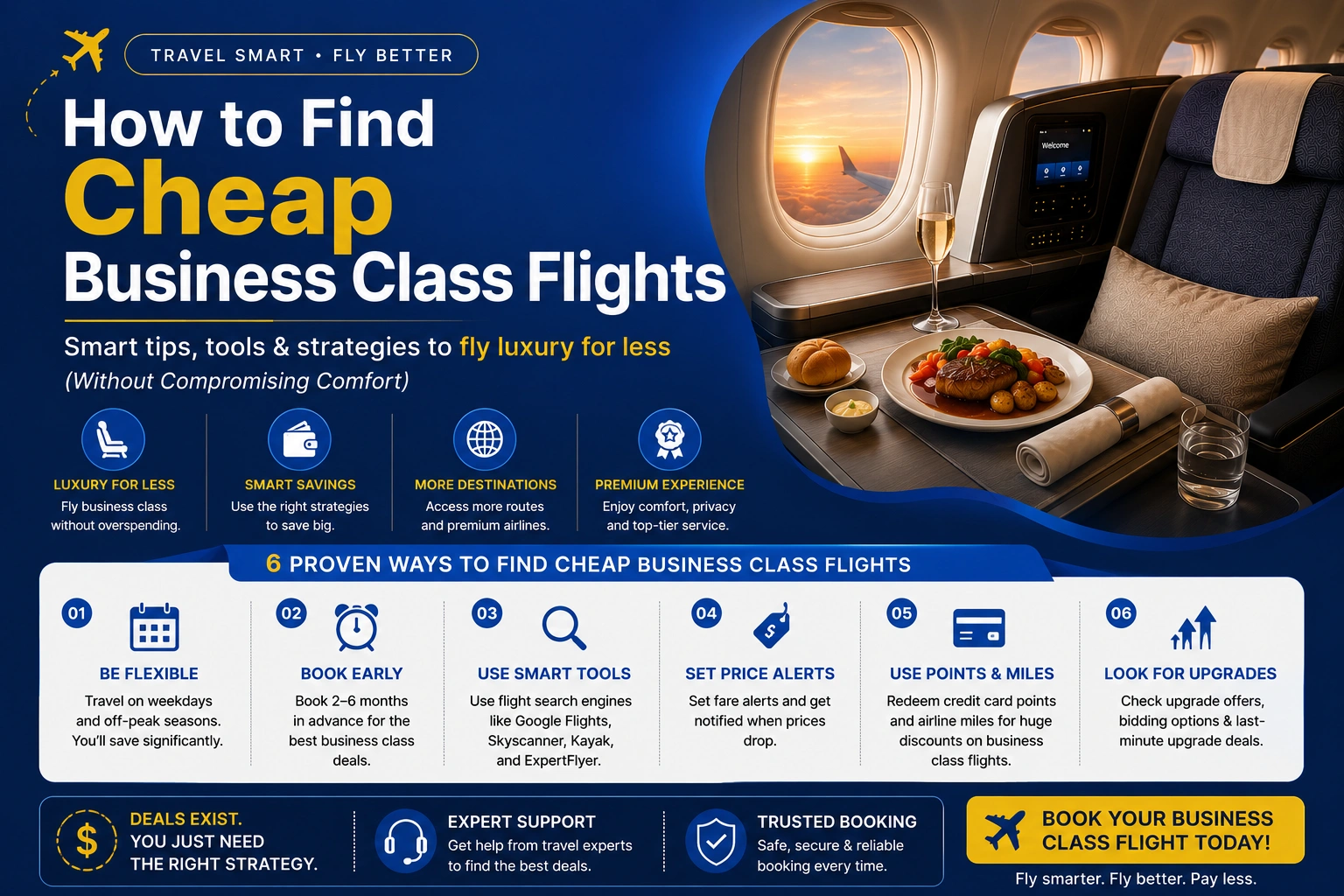
Smart Ways to Fly Premium Without Paying Premium Prices
For years, business class travel felt like it belonged to a different world — one reserved for executives on corporate accounts or travelers with seemingly unlimited budgets. That perception no longer holds in 2026. A growing number of travelers have discovered that flying in premium cabins doesn't have to mean paying the highest possible fare.
The most common mistake travelers make is assuming the price displayed on an airline's homepage represents the true market rate. Experienced flyers know better. Through smarter timing, greater flexibility, and the right booking resources, significant savings on business class fares are genuinely achievable.
At MyFlyYatra, travelers can compare international flight options across Economy, Premium Economy, Business, and First Class cabins while accessing route-specific deals, flexible itineraries, and personalized booking support. MyFlyYatra covers not only India routes but also international travel across Europe, Asia, Australia, the Middle East, and other major global destinations.
Why More Travelers Are Choosing Business Class in 2026
Attitudes toward premium travel have shifted considerably. What was once viewed purely as a luxury expenditure is increasingly seen as a practical investment — particularly on journeys of ten hours or more.
Travelers today are prioritizing:
- Comfort on long-haul flights
- Better sleep during travel
- Productivity while flying
- Faster airport experiences
- Flexible baggage allowances
- Premium customer service
Spending 12 to 16 hours in an economy seat is genuinely draining, and for frequent international travelers the cumulative toll adds up. Business class addresses this with:
- Lie-flat beds
- Lounge access
- Priority boarding
- Enhanced dining
- More privacy
- Significantly reduced travel fatigue
For many travelers making long-haul journeys regularly, business class has become less about indulgence and more about arriving in a condition to actually function.
1. Book Earlier Than Most Travelers
Timing remains one of the most reliable factors in securing a better business class fare. Airlines use dynamic pricing systems that respond to seat availability and demand — meaning the longer you wait, the more you typically pay.
For international business class in 2026, the most competitive pricing window tends to fall:
- 2 to 5 months before departure
- Earlier still during holidays and peak travel periods
High-demand seasons such as Christmas, New Year, summer school holidays, and major festivals can push premium cabin prices considerably higher. Booking ahead of these periods provides:
- Better pricing before demand spikes
- Wider seat selection
- More favorable flight timings
- Greater flexibility for changes
2. Go Beyond Airline Websites
Searching exclusively through airline websites or generalist booking platforms is one of the most common limitations travelers place on themselves. These channels rarely surface the full range of available pricing.
What travelers often miss by not exploring further:
- Consolidated fares negotiated in bulk
- Unpublished premium inventory
- Route-specific promotional pricing
- Multi-airline comparison opportunities
Specialized travel platforms like MyFlyYatra offer a more efficient way to compare routes, airlines, and premium cabin options — particularly for long-haul international travel. Travelers searching for routes such as:
- Business class flights to Europe
- USA to Asia flights
- Flights to Australia in premium cabins
- Middle East business class connections
frequently find stronger value through platforms that focus specifically on international premium travel rather than generalist search engines.
3. Flexibility Is One of Your Biggest Assets
Business class pricing is highly sensitive to timing, and even small adjustments to your itinerary can produce meaningful fare differences.
Fares are influenced by factors including:
- The specific day of departure
- Demand levels at the time of search
- Airport traffic and load factors
- Seasonal travel patterns
As a general pattern, midweek departures tend to be cheaper than Friday and Sunday travel. Early morning flights often carry lower fares than peak-hour departures. Accepting a slightly longer layover on a connecting itinerary can also reduce the overall cost substantially. Travelers with genuine schedule flexibility almost always have access to better premium fares than those locked into fixed dates.
4. Expand Your Airport Search
Limiting your search to a single departure airport significantly narrows your options. Savvy travelers compare multiple nearby airports before committing to a route.
A New York-based traveler, for example, might compare departures from:
- JFK (New York)
- Newark (EWR)
- Philadelphia (PHL)
- Washington Dulles (IAD)
The same logic applies globally. Departing from an alternative city and adding a short domestic connection can make international business class significantly more affordable without meaningfully impacting the overall journey.
5. Travel in Shoulder Season for Better Value
Premium cabin pricing tracks demand — and demand peaks predictably around school holidays and major travel periods. Choosing to travel outside these windows can unlock noticeably better fares.
Shoulder season periods that typically offer stronger value include:
- February through April
- September through early November
Beyond price, traveling during these periods often comes with added benefits:
- Less crowded airports and lounges
- Better seat availability on premium aircraft
- More upgrade opportunities
- A generally more relaxed travel experience
6. Track Fare Drops and Limited-Time Offers
Airlines continue to release targeted business class promotions in 2026, but these offers are often time-limited and can disappear within hours. Missing them is easy if you aren't actively monitoring.
Travelers who consistently secure better premium fares tend to:
- Set up fare alerts for key routes
- Monitor departure windows regularly
- Work with travel advisors who track availability on their behalf
- Subscribe to airline promotional communications
Platforms like MyFlyYatra help travelers keep track of premium cabin pricing across multiple international routes and identify offers more efficiently than manual searching alone.
7. Consider Mixing Airlines Across Your Journey
There is no rule requiring you to fly the same airline in both directions. Building an itinerary that uses different carriers outbound and return is a strategy that experienced travelers use regularly to improve both value and scheduling.
Example pairings that often work well:
- Emirates outbound, Qatar Airways return
- Turkish Airlines outbound, Lufthansa return
- Singapore Airlines outbound, Etihad return
This approach can produce:
- Lower combined fares than same-airline returns
- Better overall schedules
- Reduced layover times
- Access to different lounge networks
8. Know Which Airlines Offer the Best Business Class Value
Not every premium cabin delivers equivalent value for the price. Some airlines consistently offer a stronger combination of seat quality, service, and fare competitiveness on long-haul international routes.
Airlines frequently recognized for strong business class value in 2026 include:
- Qatar Airways Qsuite
- Emirates Business Class
- Turkish Airlines Business Class
- Singapore Airlines
- Etihad Airways
- Lufthansa
- Air France
- Cathay Pacific
The best choice for any individual traveler depends on route, flight duration, layover preferences, budget, and the type of onboard experience they prioritize.
9. The Lowest Fare Isn't Always the Best Deal
It's worth being clear-eyed about what a lower-priced business class ticket can sometimes mean in practice. Some discounted premium fares come attached to trade-offs that erode their apparent value.
Factors worth evaluating beyond price:
- Layover duration and hub airport quality
- Aircraft age and seat configuration
- Baggage allowance included in the fare
- Refund and change fee policies
- Overall airline reputation on the specific route
The most informed travelers weigh total journey quality — not just the headline number — before making a booking decision.
Why Travelers Use MyFlyYatra
MyFlyYatra helps international travelers compare routes, airlines, and premium cabin fares across a wide range of global destinations. The platform is built around the needs of long-haul travelers seeking:
- Business class flights on major international routes
- Flexible routing and multi-airline itineraries
- Side-by-side airline and cabin comparisons
- Personalized booking support from travel specialists
Travelers can explore premium options across the USA, Europe, Asia, Australia, and the Middle East while comparing Economy, Premium Economy, Business, and First Class travel in one place.
Final Thoughts
Finding genuinely affordable business class flights in 2026 is a matter of strategy rather than chance. The travelers who consistently fly premium at lower cost are those who book at the right time, stay flexible, cast a wider net when searching, and use the right platforms to surface deals that aren't visible through standard airline channels.
Premium international travel is more accessible today than at any previous point. With a thoughtful approach to planning and booking, long-haul journeys in business class can cost considerably less than most travelers assume — while delivering a meaningfully better travel experience from departure to arrival.
FAQs
The most competitive window for international business class fares is typically 2 to 5 months before departure. Prices generally rise as the departure date approaches, particularly during holidays and peak travel seasons. For high-demand periods like Christmas or summer school holidays, booking even earlier is advisable.
In many cases, yes. Specialized travel platforms can access consolidated fares, negotiated pricing, and unpublished inventory that isn't always visible through airline websites or generalist booking engines. For long-haul international routes in particular, comparing options through a dedicated travel platform often reveals better-value alternatives.
Midweek departures — particularly Tuesdays and Wednesdays — tend to carry lower fares than Friday and Sunday travel. Early morning flights also frequently offer more competitive pricing. Avoiding peak departure days is one of the simplest ways to reduce business class costs without changing your destination or airline.
Airlines consistently recognized for strong long-haul business class products include Qatar Airways, Emirates, Singapore Airlines, Turkish Airlines, Lufthansa, and Etihad Airways. The best choice depends on your specific route, departure city, budget, and what you prioritize in the onboard experience.
For most travelers on journeys of 10 hours or more, yes. Business class provides a lie-flat bed for genuine sleep, lounge access before departure, priority airport services, and significantly lower travel fatigue on arrival. For business travelers or anyone with commitments immediately after landing, arriving rested rather than exhausted has real practical value.
Occasionally, airlines release unsold premium seats at reduced prices close to departure, but this is unpredictable and not a reliable strategy. In most cases, last-minute business class fares are higher than those available weeks earlier. Early booking remains the more dependable route to better pricing and seat availability.
No. MyFlyYatra offers international flight options across multiple global destinations including Europe, Asia, Australia, the Middle East, and beyond. The platform covers Economy, Premium Economy, Business, and First Class travel across a wide range of international routes.
Yes, upgrades are possible through several routes: airline bidding programmes, redeeming frequent flyer miles or points, purchasing an upgrade at check-in if availability exists, or booking directly with the airline when promotional upgrade offers are available. Availability varies by airline, route, and how full the premium cabin is. Booking business class upfront generally provides more certainty than relying on upgrade availability.
Premium Economy sits between economy and business class in terms of space, comfort, and price. It typically offers more legroom, wider seats, and better recline than standard economy, but does not include a lie-flat bed, dedicated lounge access, or the level of privacy and service found in business class. For very long-haul flights where sleep quality matters, business class delivers a meaningfully different experience compared to Premium Economy.
It depends on the fare available at the time. When airlines run promotional business class sales, paying cash can sometimes offer better value than spending a large points balance. However, for full-fare business class tickets priced at several thousand dollars, redeeming airline miles or transferable credit card points can deliver outstanding value. Comparing the cash price against the points requirement and calculating the redemption value per point helps determine the smarter choice for each specific booking.
