


India Customs Explained: Green Channel vs Red Channel & What to Declare (2026)
Search Cheap Flights
SAVE UP TO 40%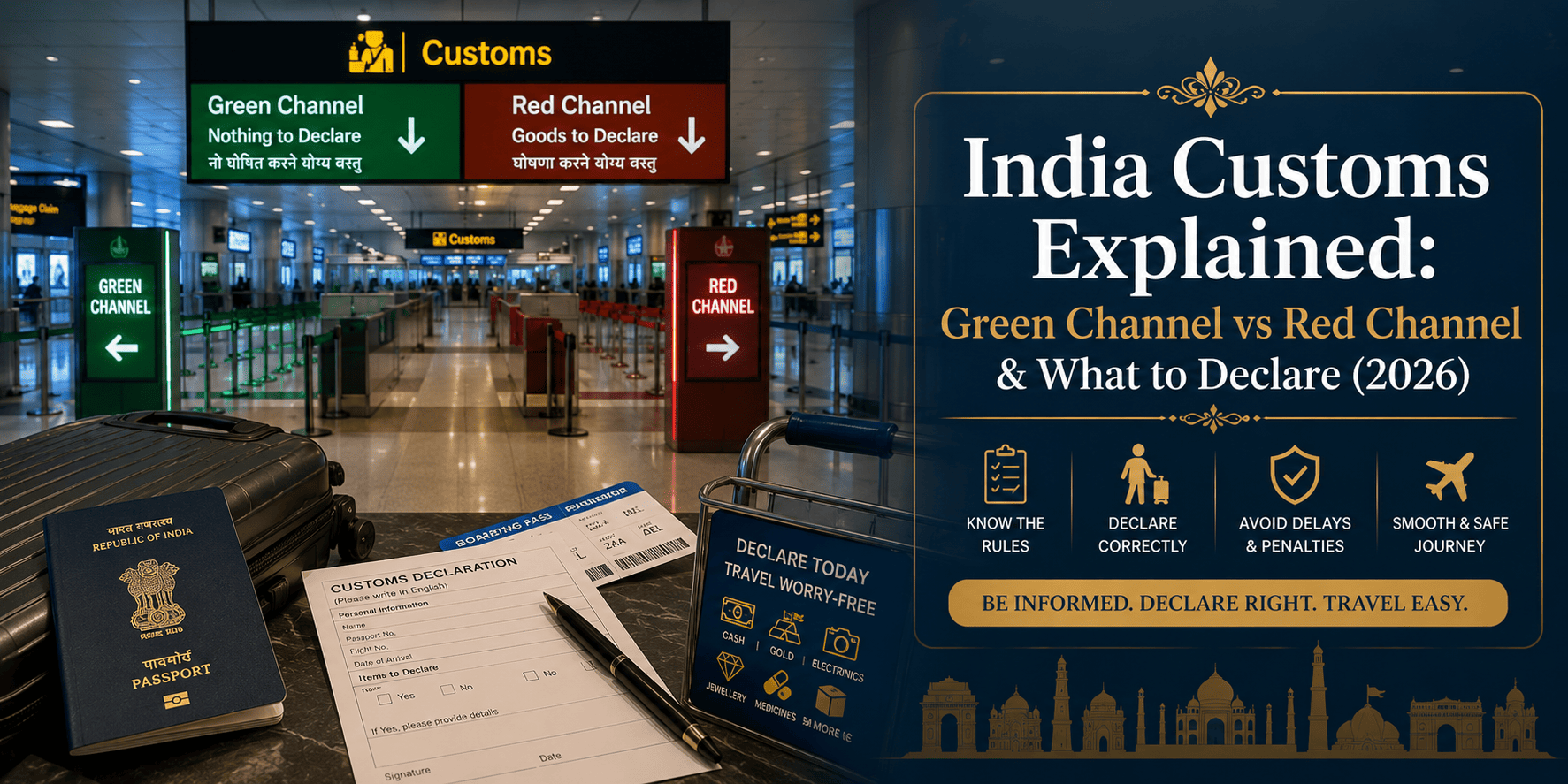
You've landed, collected your bags, and you're walking toward the exit when you see two coloured signs: Green and Red. For most travellers coming home with a suitcase of clothes and a few gifts, the choice is easy. But pick the wrong lane with the wrong things in your bag, and a relaxed arrival turns into a long conversation with a customs officer — or worse, a seizure and a fine. The good news is that the system is simple once you understand it.
This guide explains India's green channel vs red channel clearly: what each one means, your 2026 duty-free allowance (which just went up), what counts as dutiable goods, the alcohol, tobacco, and currency limits, and how the India arrival customs process actually works. Whether you're an NRI visiting family or moving back for good, knowing your channel makes clearing customs painless — and once Myflyyatra has sorted your flights home, this is the last piece of the puzzle.
Please note: This is general guidance, not legal or customs advice. Allowances, duty rates, and declaration rules change, and the 2026 Baggage Rules are recent. Always confirm the current figures for your situation with Indian Customs (CBIC) before you travelGreen Channel vs Red Channel: The Basics
Every international arrival hall in India has two exits after baggage claim, and choosing between them is a legal declaration in itself:
- Green Channel "nothing to declare." For passengers whose goods are within the duty-free allowance and who carry no dutiable, restricted, or prohibited items. You simply walk through.
- Red Channel — "goods to declare." For anyone carrying dutiable goods, items over the allowance, restricted or prohibited goods, excess alcohol or tobacco, gold or silver bars/coins, currency above the limits, televisions, drones, pets, or commercial goods — or anyone who's simply unsure.
That's the essence of red channel India meaning: it's the self-declaration lane, where you tell customs what you're carrying and pay any duty owed. The golden rule is simple — when in doubt, take the Red Channel. The officer decides what's dutiable, not you, and "I didn't know" is not a defence at the Green line.
Your Duty-Free Allowance in 2026 (Now ₹75,000)
Here's the headline update: under India's Baggage Rules 2026, the general duty-free allowance was raised to ₹75,000 (up from the old ₹50,000).
- ₹75,000: for Indian residents, persons of Indian origin (including NRIs and OCIs), and foreigners holding a valid non-tourist visa, arriving by air or sea.
- ₹25,000: a separate, lower allowance for foreign-origin tourists.
- Used personal effects — your worn clothing, toiletries, and everyday items — don't count toward these values at all.
- Land-border arrivals (from Nepal, Bhutan, or Myanmar) get lower or no general allowance.
If your dutiable goods exceed the allowance, the excess attracts customs duty — as of April 2026, generally around 10% basic customs duty on the value above your limit (down from the earlier 20%), plus any applicable surcharge or taxes. Rates vary by item, so confirm specifics with customs.
What Counts as Dutiable Goods
Two things push you into the Red Channel: value over your allowance, and a set of carved-out items that must always be declared, no matter how little they're worth.
Dutiable or must-declare goods include:
- New goods worth more than your ₹75,000 allowance (gifts count toward this).
- Gold or silver in bar, coin, or bullion form — dutiable from the very first gram.
- Gold jewellery above the duty-free weight limit (20g for men, 40g for women who've lived abroad over a year).
- Televisions — flat-panel TVs get no free allowance and are always dutiable.
- Excess alcohol and tobacco (above the limits below).
- Firearms, drones, satellite phones, and commercial-quantity goods.
- Prohibited items (narcotics, certain wildlife products, counterfeit goods) — which aren't just dutiable but not allowed at all.
Anything on this carved-out list goes through the Red Channel regardless of the ₹75,000 arithmetic.
The Sub-Limits: Alcohol, Tobacco, Laptops & Gold
Some items have hard quantity caps that operate independently of the value allowance:
- Alcohol: Up to 2 litres of spirits or wine, duty-free, for adult passengers. Beyond that, duty is steep (spirits can attract 150% basic duty plus IGST), so extra bottles get very expensive. Dry-state warning: even within your allowance, you cannot bring alcohol into Gujarat or Bihar.
- Tobacco: 100 cigarettes, or 25 cigars, or 125 grams of tobacco. Alcohol and tobacco allowances are zero for under-18s.
- Laptops: One personal laptop is duty-free for passengers over 18, in addition to the general allowance. A second laptop, or a laptop that pushes your total over ₹75,000, must be declared.
- Gold: Covered by its own weight-based rules (see a dedicated gold guide) — and remember, wearing jewellery doesn't exempt it; officers can ask you to remove and weigh it.
Carrying Cash: Currency Declaration Rules
Money has its own thresholds, governed by RBI and FEMA:
- Foreign currency: You can bring in cash up to US$5,000 (or up to US$10,000 total including traveller's cheques) without paperwork. Above either threshold, you must file a Currency Declaration Form (CDF) on arrival. There's no cap on how much you can bring — only a duty to declare it. Keep the CDF for your whole stay.
- Indian currency (₹): Residents and OCIs may carry up to ₹25,000 in Indian notes in or out of the country. Foreign tourists generally shouldn't carry Indian currency in.
- Going out: An Indian resident may carry up to about US$3,000 in cash per trip, with the rest on a forex card, within RBI's overall limits.
What to Declare at India Customs
To make it simple, think of four "declare" buckets. If you're carrying any of these, head to the Red Channel:
- 1. Dutiable goods worth more than your ₹75,000 allowance (including gifts).
- 2. Gold or silver above the duty-free limit, plus all gold/silver bars and coins.
- 3. Foreign-currency cash above US$5,000 (or US$10,000 total with traveller's cheques).
- 4. Any prohibited or restricted item — firearms, drones, satellite phones, excess alcohol/tobacco, TVs, commercial goods, or pets.
The ATITHI App & Declaration Form
You can handle your Indian airport customs declaration digitally and in advance. The official ATITHI app (the mobile companion to the Indian Customs portal) lets you declare dutiable goods and any currency above the CDF threshold before you land, generating a reference you present at customs. It's optional but smart — it speeds up the Red Channel and creates a clean record.
If you don't use ATITHI, Red Channel passengers fill out a paper Customs Declaration Form available in the arrival hall. Green Channel passengers don't need a form at all.
The India Arrival Customs Process, Step by Step
- 1. Immigration: Clear passport control (and complete India's E-Arrival Card if required).
- 2. Baggage claim: Collect your checked bags.
- 3. Decide your channel: Honestly assess whether everything is within your allowance and free of carved-out items.
- 4. Green Channel: If you're clear, walk straight through — though customs can still randomly check bags.
- 5. Red Channel: If you have anything to declare, present your ATITHI reference or fill the form, let the officer assess the duty, and pay on the spot (by card or cash) to receive an official receipt.
- 6. Exit: You're through. For unaccompanied baggage arriving later, get a Detained Baggage Receipt to preserve your duty-free entitlement.
What Happens If You Choose the Wrong Channel
Walking through the Green Channel while carrying dutiable or restricted goods is treated as non-declaration — a customs offence under the Customs Act, 1962. The consequences can include seizure of the goods, penalties (fines can run up to several times the duty evaded), and, in serious cases, prosecution. Declaring honestly, by contrast, simply means paying the duty owed and walking out with a receipt. The Red Channel is never the risky choice — the Green Channel with the wrong bag is.
NRI Customs Tips for a Smooth Arrival
- Carry original receipts for high-value electronics and jewellery to prove value and ownership.
- Don't carry items "for friends." The moment something isn't yours, it becomes a customs problem. Everything in your bag should be your own.
- Be honest and consistent if questioned — officers are experienced, and inconsistent stories invite deeper inspection. A simple, truthful answer ends the conversation.
- Remember the one-laptop rule, and keep gifts in mind — they count toward your ₹75,000.
- Mind the dry states (Gujarat, Bihar) if carrying alcohol.
- Pre-fill ATITHI if anything falls into Red-Channel territory — it saves time.
- When in doubt, declare. It's always cheaper than the alternative.
Frequently Asked Questions
Green is "nothing to declare" (within your allowance, no dutiable goods). Red is "goods to declare" (dutiable, restricted, or over-allowance items). Choosing Green wrongly is a customs offence.
₹75,000 for Indian residents, NRIs, OCIs, and non-tourist-visa holders arriving by air or sea; ₹25,000 for foreign tourists. Used personal effects don't count.
Foreign currency cash up to US$5,000 (or US$10,000 total with traveller's cheques) needs no form; above that, file a Currency Declaration Form. Indian residents/OCIs may carry up to ₹25,000 in Indian notes.
One personal laptop is duty-free. Declare a second laptop, or anything that pushes your total goods above ₹75,000.
It can be seized, you can be fined (potentially several times the duty), and serious cases can lead to prosecution. Always use the Red Channel when in doubt.
Final Word
India's customs channels aren't there to catch out honest travellers — they're a quick, self-declaration system that rewards knowing the rules. Stay within your ₹75,000 allowance and you'll breeze through the Green Channel; carry gold, extra alcohol, big electronics, serious cash, or gifts over the limit, and simply declare them through the Red Channel and pay the duty. Verify the current figures with Indian Customs before you fly, book your journey with Myflyyatra, and your arrival in India can be as smooth as the flight home.
What Customers Say About Us
We do our best to provide you the best experience ever
