


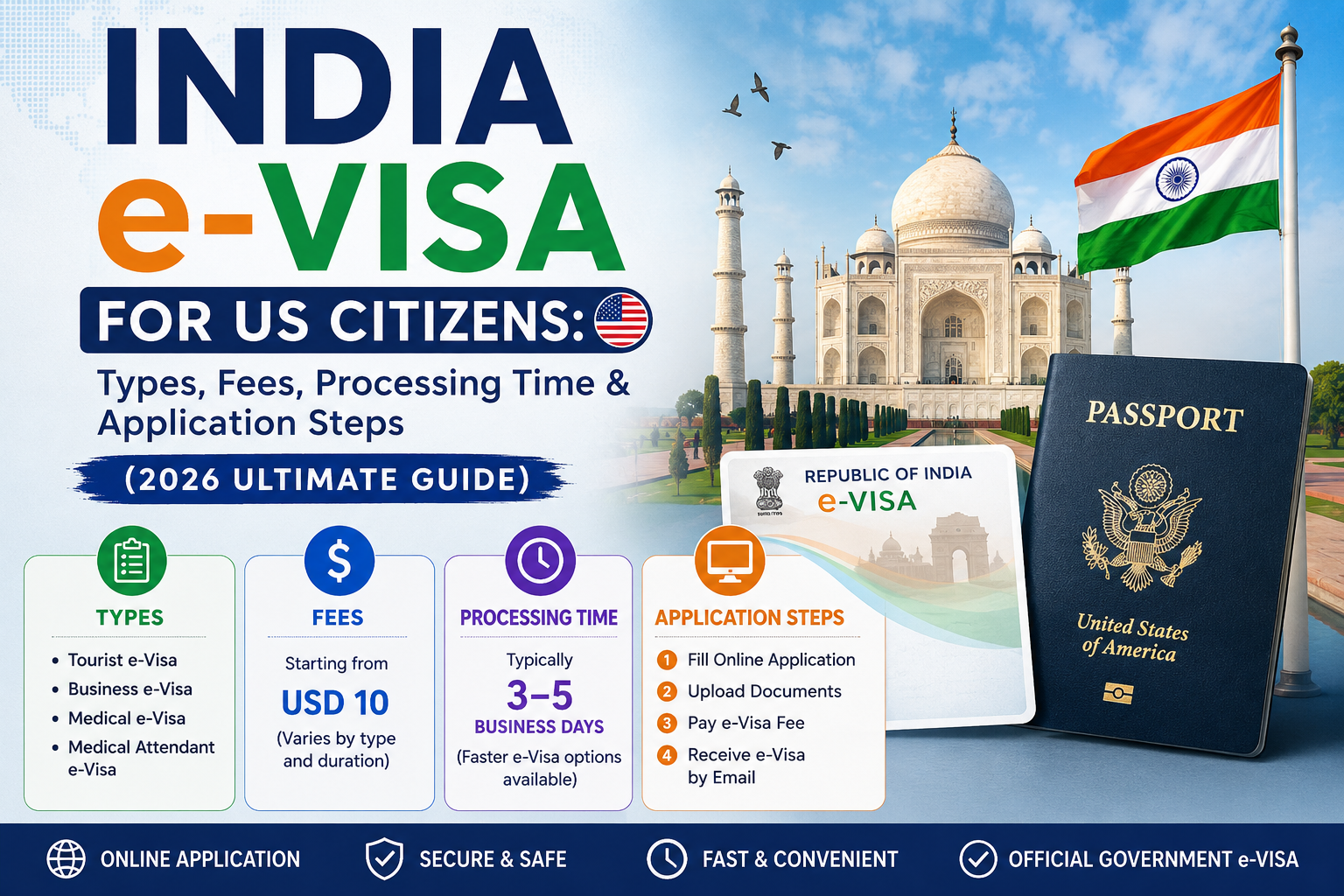
Over 9.2 million tourists visited India in 2023 (Ministry of Tourism, Government of India, 2024), and many U.S. travelers now prefer to apply online. If you're planning a 2026 trip — an NRI family visit, a Taj Mahal tour, a yoga retreat, or a last-minute business meeting — getting the India e-Visa for U.S. citizens right is one of the most important pre-flight steps you'll take.
This guide breaks down the e-Visa types, India visa fees for U.S. citizens, realistic processing time, and the exact online application steps — plus the new 2026 entry rule, pro tips, and common mistakes that cause rejections or airport stress.
Please note: This is general information, not legal or immigration advice. Visa rules and fees change often. Always confirm the latest on the official Government of India portal at indianvisaonline.gov.in before you apply or pay. Use only that official site — avoid copycat "express visa" websites.
Read this first: what's new for 2026
- E-Arrival Card is now mandatory. Since April 1, 2026, all foreign nationals—including e-Visa holders and OCI cardholders—must complete a free digital arrival card before traveling to India. It is separate from your visa.
- Stricter photo and data checks. India has tightened facial verification and document upload requirements in 2026, so issues like incorrect photos or name mismatches can more easily lead to delays.
- No visa on arrival for U.S. citizens. Visa on arrival is limited to select nationalities (such as Japan, South Korea, and certain UAE nationals). U.S. citizens must obtain an e-Visa or regular visa before boarding their flight.
- 10-year tourist visa available for U.S. nationals. A long-validity regular tourist visa option (around $160, processed via VFS Global) is available for eligible U.S. travelers who prefer a multi-year sticker visa instead of an e-Visa.
What is the India e-Visa, and who should use it?
The India e-Visa is a digital travel authorization (an ETA) that lets eligible travelers, including U.S. passport holders, apply online before they fly. It cuts out the consulate visit and speeds up arrival at approved airports and seaports. For most short trips — tourism, short business, conferences, or medical visits — it's the fastest and easiest option.
The e-Visa is best for you if:
- You're taking a short leisure trip (sightseeing, visiting family or friends).
- You're attending short business meetings, a trade fair, or a conference.
- You're traveling for medical treatment at a recognized hospital.
- You're looking for a fully online process with approval received by email.
- You're entering through a major airport or seaport (not a land border).
Consider a regular (sticker) visa instead if:
- You travel to India often and want the 10-year validity (U.S. nationals can get this again).
- You plan a long stay beyond what the e-Visa allows.
- Your purpose requires a special visa (employment, study, research, journalism, missionary work). The e-Visa does not cover paid work or formal study.
- Your nationality is not eligible for the e-Visa, or you're entering through a land border.
India e-Visa types for U.S. citizens
Pick the right category for your main purpose. India can refuse entry if your visa type doesn't match what you're actually doing. The most searched one is the tourist e-Visa, but business and medical e-Visas are also common.
Tourist e-Visa — for sightseeing, visiting friends and family, short wellness retreats, and normal leisure travel. Attending a wedding as a guest (not working) usually fits here. It comes in 30-day, 1-year, and 5-year options.
Business e-Visa — for meetings, trade fairs, and short business visits. It is not a work permit; paid employment requires a different visa. Validity is one year with multiple entries, but each stay should not exceed 180 days.
Medical e-Visa (and Medical Attendant) — for treatment at recognized hospitals or clinics. India also offers an e-Medical Attendant visa for up to two attendants accompanying the patient.
Conference e-Visa — for attending conferences or seminars organized by Indian government bodies. Validity is 30 days with single entry. Some events require additional clearances, so applying early is recommended.
Also available: India has added newer online categories such as e-Ayush (yoga, Ayurveda, and wellness) and e-Student options. If your trip is for one of these, check the official portal for the exact category and rules.
India e-Visa fees for U.S. citizens in 2026
Your fee depends on the visa type, length, number of entries, and — for the 30-day tourist e-Visa — the season. You pay online during the application. Your bank may also add a foreign-transaction fee.
Tourist e-Visa fees (U.S. passport holders)*
| Tourist e-Visa | Validity | Entries | Fee (approx., USD) |
|---|---|---|---|
| 30-day | 30 days from first arrival | Double | $10 (Apr–Jun) / $25 (Jul–Mar) |
| 1-year | 365 days from grant | Multiple | $40 |
| 1-year | 365 days from grant | Multiple | $40 |
| 5-year | 5 years from grant | Multiple | $80 |
*Plus a bank transaction charge of about 2.5%. Business, medical, and conference e-Visas use separate fee tables (the conference e-Visa is around $80). Fees can change — always confirm the live amount on the official portal before paying.
Costs to budget for
- The government e-Visa fee (from the official fee table).
- The ~2.5% bank charge added at payment.
- Your bank's foreign-transaction fee (varies by card).
- Re-application time if you upload a bad photo or incorrect details — your “true cost” includes lost time, not just money.
Fee and planning snapshot
| Visa type | Best for | What affects the total most | Timing risk |
|---|---|---|---|
| Tourist e-Visa | Leisure, family visits, holidays | Validity/entries + season | Medium (peaks at holidays) |
| Business e-Visa | Meetings, trade fairs | Category rules + correct documents | High (mistakes derail trips) |
| Medical e-Visa | Treatment in India | Supporting documents + urgency | Medium–High | Conference e-Visa | Approved events | Event approvals/clearances | High (approval depends on others) |
Important: There is no visa on arrival for U.S. citizens, and the e-Visa fee is non-refundable even if your visa is refused.
India e-Visa processing time in 2026
Processing time depends on volume, how clean your data is, and whether your case needs extra review. Many e-Visas are approved within a few days, but plan a buffer — especially around summer, Thanksgiving, Christmas, and major Indian festivals.
Practical planning rule
- Apply at least 2–4 weeks before departure. You can apply up to 120 days ahead for most categories (30 days ahead for the 30-day tourist e-Visa).
- Apply at least 4 days before arrival at the very minimum — that is the official cutoff.
- The ETA often arrives by email in about 48–72 hours, but do not rely on last-minute approval.
What can slow your approval
- Typos or mismatches between your form, passport, and ticket details.
- A photo that does not meet requirements (wrong background, blurry, or too dark).
- An unclear passport scan or incorrect file size during upload.
- Additional security review of certain applications.
- Peak-season volume, which increases processing times and slows support responses.
India's mandatory E-Arrival Card (new for 2026)
This is the change most travelers don't know about. Since April 1, 2026, every foreign national — including e-Visa holders and OCI cardholders — must complete a free digital E-Arrival Card before arriving in India.
How it works:
- Fill it out on the official government portal or the Su-Swagatam app.
- Do it between 72 and 24 hours before your departure.
- It is free and quick.
- It generates a QR code that immigration scans on arrival.
- Save a digital or printed copy of the confirmation.
This replaced the old paper forms handed out on planes. The E-Arrival Card is not a visa — you still need your e-Visa too. Skipping it can slow you down at the immigration counter, so add it to your checklist.
How to apply for the India e-Visa online (step by step)
Most problems happen because people rush the form, not because they're ineligible. Treat it like a legal document — one typo can force a re-application.
Application workflow
- Go to the official portal: indianvisaonline.gov.in/evisa/tvoa.html. Use only this site.
- Pick the right category (tourist, business, medical, or conference) and the correct duration.
- Fill in your details exactly as they appear in your passport — name spelling, name order, date of birth, and passport number.
- Upload your documents (photo and passport bio page) that meet the specifications.
- Pay the fee online with a credit or debit card (a ~2.5% bank charge applies).
- Wait for the ETA by email. Confirm the status shows "GRANTED" before you fly.
- Print and save your ETA. Carry it for airline check-in and Indian immigration.
- Complete the E-Arrival Card 72–24 hours before departure.
Upload checklist (avoids most rejections)
- Photo: recent, front-facing, plain white background, face clearly visible, JPEG (commonly 10 KB to 1 MB, about 2×2 inches).
- Passport bio page: clear scan, PDF under ~300 KB.
- Passport validity: at least 6 months from your arrival date, with at least 2 blank pages.
- Details match: your form, passport, visa, and flight ticket all use the same name spelling and order.
- Supporting documents (for business/medical) ready and in English.
Real example: a name mismatch
If your passport shows First name: Rahul, Surname: Kumar, but your ticket says Rahul K or flips the name order, you can get extra scrutiny at airline check-in. Airlines must check documents before boarding, and they face penalties for carrying travelers with wrong documents. So line up your passport, visa, and ticket names as closely as possible.
Entry rules you should know before booking flights
- Designated entry points only. The e-Visa works at about 30 major airports (Delhi, Mumbai, Bengaluru, Chennai, Hyderabad, Kolkata, Goa, Kochi, Ahmedabad, and more) and about 5 seaports. Confirm your arrival airport is on the list before booking — especially for smaller regional airports.
- No land borders. You cannot enter on an e-Visa by land from Nepal, Bhutan, or Myanmar.
- Stay limits. On the 1-year and 5-year tourist e-Visas, U.S. travelers can stay up to 180 days per calendar year. Business e-Visa stays should not exceed 180 days per visit (longer stays may require FRRO registration).
- Restricted areas. The e-Visa is not valid for Protected, Restricted, or Cantonment areas — those require separate permission.
- Biometrics on arrival. Your fingerprints and photograph are captured at immigration upon arrival in India.
- One passport rule. Travel using the same passport you applied with. If you obtain a new passport after approval, carry the old passport along with the ETA copy.
OCI option for travelers of Indian origin
Many U.S. travelers visiting family are of Indian origin. If you're a foreign citizen who once held Indian citizenship (or your parent/spouse did), you may qualify for an OCI card — a lifelong India entry document, so you wouldn't need a separate visa each trip. OCI holders still need the E-Arrival Card in 2026. If you travel to India often, the OCI can be worth looking into.
2026 trends that matter
More automated checks. Airlines and border systems increasingly match data automatically, so clean, consistent details matter more than ever. Travel volume is high — global passenger demand (RPK) grew about 10.4% in 2024 versus 2023 (IATA, 2025) — which pushes systems to auto-approve clean cases and flag the rest.
More fraud, more scrutiny. Fake "express visa" sites and unofficial agents are common. Apply and pay only on the official portal. If you want help, use a reputable travel advisor for document review rather than handing your identity documents to unknown parties.
Peak surges affect timing. International tourism keeps rebounding, and India is benefiting. During busy periods, plan your visa and flights together — a visa delay can make a nonrefundable premium ticket painful.
Expert pro tips for U.S.–India travelers
- Apply early, not in the last few days — peak season is unpredictable.
- Use your exact passport name and number everywhere.
- Check your photo and passport scan before uploading; bad files cause most rejections.
- Confirm your ETA shows "GRANTED" before you fly.
- Carry both printed and digital copies of the ETA.
- Do the E-Arrival Card in the 72–24 hour window.
- Confirm your arrival airport is e-Visa approved before booking.
- Match visa timing with flight timing — apply for the visa before buying nonrefundable fares when you can.
Common mistakes to avoid
- Choosing the wrong category (for example, tourist when you're doing business). Match the visa to your real purpose.
- Forgetting the new E-Arrival Card and getting held up on arrival.
- Name or passport-number typos that don't match your passport or ticket.
- Uploading a bad photo or scan that fails the specifications.
- Applying too late and flying with a “pending” status.
- Booking a flight to a non-approved airport for e-Visa entry.
- Using a fake visa website that overcharges or steals your data.
- Assuming visa on arrival is available — it isn’t for U.S. citizens.
Conclusion
For most U.S. travelers, the India e-Visa is the fastest way to get entry permission for a short trip — if you pick the right type and submit clean, consistent documents. In 2026, with higher travel volumes, tighter digital checks, and the new mandatory E-Arrival Card, small mistakes can cause big delays.
Next step: open the official e-Visa portal, confirm your category, and get your passport scan and photo ready before you start. If you're booking flights at the same time — especially premium cabins — plan your booking and visa timeline together so you can travel with confidence. MyFlyYatra can help you compare business class options and fare rules that fit your visa timing.
FAQs
Apply on the official Government of India portal, upload your passport bio page and photo, and pay the fee online. After approval, save and print the ETA and show it at check-in and on arrival. Make sure every detail matches your passport exactly. Then complete the E-Arrival Card before departure.
It varies, but plan a 2–4 week buffer before departure (the ETA often comes in 48–72 hours). Applying in the last few days raises the risk of a "pending" status at check-in.
Tourist, business, medical (plus medical attendant), and conference — with newer e-Ayush and e-Student options too. Pick by your main purpose, not convenience. The wrong category can cause refusal at the border.
Tourist e-Visa: about $10–$25 (30-day), $40 (1-year), $80 (5-year), plus a ~2.5% bank charge. Business, medical, and conference fees follow separate tables. Confirm the live amount on the official portal.
Not always. Some people mean the paper sticker visa (like the restored 10-year U.S. tourist visa), others mean the tourist e-Visa. For short leisure trips, the tourist e-Visa is the common online choice.
No. Only about 30 designated airports and 5 seaports accept e-Visa entry, and no land borders. Confirm your arrival airport before booking.
Do not fly with incorrect details — you may be denied boarding or refused entry. You'll usually need to reapply with correct details. Review every field right after approval.
Yes, it's strongly recommended. Many places accept a digital copy, but a printout is a reliable backup if your phone dies. Keep both.
Usually yes, as long as you enter within the e-Visa's validity window. If your new date falls outside that window, you'll need a new e-Visa. Re-check validity before rebooking.
If your dates are flexible, apply first to lower your risk. If you must book first (for a fare sale), choose a fare with good change terms and apply right away. For business class travelers, expert fare guidance — such as from MyFlyYatra — can help balance deal timing with visa timing.
