


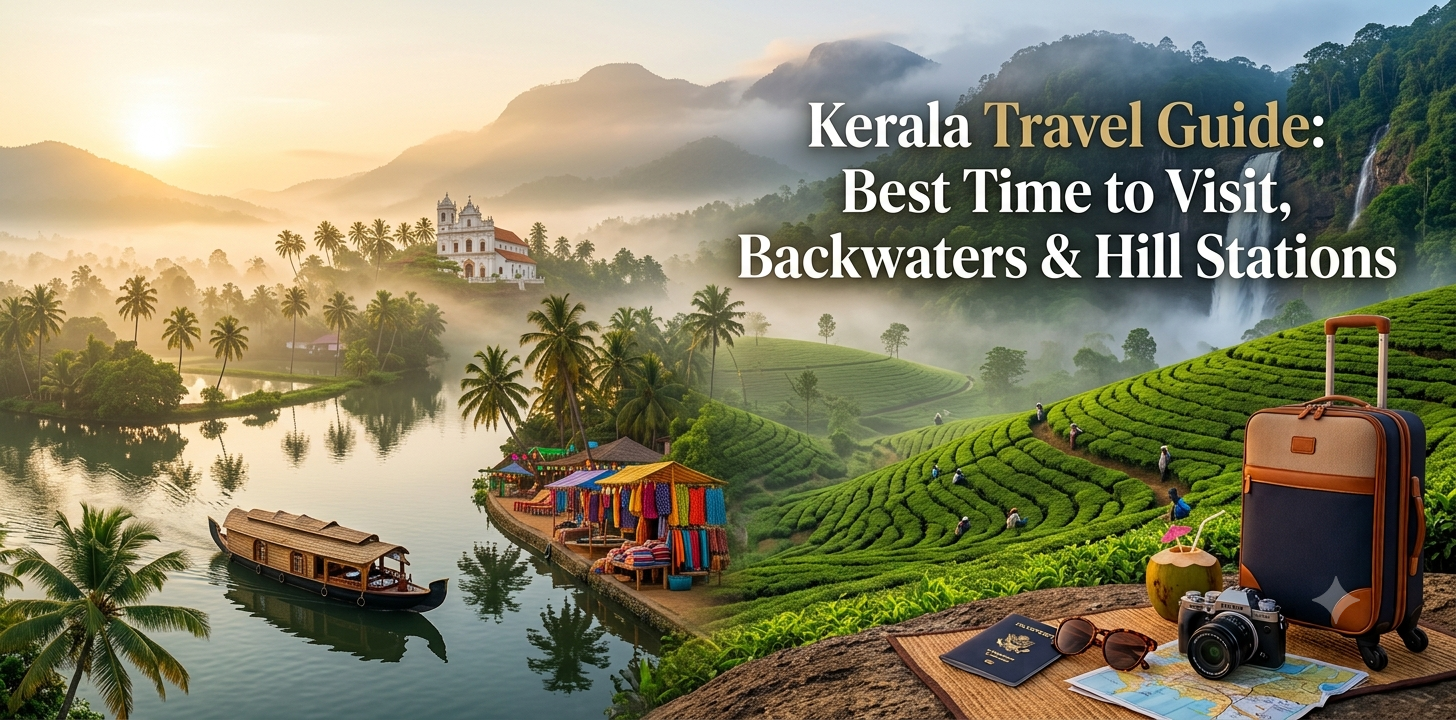
There's a reason Kerala carries the tagline "God's Own Country." Tucked along India's southwestern coast, this narrow green state stacks palm-fringed backwaters, misty tea-covered mountains, spice plantations, Ayurvedic retreats, colonial port towns, and quiet beaches into a stretch of land you can cross in a few hours. After a decade of sending travelers here, I can tell you Kerala is the rare destination that lives up to its brochure — as long as you time it right and don't try to see everything at once.
This Kerala travel guide gives you the honest, practical version: the best time to visit Kerala, a real kerala backwaters guide (not just pretty photos), how an Alleppey houseboat trip actually works, the best of Munnar's hill country, how flights to Cochin work if you're flying long-haul, and a day-by-day itinerary that ties it all together without wearing you out.
What Makes Kerala Different
Most first-timers expect a beach holiday and are surprised to find Kerala's magic is inland. It's a place of slow water and high hills. You drift through a maze of canals on a houseboat one day and wake up to tea gardens in the clouds the next. The food is coconut-rich and unforgettable, the pace is unhurried, literacy and infrastructure are among the best in India, and English is widely spoken. For an international traveler, it's one of the smoothest, safest, most rewarding corners of the country.
The trick is that Kerala's three signature experiences — backwaters, hill stations, and heritage coast — sit in different places and suit different moods. Good planning stitches them into one seamless loop.
Best Time to Visit Kerala
The best time to visit Kerala is October to March, with the sweet spot being November through February:
dry, sunny days, comfortable humidity, calm backwaters, and clear mountain views in Munnar. This is peak
season, and it's peak for good reason.
Here's the fuller picture so you can choose with intent:
- November–February (peak): The ideal window. Perfect weather across backwaters, hills, and coast. Book houseboats and Munnar hotels well ahead, especially around Christmas and New Year, when demand and prices spike.
- October & March (shoulder): Still lovely, thinner crowds, better rates. March starts warming up but remains very doable.
- April–May (hot): Humid and sticky on the coast, though the hills stay pleasant. Fewer tourists, lower prices.
- June–September (monsoon): Heavy, dramatic rain turns everything electric green. Many travelers avoid it, but this is actually the traditional season for authentic Ayurvedic treatment — the humid air is considered ideal for the therapies, and specialized wellness retreats do their best work now. If rejuvenation is your goal rather than sightseeing, monsoon Kerala is a well-kept secret.
If you want the classic backwaters-and-hills trip with reliable weather, aim squarely at the November–February band.
Kerala Backwaters Guide: Where to Go and What to Expect
The backwaters are a 900-kilometer network of interconnected lakes, canals, rivers, and lagoons
running parallel to the coast. Life here happens on the water — village houses, rice paddies below
sea level, canoes ferrying kids to school, fishermen, coconut groves leaning over the channels.
Cruising through them is the single most iconic Kerala experience.
Not all backwaters are the same, so here's where to base yourself:
- Alleppey (Alappuzha) — the "Venice of the East" and the beating heart of the backwaters. The largest houseboat fleet, the widest range of routes, and the classic Kuttanad paddy-field scenery. This is where most travelers do their houseboat trip, and rightly so.
- Kumarakom — quieter and more upscale, set on Vembanad Lake, with a bird sanctuary and a cluster of luxury resorts. Great for couples who want calm and comfort.
- Kollam & the Kollam–Alleppey stretch — a longer, less crowded route; the full-day public ferry between the two is a budget-friendly, scenic alternative to a private boat.
- Kuttanad — the deep agricultural heart, one of the few places on earth where farming happens below sea level. The most authentic village views.
Alleppey Houseboat Trip: How It Actually Works
An Alleppey houseboat trip is the highlight of most Kerala itineraries, so here's how to do it well rather than just book blindly.
What you're renting: A kettuvallam — a traditional rice barge converted into a floating hotel, with one to several en-suite bedrooms, a living deck, and a crew that includes a captain and a cook who prepares fresh Kerala meals onboard (the fish curry is a rite of passage).
Overnight vs. day cruise: An overnight stay (roughly noon to mid-morning next day) is the full experience — sunset over the paddies, dinner on the water, waking up to mist on the lake. If you're short on time, a shorter day cruise still delivers the scenery.
Private vs. shared: Private boats are the norm and worth it for the intimacy. There are also shared/luxury cruise options if you're solo or watching budget.
A few things worth knowing:
- Boats generally anchor for the night (they don't cruise after dark), so choose an operator with a good mooring spot away from clusters of other boats.
- Cruising pauses during the day too around meal times and afternoons — it's a slow, restful experience by design, not a sightseeing sprint.
- Rooms have AC, but often only during fixed evening hours when the generator runs. Confirm this when booking.
- Book a reputable operator, not the cheapest listing. Ask about the boat's condition, the route, meal inclusions, and AC hours. Quality varies enormously.
- Pack light, bring insect repellent, and go in with the right mindset: the point is to slow all the way down.
One night on a houseboat is enough for most travelers to get the full magic without restlessness. If you love it, a second night in a different area (say, a quieter Kumarakom route) rewards you.
Munnar: Things to Do in Kerala's Tea Country
Climb from the coast into the Western Ghats and you reach Munnar, a hill station carpeted in emerald tea plantations at around 1,600 meters. The air turns cool, the views turn cinematic, and the pace shifts again. Here are the Munnar things to do that actually earn their spot:
- Wander the tea gardens & visit a tea museum. The rolling, manicured slopes are the reason to come. The Kannan Devan / Tata Tea Museum walks you through the region's tea history and processing, tasting included.
- Eravikulam National Park. Home to the endangered Nilgiri tahr (mountain goats you can often see up close) and spectacular high-altitude grasslands. A must — go early to beat crowds.
- Top Station & Kolukkumalai. Panoramic viewpoints on the Kerala–Tamil Nadu border; Kolukkumalai is billed as one of the world's highest tea estates and a legendary sunrise jeep trip.
- Mattupetty Dam & Echo Point. Easy, scenic stops for boating and photos along the lake.
- Attukad & Lakkam Waterfalls. Especially full and dramatic just after the monsoon.
- A spice plantation tour. Cardamom, pepper, cinnamon, vanilla — Munnar and nearby Thekkady are the spice basket of India.
Give Munnar two nights so you're not spending the whole visit driving up and down the ghats.
Beyond Backwaters and Hills
If your schedule allows, Kerala rewards a few more stops:
- Fort Kochi (Cochin). Colonial-era streets, Chinese fishing nets, cafés, art galleries, the Mattancherry Palace and Paradesi Synagogue in Jew Town, and an evening Kathakali performance (Kerala's dramatic, elaborately costumed classical dance-theatre). The most characterful town in the state.
- Thekkady (Periyar). A wildlife reserve where you cruise a lake looking for elephants and, if you're lucky, other wildlife; also spice-plantation country.
- Wayanad. Lush, offbeat hill district with caves, waterfalls, wildlife, and far fewer tourists — great if you have extra days.
- Varkala & Kovalam. Kerala's headline beaches. Varkala's dramatic red cliffs with cafés along the top are the more atmospheric of the two.
- An Ayurveda retreat. Even a single authentic treatment is worth building in — Kerala is the global home of Ayurveda.
Getting There: Flights to Cochin (and Trivandrum)
Kerala has three international airports, which gives you useful flexibility:
- Cochin / Kochi (COK) — the main international gateway and the most convenient base for reaching the backwaters, Munnar, and Fort Kochi. Fun fact: it's the world's first fully solar-powered airport.
- Trivandrum / Thiruvananthapuram (TRV) — best for the south (Varkala, Kovalam, Kollam).
- Calicut / Kozhikode (CCJ) — handy for the north (Wayanad).
If you're flying long-haul from the US or elsewhere, the key thing to know: there are no non-stop flights from the USA to Kerala. Every routing is one-stop, and total travel time typically runs 18–24+ hours. Two main paths:
Via a Gulf hub (usually smoothest). Emirates (via Dubai), Etihad (via Abu Dhabi), and Qatar Airways (via Doha) connect major US gateways to both Cochin and Trivandrum with a single change. Etihad and Emirates are especially popular for Kerala routes.
Via Europe or an Indian metro. KLM (via Amsterdam), Lufthansa (via Frankfurt),
or Air India (often via Delhi/Mumbai) are solid alternatives, sometimes cheaper or better
timed.
Two practical notes:
- Compare all three airports. Fares into TRV or CCJ can undercut COK in peak season, and picking the airport nearest your first stop can save hours of driving.
- Airline schedules on the US–India corridor have shifted more than usual recently, so verify current routes and timings when you book rather than assuming last year's schedule still holds.
Business Class Flights to Trivandrum: Worth It?
For an 18–24 hour, one-stop journey, business class flights to Trivan (or Cochin) are one of the genuinely worthwhile splurges — a lie-flat bed is the difference between landing ready to explore and losing your first day to fog.
Your strongest premium-cabin options into Kerala:
- Etihad (via Abu Dhabi) consistently one of the most popular business-class choices for TRV, with competitive premium fares and a strong Abu Dhabi hub.
- Emirates (via Dubai) — the A380 experience where available, generous baggage, and Emirates' well-known onboard product.
- Qatar Airways Qsuite (via Doha) — routinely rated among the best business seats in the sky, with private-suite doors on many aircraft.
- Air India — its refreshed lie-flat business cabin under Tata, often routed via an Indian metro onward to Kerala.
Booking tips that actually lower the price:
- Aim for November.It tends to be the cheapest month for premium fares into Trivandrum, just as the weather turns ideal.
- Book early and be date-flexible. Business fares to South India can run into the several thousands and climb sharply over the December holidays.
- Use miles or a consolidator. Award redemptions (particularly on Qatar and Air India) and specialist NRI/India travel agencies can beat published business fares meaningfully.
- Prioritize the long leg. If a full business ticket is a stretch, splurge on the transatlantic/Gulf leg and fly economy on the short final hop — that's where comfort matters most.
Kerala 7 Day Itinerary
Here's a kerala 7 day itinerary that flows naturally from coast to water to hills, minimizing backtracking. It assumes you fly into Cochin (COK). Adjust the pace to suit — this is deliberately unhurried.
Day 1 — Arrive & Fort Kochi Land at Cochin, settle into Fort Kochi, and ease in gently (especially if you're jet-lagged from a long-haul flight). Stroll the waterfront, see the Chinese fishing nets at sunset, and catch an evening Kathakali performance.
Day 2 — Explore Kochi Mattancherry Palace, the Paradesi Synagogue and Jew Town's antique shops, the art cafés, and a leisurely Kerala lunch. An easy, culture-rich day.
Day 3 — Alleppey Houseboat Drive to Alleppey (about 1.5 hours) and board your houseboat around midday. Cruise the backwaters, watch village life drift by, eat freshly cooked Kerala food onboard, and fall asleep to the sound of water.
Day 4 — Backwaters to Munnar Disembark mid-morning and drive up into the hills to Munnar (roughly 4–5 hours, scenic the whole way). Arrive to cool air and tea slopes; relax for the evening.
Day 5 — Munnar Highlights Tea gardens and the tea museum, Eravikulam National Park for the Nilgiri tahr, Mattupetty Dam and Echo Point, and a viewpoint for sunset. A full, rewarding day in the clouds.
Day 6 — Thekkady (or More Munnar) Option A: transfer to Thekkady (Periyar) for a spice-plantation tour and a Periyar Lake wildlife cruise. Option B: a slower second Munnar day with a Kolukkumalai sunrise jeep trip and a spa afternoon.
Day 7 — Return & Depart Drive back toward Cochin (or onward to Trivandrum if you added the south), with a final Kerala meal before your flight home.
Have only 4–5 days? Do Kochi → Alleppey houseboat → Munnar and skip Thekkady. Have 9–10? Add Wayanad or the southern beaches of Varkala and Kovalam.
Kerala Travel Tips
A handful of kerala travel tips that make the trip smoother:
- Hire a car with a driver. For a multi-stop loop like this, a private car and driver for the trip is far easier (and often cheaper than you'd expect) than juggling taxis and trains. Roads through the ghats are winding — let a local handle them.
- Rideshares work in the cities. Unlike some Indian destinations, Ola and Uber operate in Kochi, and Kochi even has a metro. Handy for getting around town.
- Pack for two climates. Light, breathable clothes for the humid coast and backwaters; a warm layer for cool Munnar mornings and evenings.
- Carry cash for small spots. Cards work at hotels and bigger restaurants; keep rupees for shacks, tolls, tips, and rural areas. Use a card with no foreign transaction fees and withdraw from ATMs over airport exchange counters.
- Get a local SIM or eSIM. Coverage is good; it makes maps, rideshares, and bookings painless.
- Book houseboats and Munnar stays ahead in peak season — the good ones sell out.
- Respect local customs. Dress modestly at temples and churches, remove shoes where required, and ask before photographing people.
- Try the food properly. Sadhya (the banana-leaf feast), appam with stew, Malabar biryani, Kerala fish curry, and filter coffee are non-negotiable.
Frequently asked questions
5–7 days covers the classic loop of Kochi, backwaters, and Munnar comfortably. 9–10 lets you add Thekkady, Wayanad, or the southern beaches.
Cochin (COK) for the central circuit (backwaters, Munnar, Fort Kochi), Trivandrum (TRV) for the south, Calicut (CCJ) for the north.
For most travelers, yes — it captures the full experience without restlessness. Add a second night in a different area if you fall in love with it.
On an 18–24 hour one-stop journey, if the budget allows, yes — arriving rested is a genuine upgrade, especially over the long international leg.
Final Word
Kerala works best when you let it set the pace. Come in the October-to-March window, fly a smart one-stop routing into Cochin or Trivandrum (in a lie-flat seat if you can swing it), and build a loop that moves from the heritage streets of Kochi to a slow night on the Alleppey backwaters and up into the tea-scented hills of Munnar. Do that, and you'll understand exactly why they call it God's Own Country — and why so many travelers come back.
