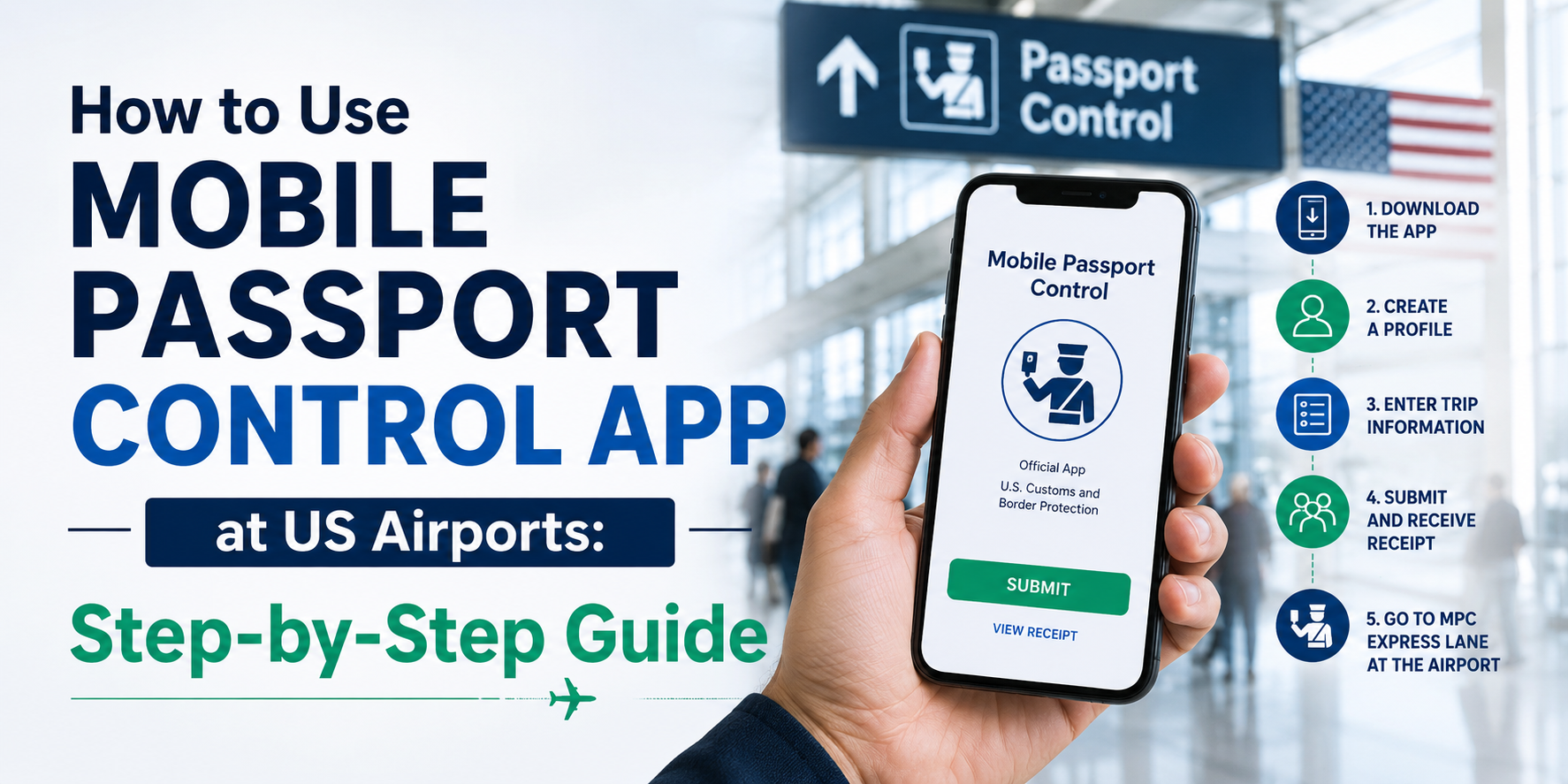
International arrivals are surging again—US Customs and Border Protection (CBP) processed 420+ million
travelers across ports of entry in FY2024 (CBP, 2024). With peak travel windows (summer, Thanksgiving,
winter holidays) pushing immigration lines to 60–120+ minutes at busy hubs, knowing how to use the mobile
passport control app usacan be the difference between making a connection and rebooking your trip. The
Mobile Passport Control (MPC) program lets eligible travelers submit passport and trip details to CBP
through an official app and access a dedicated MPC lane at participating airports.
This 2026 guide shows you exactly how MPC works, how to set it up, what to do when you land, common mistakes
to avoid, and what’s changed recently—especially useful for NRI travelers and students flying from the USA
or Canada to India and back through major US
gateways.
What the Mobile Passport Control (MPC) app is (and what it isn’t)
MPC is a CBP program that streamlines the information submission part of primary inspection for eligible
travelers arriving in the United States. You submit your passport data, photo(s), and customs declaration
responses in the app after you land, then present a QR code to a CBP officer at a designated MPC lane.
MPC vs Global Entry vs ESTA
CBP positions MPC as a queue-management and data pre-submission tool. In practice, time savings vary by
airport staffing and whether MPC lanes are open at your arrival time—so it’s best viewed as a high-upside,
low-risk add-on for eligible travelers.
Who can use the US customs mobile app (MPC) in 2026?
Eligibility and participation can change, so confirm in the app and on CBP’s MPC page before travel.
Generally, MPC is available to:
For NRI travelers: if you are a US citizen/GC holder flying back from India (often via DEL/BOM/BLR to JFK/EWR/ORD/SFO/IAH), MPC can be
especially helpful during banked arrivals when multiple long-haul flights land within 30–60 minutes.
Real-world benchmark:US airports handled much higher passenger volumes post-pandemic, with TSA reporting 3.0+
million passengers screened in a single day multiple times in 2024–2025 (TSA, 2025). Higher throughput days
correlate with longer immigration and baggage hall congestion at major hubs—exactly when MPC lanes can help.
Step-by-step: How to use the mobile passport control app usa at the airport
Use this exact sequence to minimize errors and avoid getting sent back to the standard line.
Step 1: Download the official MPC app and create a profile
Step 2: Wait until you land (then prepare your submission)
In 2026, the most reliable approach is: submit after arrival(wheels down) and when you have cellular/Wi‑Fi.
Some airports support submissions in the terminal area; don’t submit too early if the app warns against it.
Step 3: Answer the customs declaration and take the in-app photo
Step 4: Get your QR code and head to the MPC lane
After submission, the app generates a time-limited QR code. Follow airport signage for “Mobile Passport
Control” or ask staff where the MPC line is located.
Step 5: Present the QR code + passport to the CBP officer
Bring your physical passport/green card. The officer may ask routine questions (trip purpose, duration
abroad, items declared). If you’re connecting onward domestically, proceed to baggage recheck and TSA
screening as usual.
Where MPC works: Major airports, typical wait-time impact, and what to expect
MPC is not available at every airport/terminal at all times. The experience depends on lane staffing and how
many flights arrive simultaneously. CBP has expanded and optimized digital arrival flows over the past few
years, but operations still vary by port.
| Scenario |
Typical outcome with MPC |
What to do |
Best for |
| Dedicated MPC lane open + moderate arrivals |
Often faster than regular line |
Submit after landing, go straight to MPC signage |
Business travelers, families with kids |
| MPC lane open + heavy banked arrivals |
Still faster, but queues can form |
Submit ASAP after landing, walk quickly, keep group together |
Connection-risk itineraries |
| No MPC lane staffed |
Little or no benefit |
Ask staff; if closed, join standard line |
Late-night arrivals |
| Global Entry available to you |
Usually the fastest |
Use GE kiosks; keep MPC as backup |
Frequent flyers |
Data point that matters:CBP reports MPC is available at dozens of US entry pointsand is designed to reduce
inspection time and congestion (CBP, 2025). But because lane staffing and terminal layouts differ, your
“minutes saved” will vary—so plan connections conservatively.
Common mistakes to avoid (that cause delays or rejection)
Pro tip for NRI family trips:If you’re arriving with elders or children, assign one person to manage
submissions for the group. Keep everyone’s passports accessible (not buried in carry-ons), because secondary
checks often happen due to document scrambling, not app issues.
What’s changing in 2026: Digital identity, airport ops, and smarter border flows
In 2026, border processing is increasingly shaped by biometric identity, higher passenger volumes, and
airline operational volatility (weather disruptions, rolling ATC constraints, and schedule “banks”).
Airlines and airports are also pushing more passengers into app-based flows end-to-end.
Practical implication: treat MPC as one part of a “friction reduction stack”—along with longer connection
buffers, earlier seat selection, and carry-on discipline—especially when returning from India during peak
diaspora travel months.
Conclusion: Use MPC to reduce arrival friction in 2026
If you’re planning international travel with tight connections—especially USA/Canada to India and back—build
a smoother end-to-end journey: choose smart routings, protect your connection time, and use the right tools
at the border. For premium cabin deals and expert support 9am–9pm (EST), 7 days—including help during
disruptions—book with MyFlyYatra or call our Emergency Travel
Center: 1-888-413-5701within 24 hours of departure or while traveling.
FAQs:
The Mobile Passport Control (MPC) app allows eligible travelers entering the United States to
submit passport information, a photo, and customs declaration details electronically before
arrival.
Upon submission, travelers receive a QR code that can be presented at designated MPC lanes
(where available) to speed up processing with U.S. Customs and Border Protection officers.
Yes, the MPC app is an official application provided by U.S. Customs and Border Protection
(CBP).
It is safe to use when downloaded from trusted sources such as the Apple App Store or Google
Play Store.
The app is free and does not require any payment or subscription.
Eligibility for the MPC app depends on current CBP rules and the participating airport.
Some visa holders, including H-1B, F-1, and B1/B2 travelers, may be eligible at certain ports of
entry, while others may not.
It is recommended to check eligibility directly within the app or through official CBP guidance
before travel.
In most cases, the MPC app replaces the traditional paper customs declaration form by allowing
digital submission.
However, CBP officers may still ask questions or request additional information during
inspection depending on your travel details.
It is generally recommended to submit your MPC information after landing, once you have access
to a stable internet connection.
Submitting at the correct time ensures your QR code remains valid for processing at the airport.
No, MPC does not guarantee faster processing.
When dedicated MPC lanes are available, it may reduce wait times. However, if lanes are
unavailable or merged with standard queues, processing times may be similar to regular lines.
Yes, the MPC app supports group submissions for families traveling together.
All family members included in the submission should remain together during the customs
inspection process for smoother processing.
If you cannot access your QR code due to a phone issue, you may need to resubmit your
information or proceed through the standard immigration line.
It is advisable to keep your device charged and have a backup option when traveling
internationally.
Global Entry typically offers faster and more consistent processing but requires an application,
interview, and fee.
MPC is free and easier to use, making it a convenient option for occasional travelers or as a
backup when Global Entry is not available.
Yes, MPC can be used for eligible international arrivals into the United States, including
flights from India, provided the airport participates in the program.
Availability and eligibility depend on U.S. Customs and Border Protection rules and the specific
port of entry.