


Multi-City India Trips With Miles: Fly USA–Delhi and Return Mumbai–USA Without Booking Two Round Trips
Search Cheap Flights
SAVE UP TO 40%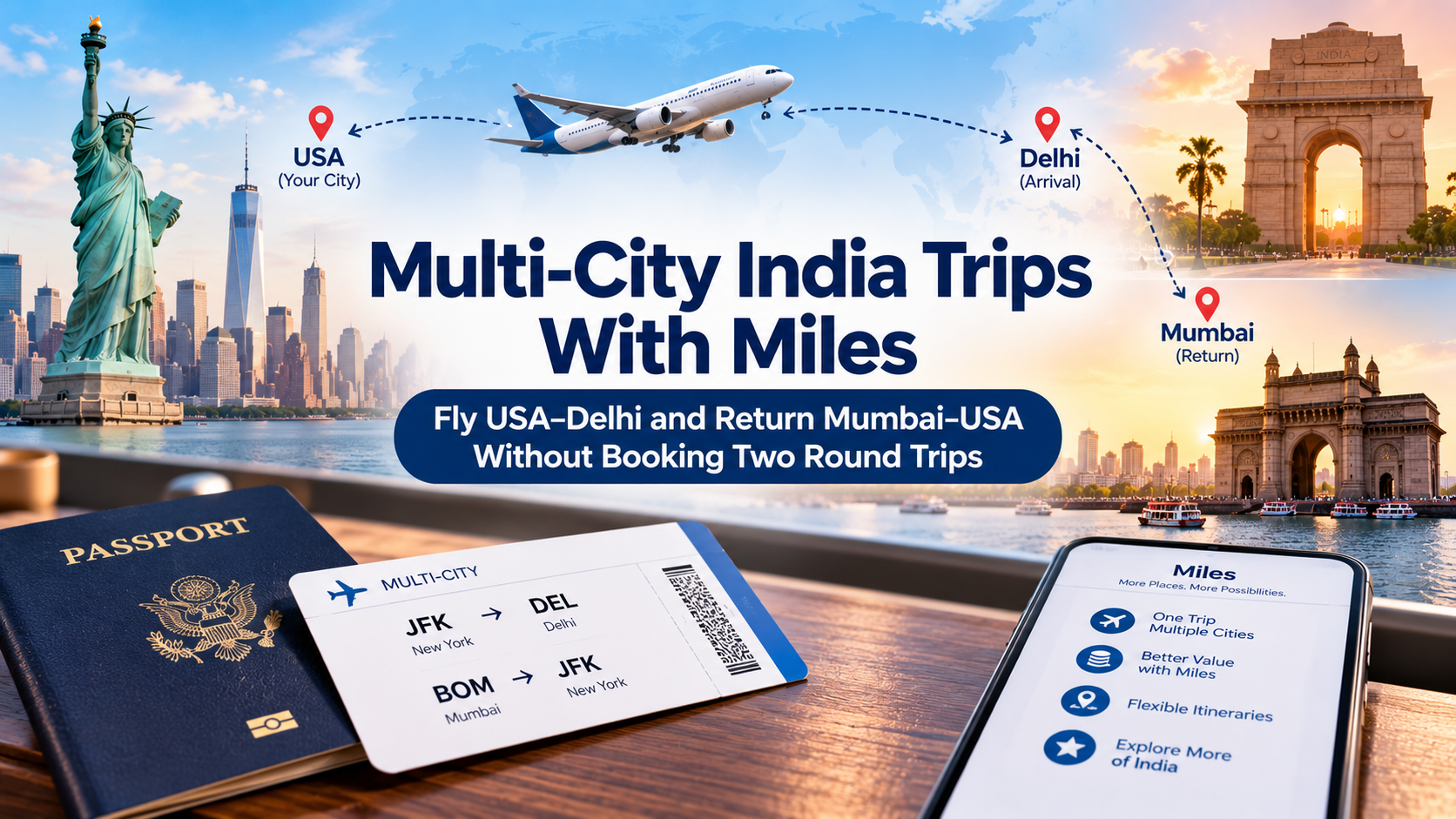
Flying from the USA to Delhi does not mean you have to return home from Delhi.
If your India trip takes you from Delhi through cities such as Agra, Jaipur, Udaipur, or Mumbai, you can fly into Delhi and start your return journey from Mumbai. When miles are involved, this can often be built as an open-jaw award trip, either through one supported multi-city booking or two separate one-way awards.
A simple trip could look like this:
New York → Delhi
Travel through India
Mumbai → New York
You do not need to book a USA–Delhi round trip and then another USA–Mumbai round trip. You also do not need to fly from Mumbai back to Delhi just because Delhi was your original arrival airport.
The important part is knowing how to search each international direction, which mileage programs can support the trip, and when using two one-way awards makes more sense than trying to force everything into one reservation.
How a USA–Delhi / Mumbai–USA Miles Trip Actually Works
A Delhi-in, Mumbai-out trip has three separate pieces.
| Part of the trip | How it can work |
|---|---|
| USA → Delhi | International award flight |
| Delhi → Mumbai | Travel separately within India |
| Mumbai → USA | International award flight |
The middle section does not have to be part of your international award.
For example, imagine you live in New York and want to spend two weeks traveling through northern and western India. You could use miles for a New York-to-Delhi flight, spend several days in Delhi, visit Agra and Jaipur, continue to Mumbai, and then use another award to fly from Mumbai back to New York.
That makes much more sense than traveling all the way from Mumbai back to Delhi simply because your original flight landed there.
The same idea works with other U.S. gateways. Someone from Chicago could fly ORD → DEL and later return BOM → ORD. A San Francisco traveler could do SFO → DEL and then BOM → SFO.
The exact airlines and mileage programs may differ, but the structure stays the same.
Open Jaw vs Stopover: What Are You Actually Booking?
These two terms are often mixed together, but they describe different things.
The Delhi–Mumbai Gap Is an Open Jaw
If your trip is:
USA → Delhi
Mumbai → USA
you have an open jaw because you arrive in one city but start your return trip from another.
The travel between Delhi and Mumbai is handled separately. In airline terminology, this gap is often called a surface sector.
You could fly between the cities, take trains, hire transportation, or visit several destinations on the way. Your international award does not necessarily need to cover that part.
A Stopover Is Different
Now imagine this trip:
New York → Paris → Delhi
Spend three days in Paris
Continue Paris → Delhi
Paris is a stopover because you deliberately stay in an intermediate city before continuing to your destination.
You could even have both concepts in one larger trip: a stopover on the way to India and an open jaw inside India.
For example:
New York → Paris — 3-day stopover → Delhi
Travel across India
Mumbai → New York
Keeping these two concepts separate makes award searches much easier.
One Multi-City Award or Two One-Way Awards?
This is where many travelers make the process harder than it needs to be.
A multi-city India trip does not automatically need to be issued as one traditional round-trip award. Sometimes the cleaner option is simply to book the outbound and return separately.
Option 1: One Multi-City or Open-Jaw Award
If your loyalty program supports it and suitable award seats are available, you may be able to book something such as:
New York → Delhi
Mumbai → New York
within one award reservation.
This can make the itinerary easier to manage, but it does not mean it will always use fewer miles or cost less.
Option 2: Two One-Way Awards
You could instead book:
Award 1: New York → Delhi
Award 2: Mumbai → New York
That is still very different from buying two round-trip tickets.
American Airlines, for example, states that AAdvantage awards are valid for one-way travel and that awards can be combined to create round-trip or multi-city trips.
Two one-way awards can be especially useful when award availability is much better in one loyalty program for the outbound and another program for the return.
| Booking approach | When it can make sense |
|---|---|
| One multi-city award | One program has good space in both directions |
| Two one-way awards | Different programs offer better availability each way |
| Miles one way, cash the other | Only one direction provides good award value |
| Cash open-jaw ticket | Award prices or cash fees are too high |
Do not assume the first option is automatically the best. Search the actual flights first.
Which Miles Programs Can Work for a Delhi-In, Mumbai-Out Trip?
There is no single “best” loyalty program for every USA–India trip. Award inventory changes by date, airline, cabin, and route.
The better strategy is to understand which programs give you useful booking options and then compare the seats available for your dates.
Air Canada Aeroplan
Aeroplan is one of the more flexible programs for complicated itineraries. Its current Flight Reward Policy allows one-way, round-trip, open-jaw, and multi-city rewards. That makes it relevant for a trip where you arrive in Delhi but leave India from Mumbai.
Aeroplan also allows an international stopover for an additional 5,000 Aeroplan points. One stopover is permitted per direction, the stop can last up to 45 days, and stopovers are not permitted within the United States or Canada.
For example, someone could potentially build a larger international itinerary with a stopover outside North America before reaching India. That stopover is separate from the Delhi/Mumbai open jaw.
The main lesson is not that every Aeroplan itinerary should include a stopover. It is that Aeroplan gives you several ways to structure an award, so it is worth checking when planning a more complicated India trip.
Flying Blue
Flying Blue can be useful when Air France, KLM, or eligible partner airlines have suitable award space for India.
Flying Blue currently allows a complimentary stopover of at least 24 hours between qualifying flights operated by Air France, KLM, or airline partners. The program directs members to customer service to arrange these stopover reward tickets.
For example, your outbound could involve the USA, Paris or Amsterdam, and Delhi. You would then travel through India independently before searching separately for your Mumbai-to-USA return.
Flying Blue also makes an important point that applies to award travel in general: reward tickets still carry airport taxes and carrier surcharges that have to be paid separately from the miles.
That is why you should never compare two awards based only on the mileage number.
American AAdvantage
AAdvantage can also fit the two-one-way strategy because American states that one-way awards can be combined to create round-trip or multi-city travel.
Suppose you find a useful award from the USA to Delhi but cannot find a good return from Delhi. Instead of giving up, search Mumbai → USA independently.
This is one of the biggest advantages of thinking about the trip as two international directions rather than one fixed round trip.
Air India Maharaja Club
Air India deserves special attention because it is such an important airline for USA–India travel.
However, there is a current limitation travelers should know about. As of September 2026, Air India's Maharaja Club FAQ says multi-city bookings using Maharaja Points are not currently available.
That does not mean you cannot use Maharaja Points for travel to or from India. It means you should not expect the Maharaja Club booking system to create the entire Delhi-in, Mumbai-out journey as one multi-city redemption.
Air India also expanded Maharaja Club in May 2026 so members can earn and redeem points on eligible Air India Express travel, adding more options within the broader Air India network.
For a USA–Delhi / Mumbai–USA trip, check the available redemption options for each direction rather than assuming the whole open jaw can be booked in one Maharaja Points transaction.
You Do Not Need the Same Miles for Both Directions
This is one of the most useful parts of an open-jaw strategy.
Imagine you find a reasonable award from Chicago to Delhi through one loyalty program, but that same program wants far more miles for your Mumbai-to-Chicago return.
There is no rule saying you must stay with it.
You could potentially book:
USA → Delhi with Program A
Mumbai → USA with Program B
The flights do not even have to be on the same airline alliance when they are separate awards.
This gives you more freedom to work with actual award availability instead of forcing your trip into one loyalty program simply because that is where you started searching.
The downside is that you now have two reservations to manage. But for many travelers, that extra administration is worth it if the itinerary, cabin, or mileage requirement is better.
How to Search Award Space Before Transferring Points
Do not begin by transferring points. Begin by finding flights you can actually book.
A practical search process is:
- Search USA → Delhi for your real travel date and passenger count. Then check nearby dates or practical alternative U.S. airports if the first results are poor.
- Search Mumbai → USA separately. Do not assume that good award space on the outbound means good space will exist on the return.
- Write down the miles, cash taxes and surcharges, cabin, number of stops, and total journey time for each realistic option.
- Compare whether one loyalty program works well in both directions or whether two separate programs give you a better trip.
- Confirm award availability for the actual number of travelers. One available seat does not mean four seats are available.
- Only after you have a workable itinerary should you decide whether transferring flexible points makes sense.
- Once the long-haul international flights are confirmed, build the Delhi-to-Mumbai part of your India trip around those dates.
The order matters. Transferring points first and searching later can leave you with miles trapped in a loyalty account that no longer has useful award space for your trip.
What Happens Between Delhi and Mumbai?
Nothing says you need to fly straight from Delhi to Mumbai. That gap is one reason the open-jaw structure is useful in the first place.
A traveler could follow a route such as:
Delhi → Agra → Jaipur → Udaipur → Mumbai
and then fly home from Mumbai.
Another traveler might spend a week in Delhi and northern India, then buy a separate domestic flight from Delhi to Mumbai before starting the international return.
The best choice depends on what you want to do in India.
Just remember that a separately booked domestic flight has its own ticket conditions, baggage rules, and disruption risks. If you book a domestic flight into Mumbai and then have an unrelated international award departing Mumbai a few hours later, the tickets normally do not have the same protection as one through-ticket itinerary.
That deserves extra planning.
Real Example: New York → Delhi / Mumbai → New York
Consider a traveler who lives in New York and wants to visit Delhi, Agra, Jaipur, and Mumbai.
Instead of searching only:
New York → Delhi → New York
the traveler searches the trip in two parts.
First:
JFK/EWR → Delhi (DEL)
Then separately:
Mumbai (BOM) → JFK/EWR
Suppose the outbound has strong award availability through one program but the Mumbai return is expensive in miles. The traveler can check other loyalty programs for the return instead of changing the entire trip.
Once both long-haul flights are secured, the India itinerary can be built between them:
New York → Delhi
Delhi → Agra → Jaipur → Mumbai
Mumbai → New York
That is the real advantage of this strategy. It is not about creating the most complicated award possible. It is about matching your flights to the way you actually want to travel through India.
If you are comparing cash fares as well, MyFlyYatra's current USA-to-India flight coverage includes Delhi, Mumbai, Hyderabad, Bengaluru, Chennai, Ahmedabad, Amritsar, and other Indian destinations, which can help you compare whether a cash open-jaw ticket makes more sense than using miles.
What If You Find an Award to Delhi but Nothing From Mumbai?
Do not immediately abandon the open jaw. Award availability changes constantly, and the best return may not look exactly like the itinerary you first imagined.
Start by checking Mumbai-to-USA flights one or two days earlier and later. If that does not help, look at alternative U.S. arrival airports that you could reasonably position home from.
You can also check another loyalty program. This is where the two-one-way approach becomes useful: the program that gave you a good USA-to-Delhi award does not have to provide your Mumbai return.
Another option is to check whether another Indian departure point offers significantly better award availability. Bengaluru, Hyderabad, or even Delhi may sometimes produce a better option.
Returning to Delhi should usually be treated as a fallback rather than the default. If flying Mumbai → Delhi → USA adds another domestic ticket, hotel night, baggage transfer, or a full day of travel, the “cheaper” award can quickly stop being cheaper.
Do Not Compare Miles Alone
An award ticket is not free simply because miles cover the base redemption.
You should compare:
Miles + taxes + carrier-imposed charges + positioning costs
For example, imagine one itinerary costs fewer miles but requires much higher cash surcharges, while another costs somewhat more miles but much less cash.
The first result is not automatically better.
Flying Blue states that taxes and carrier surcharges on reward tickets must be paid separately, while American also notes that taxes and carrier-imposed fees vary by itinerary and appear during the award search.
This is especially important for premium-cabin awards, where the difference between two programs can be substantial.
Before transferring points, write down the complete cost of each option rather than focusing on the mileage headline.
Booking for Two, Three, or Four Travelers
A strategy that works perfectly for one person may not work for a family.
Suppose you search New York → Delhi and find one business-class award seat. That does not mean four business-class seats are available at the same price.
Always search using the real number of passengers.
If you are traveling as a family, flexibility becomes more important. You may need to compare nearby dates, different cabins, different U.S. gateways, or separate routings.
You might also find business-class award space for two travelers but only economy or premium-economy space for the rest. Whether splitting the group makes sense depends on your family and travel priorities.
The main mistake to avoid is transferring enough points for four people after only confirming award availability for one.
Be Careful With Separate Tickets
Open-jaw travel often involves more than one reservation, which makes connection planning important.
Imagine this return:
Jaipur → Mumbai on a separately purchased domestic ticket
Mumbai → USA on an international award ticket
If the Jaipur flight is delayed and you miss your separate international flight, you may not have the same protection you would receive on a single through-ticket.
That does not mean you should avoid separate tickets. It means you should build enough time into the itinerary and understand what happens to checked baggage, terminal transfers, and rebooking if the first flight is disrupted.
For a long-haul USA flight, arriving in Mumbai earlier than strictly necessary may be worth the peace of mind.
When Paying Cash Can Be Better Than Using Miles
Having miles does not mean you should always use them.
Sometimes award pricing is simply poor. Other times, the mileage requirement looks reasonable until high surcharges are added.
Cash can also make more sense when your dates are fixed and you need several seats on the same flight.
Before booking an award, compare a cash open-jaw search for:
USA → Delhi
Mumbai → USA
with the complete cost of the award option.
MyFlyYatra's current flights-to-India pages allow travelers to compare routes and fare options from major U.S. cities to Delhi, Mumbai, and other Indian destinations.
If a well-priced cash ticket keeps the whole trip on one booking, earns miles, and avoids large award surcharges, saving your points for another journey can be the smarter decision.
What About Business Class?
Open-jaw searching can be especially useful when you want business class because premium award space can be much harder to find than economy.
You may find business-class availability from the USA to Delhi but nothing useful from Delhi on your return date. Mumbai may have better options.
Or you may find a strong business-class award outbound but only premium economy on the return.
That does not automatically make the trip a bad deal. You can mix cabins when the overall value makes sense.
The same logic applies to cash tickets. MyFlyYatra currently lists business-class options to Delhi and other Indian gateways, and its Delhi content specifically recognizes the value of using Delhi as the start of a multi-city India trip rather than automatically returning from the same city.
The goal is not to create a perfectly symmetrical itinerary. It is to build the best trip available for your dates, miles, budget, and comfort level.
USA–India Multi-City Award FAQs
Yes. You arrive in India through Delhi but begin your international return journey from Mumbai. The gap between Delhi and Mumbai is the open part of the itinerary, and you arrange travel between those cities separately.
No. Depending on the loyalty program and available award seats, you may be able to book a supported multi-city/open-jaw award or use two separate one-way awards: USA → Delhi and Mumbai → USA.
Yes. If the two directions are booked separately, you can potentially use one loyalty program for the flight to Delhi and another for the return from Mumbai. This can be useful when award availability differs by program.
Not as one multi-city Maharaja Points booking at present. Air India's current Maharaja Club FAQ says multi-city bookings using Maharaja Points are not available.
No. The Delhi-to-Mumbai portion can be handled separately. You could fly, take trains, or visit several cities between Delhi and Mumbai before your international return.
Not necessarily. Compare the mileage requirement, taxes, carrier surcharges, routing, cabin, and award availability before deciding. Two one-way awards can sometimes give you much more flexibility.
Possibly. It depends on the loyalty program. Aeroplan currently permits one international stopover per direction for an additional 5,000 points, while Flying Blue allows qualifying stopovers of 24 hours or more on eligible reward itineraries.
Usually, no. Find the flights you can actually book, verify availability for the correct number of passengers, and check the complete mileage and cash cost first. Only then should you decide whether transferring points makes sense.
Final Takeaway
A multi-city India trip with miles does not have to mean booking two round trips or returning to the Indian city where you first landed.
For many travelers, the cleaner structure is:
USA → Delhi
Travel through India
Mumbai → USA
The international flights might be booked as one supported open-jaw itinerary, two one-way awards, or even a mix of miles and cash.
Start by searching each international direction separately. Compare award availability, mileage requirements, taxes, surcharges, and the real cost of positioning between airports. Then choose the booking method that fits your trip rather than forcing your trip to fit one loyalty program.
That flexibility is what makes a Delhi-in, Mumbai-out itinerary useful in the first place.
What Customers Say About Us
We do our best to provide you the best experience ever
