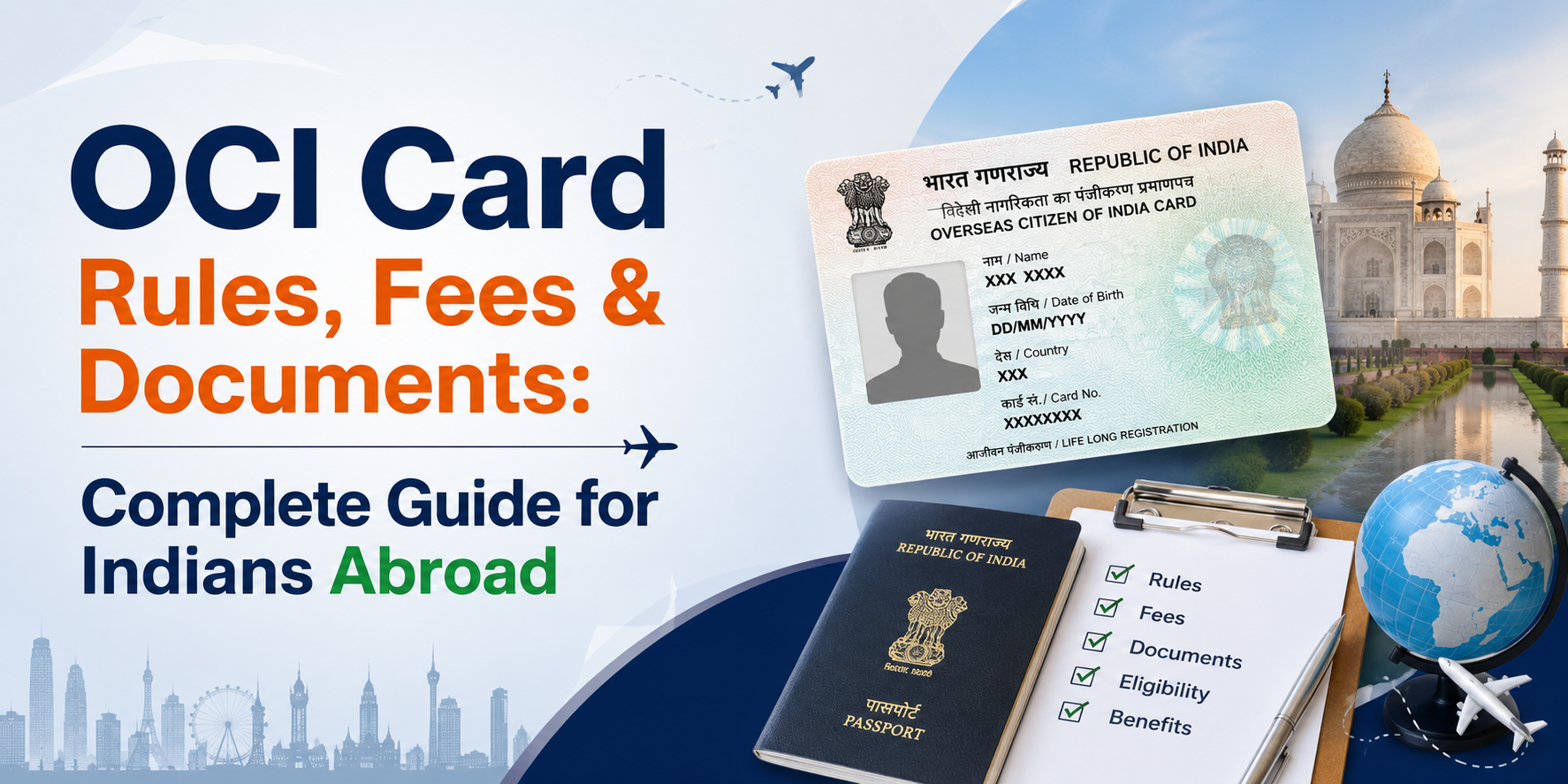
Over 4.5 million Overseas Citizen of India (OCI) cards have been issued globally, making OCI one of the most-used long-term travel and residency privileges for the Indian diaspora (Ministry of Home Affairs—OCI Dashboard/FAQs, 2025). If you’re an NRI traveling on flights from the U.S. to India or Canada to India, an OCI card is often the difference between stressful last-minute visa planning and flexible, multi-entry access for family visits, studies, business travel, and longer stays.
This 2026 guide breaks down OCI card rules India, the latest practical expectations at airports and immigration, a complete list of OCI card documents, fees, processing timelines, and real-world situations such as new passport updates, newborn applications, spouse-based OCI, and renunciation. You’ll also learn the most common mistakes that delay OCI approvals—and how to avoid them before your next trip to India.
What an OCI card allows (and what it doesn’t) in 2026
OCI is not dual citizenship, but it offers powerful long-term privileges. In day-to-day practice, OCI functions like a “lifelong multi-entry visa” plus additional benefits for NRIs visiting India frequently.
Key benefits you can rely on
Important limitations (often missed)
OCI card rules India: eligibility and who should apply
Eligibility typically covers foreign citizens who were eligible to become Indian citizens on/after 26 Jan 1950, were Indian citizens, or are children/grandchildren of such persons—plus spouse-based eligibility in specific cases (MHA OCI FAQs, 2025). For Indian-origin families in North America, the most common paths are: former Indian passport holders, OCI for minor children, and spouse-based OCI.
Common real-world eligibility scenarios
Practical 2026 note:Consulates and outsourced centers continue to tighten document matching (names, DOB, places) as fraud controls and digitization increase. Expect more “additional document” requests if your records don’t align.
OCI card documents: 2026 checklist (by applicant type)
Documentation varies slightly by jurisdiction (US/Canada mission) and applicant category, but these are the most consistently requested items. The goal is simple: prove identity, current citizenship, Indian origin (or spousal link), and clean photo/signature compliance.
Core OCI card documents (most applicants)
Additional documents for common categories
Pro tip:Before you upload, ensure identical spelling across passport, birth certificate, and prior Indian documents. Even a missing middle name or swapped surname order can trigger a hold.
OCI fees, timelines, and what to budget for in 2026
Costs vary by country/mission and service provider (outsourcing and shipping can add meaningful overhead). As a benchmark, many applicants report an all-in range of a few hundred dollars depending on service fees, courier, photos, and notarization. Always validate the latest fee schedule on your Indian mission/outsourced center site before paying.
Processing times are not fixed. A practical benchmark is several weeks, with delays during peak travel seasons (summer, winter holidays) and when additional documents are requested. Digitization has improved tracking, but spikes in demand still create backlogs.
| Cost/Timing Factor |
What Typically Impacts It |
How to Reduce Delays/Cost |
| Application fee |
Mission/consulate schedule; applicant category |
Confirm fees on the official mission website before submitting |
| Service/outsourcing fee |
Local center policies; optional add-ons |
Avoid unnecessary premium add-ons unless time-critical |
| Courier/shipping |
Distance, signature requirement, return label |
Use trackable shipping and keep scans of labels and receipts |
| Timeline |
Peak travel months, document mismatches, and verification checks |
Submit 8–12 weeks before intended travel whenever possible |
Why timelines matter now:International travel demand remains elevated post-pandemic. In 2025, India was among the world’s fastest-growing aviation markets, with traffic steadily rising (IATA, 2025). More travel demand generally means more time sensitivity—and more OCI-related urgency before family trips.
2026 trends and recent changes that affect OCI applicants
In 2026, OCI processing continues shifting toward tighter digitization, stricter document verification, and clearer enforcement at check-in/immigration for travelers with mismatched identity records. This mirrors broader border-tech modernization trends globally; for example, biometric and digital identity use at borders continues expanding worldwide as governments invest in faster, more secure processing (International Air Transport Association, 2025).
What this means practically for NRIs in the US/Canada
Data point to plan around:The Indian diaspora remains one of the largest globally, and India continues to be a top recipient of remittances— over $100B annually in recent years, reflecting sustained travel and family ties (World Bank, 2023; most recent consolidated global remittance reporting). The practical implication: OCI demand stays structurally high.
Common mistakes to avoid (and pro tips that save weeks)
Most OCI delays aren’t “eligibility” problems—they’re execution problems. Here are the issues that repeatedly cause rework.
Mistakes that cause rejections/holds
Pro tips used by frequent India flyers
What to do when passports change, kids grow up, or details change
Life changes are where OCI confusion spikes: new passports, newborns, and address changes. While OCI is often described as lifelong, you still need to keep details aligned with current travel documents to avoid airline check-in or immigration friction.
New passport: how to avoid airport problems
Minors turning 18: plan ahead
Teen-to-adult transitions often trigger the highest mismatch risk (new signatures, renewed passports, address changes for college). Build a checklist 3–4 months before major travel so you’re not fixing identity issues the week of your flight.
Conclusion: make OCI painless—and protect your India travel plans
If you’re planning an India trip from the US or Canada—especially for weddings, holidays, or family emergencies—pair your OCI planning with flight planning early. MyFlyYatra helps NRIs find affordable business class flights and supports travelers end-to-end: 9am–9pm (EST), 7 days, plus our Emergency Travel Center (1-888-413-5701)for urgent issues within 24 hours of departure or while traveling.
Next step: Once your OCI timeline is clear, lock in your preferred dates and ask MyFlyYatra for a business class deal that fits your routing, family needs, and flexibility requirements at Myflyyatra.
FAQs:
OCI allows long-term, multiple-entry travel to India, but it is not citizenship and has restrictions (no voting, no government employment). The most important 2026 reality is stricter document verification and higher sensitivity to name/DOB mismatches at submission and travel touchpoints.
Most applicants need a valid foreign passport, proof of address, photos/signature per specification, and proof of Indian origin (such as surrendered Indian passport or birth/parent linkage documents). Minors and spouse-based applicants need additional relationship documents.
Timelines vary by mission workload, seasonality, and whether the case triggers additional verification. A practical best practice is to apply 8–12 weeksbefore intended travel, especially for summer and winter holiday peaks.
Total cost depends on the official fee plus outsourcing/service charges, courier, and document services. Always confirm current fees on the official Indian mission/outsourced center website serving your jurisdiction before paying.
Possibly, depending on your nationality and visa eligibility. Many travelers use an India visa (including e-Visa where eligible) to travel while OCI is pending, but you should confirm rules with official sources and avoid overlapping/conflicting applications.
You generally travel with your valid passport and OCI card, but you should ensure your details remain consistent. If your passport renewal includes a name change or major identity changes, expect to update records to prevent check-in/immigration issues.
In many cases, yes—spouse-based OCI can be available if eligibility criteria are met and the marriage is registered and subsisting. These cases typically face higher documentation scrutiny, so prepare a stronger evidence set.
The most common cause is document mismatch—name formats, DOB, and inconsistent parental/spousal linkage across records. The second is non-compliant photos/signatures or unclear scans that fail verification.
OCI is typically favored for Indian-origin travelers who qualify because it reduces repeat visa applications and supports frequent long stays. A visa can still be useful for those who don’t qualify for OCI or need a quicker interim travel solution.
Focus on the fastest lawful travel path (often a visa option if eligible) while you continue OCI separately. If you’re booking flights under time pressure, work with a travel advisor who can manage rebooking risk and help you choose routings with fewer disruption points.