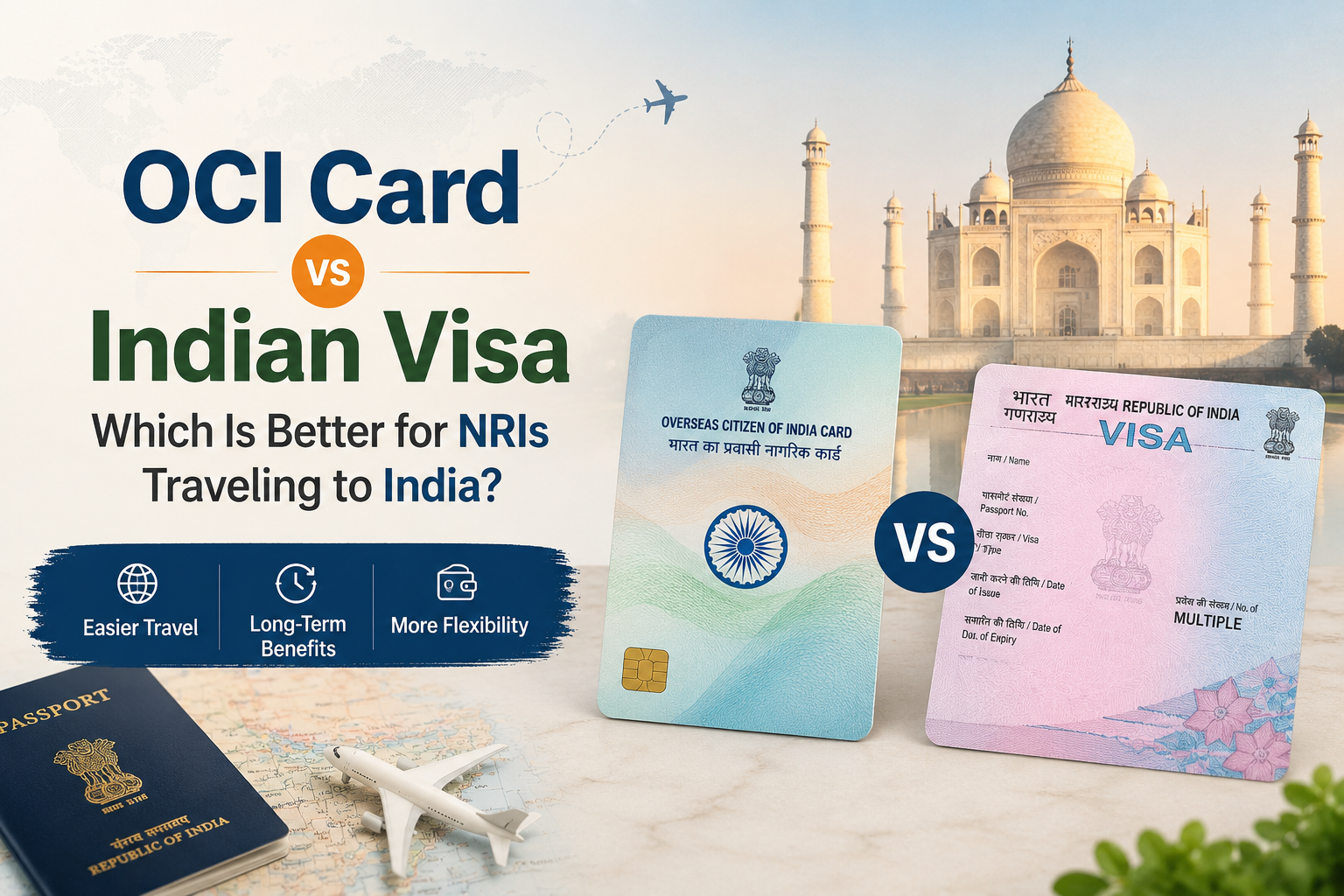
In 2025, India issued more than 9.2 million tourist visas/e-Visas, keeping “quick entry” options in high demand for NRIs and foreign passport holders (Ministry of Home Affairs, India, 2025). At the same time, thousands of OCI (Overseas Citizen of India) holders continue to benefit from long-term, multi-entry access—until a rule change, document mismatch, or airline check-in hiccup turns a simple trip into a stressful one.
If you’re comparing oci card vs indian visa nri, the best choice in 2026 depends on your travel frequency, passport status, family needs, and risk tolerance for last-minute changes. This guide breaks down OCI vs e-Visa India, costs, timelines, real-world scenarios, and the most common mistakes NRIs make—so you can choose the option that minimizes friction and maximizes flexibility.
What an OCI card really gives you (and what it doesn’t)
An OCI card is a long-term immigration status (not citizenship) that typically works best for NRIs/PIOs who travel to India repeatedly or want the convenience of multi-entry travel without reapplying each time. In practice, OCI is a “set it up once, use it for years” solution—especially valuable for family travel, emergencies, and frequent India visits.
Key OCI advantages for NRIs
Important OCI limitations to know in 2026
Indian visa options in 2026: e-Visa vs regular visa
For NRIs who don’t qualify for OCI—or who need a fast, trip-specific permission—Indian visas remain a practical route. The most commonly compared option today is OCI vs e-Visa India, because e-Visas are designed for speed and self-service.
When e-Visa is a strong fit
When regular visa/consular visa makes sense
Trend note for 2026: India continues to push digitization of traveler processing, but airlines still enforce strict “document match” rules at the counter. Even minor mismatches (middle names, hyphens, passport renewal not linked) can cause delays.
OCI card vs Indian visa NRI: side-by-side comparison table
Use the table below to decide based on frequency, effort, and risk. Costs and timelines vary by nationality, consulate/VFS partner, and season; treat these as decision criteria rather than fixed guarantees.
| Decision Factor |
OCI Card |
Indian e-Visa / Visa |
| Best for |
Frequent travelers, families, long-term India access |
Occasional trips, quick one-off travel |
| Entries |
Multiple entry (long-term) |
Depends on visa type (often limited by validity/entry rules) |
| Application effort |
Higher upfront (documentation, eligibility proof) |
Lower upfront (especially e-Visa); repeat per trip or period |
| Risk at check-in |
Moderate if passport/OCI details not aligned |
Moderate if visa printouts/data mismatch or approval delays |
| Long-term value |
High ROI for frequent flyers |
Good for low-frequency travel; higher total effort over time |
2026 realities: policy enforcement, digitization, and airline document checks
In 2026, the “best” option isn’t just about India’s entry rules—it’s also about airline compliance and operational realities at North American airports. According to IATA, timely and accurate passenger data is a key driver of smoother border processing, and airlines can be penalized for boarding non-compliant travelers (IATA Travel Centre guidance, 2025).
What’s changing in practice (May 2026)
Why this matters: OCI tends to reduce “approval timing” risk, while e-Visas can reduce “eligibility-documentation” burden—until you’re traveling within days and an approval or data correction becomes stressful.
Practical decision framework: choose based on your NRI travel profile
Here’s a practical way to decide without overthinking. For many NRIs, the optimal approach is: OCI if eligible and traveling regularly; otherwise, e-Visa for speed and simplicity.
Scenario-based recommendations
Cost and time “ROI” idea (simple rule)
If you expect 3–5 India trips in the next 3 years, OCI typically pays off in reduced reapplication time and lower risk of last-minute visa processing. If you expect 0–2 trips, e-Visa often remains the leaner choice.
Travel demand supports planning ahead:India remained one of the fastest-growing major aviation markets, with air passenger traffic continuing to trend upward through the mid-2020s (IATA, 2025). Higher demand usually means higher peak-season processing volume—so earlier action matters.
Common mistakes to avoid (and pro tips that prevent airport disasters)
Most NRI travel issues aren’t “denied entry” problems—they’re documentation alignmentand timingproblems. Fixing them early is the cheapest travel insurance you can buy.
Mistakes that cause check-in delays
Pro tips (high-impact, low effort)
MyFlyYatra advantage for NRIs:If disruptions hit (snowstorms, strikes, hurricanes), our team is available 9am–9pm EST, 7 days, and our Emergency Travel Centersupports urgent cases within 24 hours of departure: 1-888-413-5701. We aim to “get it right or make it right,” before, during, and after travel.
Conclusion: the best choice depends on frequency, eligibility, and risk tolerance
If you’re planning your next India trip—especially business class deals from the USA or Canada—MyFlyYatra can help you build the right itinerary, avoid documentation pitfalls, and stay protected during irregular operations. Visit or call our Emergency Travel Center: 1-888-413-5701(urgent cases within 24 hours of departure).
FAQs:
An OCI card is a long-term immigration status allowing repeated entry without reapplying for a visa each trip. An Indian visa (including e-Visa) is trip- or period-specific permission that usually requires reapplication based on validity and purpose.
For frequent travelers (typically 2+ India trips per year), OCI usually offers better long-term convenience and lower administrative effort. It also reduces last-minute “approval timing” stress compared to applying for a visa repeatedly.
If you already have OCI, it’s often the fastest because you’re not waiting for approval. If you don’t have OCI, e-Visa can be faster than consular visas, but processing times can vary—especially during peak travel months.
Often, you may need to use an appropriate visa option while OCI is pending, depending on your situation and eligibility. Confirm the latest guidance with the official government sources and your airline before booking non-refundable tickets.
Yes, children need their own OCI card or visa—there isn’t a “family OCI” that covers everyone. For family travel, aligning documents early is critical because one missing approval can disrupt the entire itinerary.
In many cases, you must ensure your OCI details and travel documents remain consistent with your current passport information. Even when rules allow travel, airlines may still require clarity and matching documentation at check-in.
No. OCI is not citizenship and does not provide an Indian passport or political rights. It is a long-term status intended to simplify entry and stay for eligible foreign nationals of Indian origin.
If a student qualifies and expects regular travel, OCI can reduce repeated application work over multiple years. If travel is occasional and eligibility documentation is burdensome, an e-Visa may be the more practical short-term choice.
Carry your passport, OCI card or visa approval (digital and printed), and a ticket that matches your passport name exactly. If you recently changed names or renewed a passport, bring supporting documents to prove continuity.
Choose itineraries with buffer time for connections and book with support that can re-accommodate you during disruptions. MyFlyYatra specializes in affordable business class flights and provides hands-on help before, during, and after travel via flights to india.