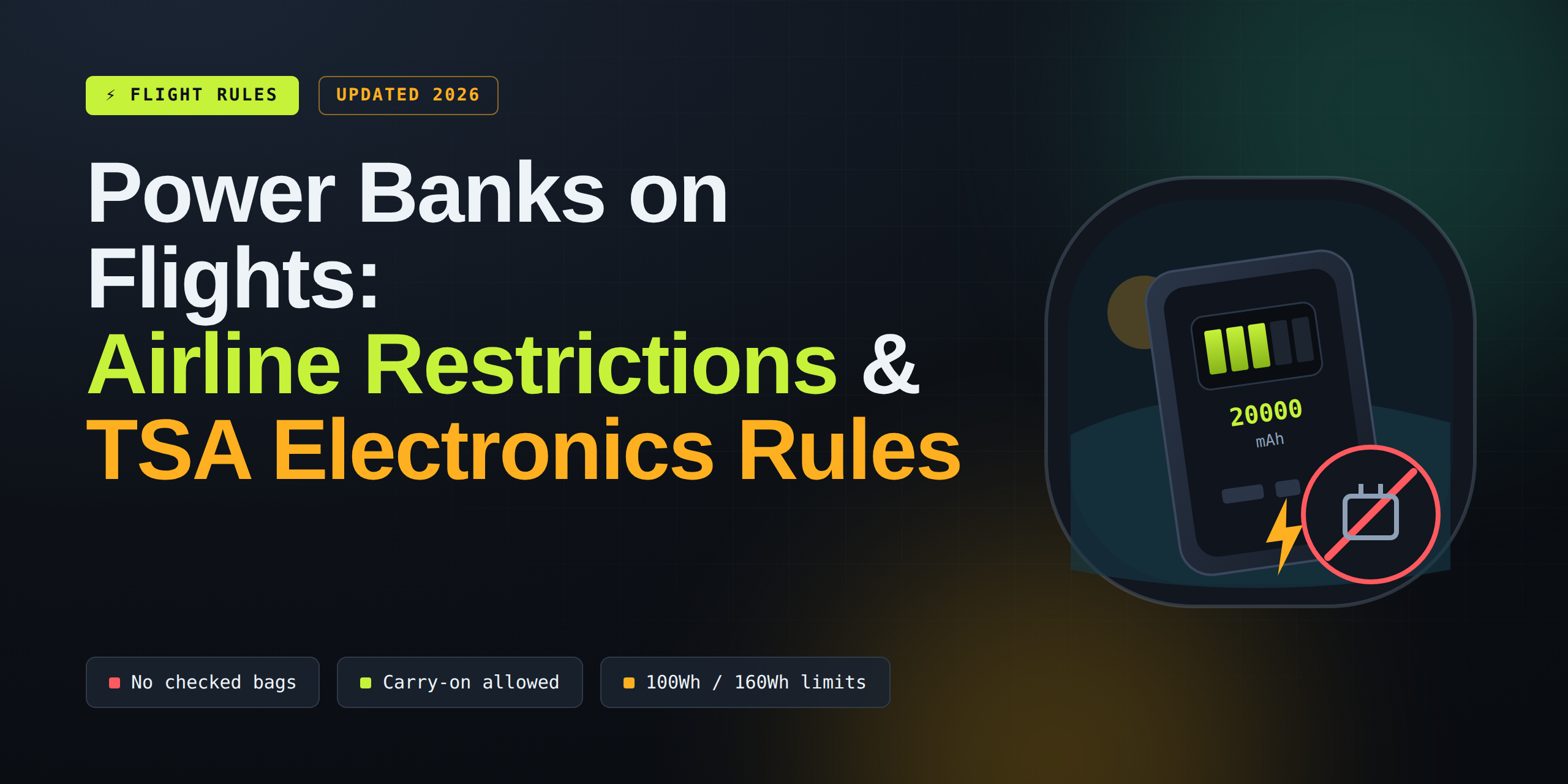
Power banks are one of the most commonly confiscated “everyday” travel items—not because they’re banned, but
because travelers miss the fine print: watt-hours (Wh), spare-battery rules, and airline-specific caps. In
the U.S., the TSA’s checkpoint guidance is clear that spare lithium batteries (including power banks) can’t
go in checked baggage, yet many passengers still pack them incorrectly and get pulled for secondary
screening. If you’re wondering whether a power bank allowed on flightsis still a “yes” in 2026, the answer
is: yes—if you follow Wh limits, protect terminals, and keep it in carry-on. This guide breaks down TSA
rules, key airline rules power bank limits, real-world airport scenarios, and a practical
checklist—especially useful for NRI travelers flying long-haul USA or Canada to India.
Why power banks are regulated (and why enforcement feels stricter in 2026)
Power banks contain lithium-ion cells, which can enter thermal runaway if damaged, short-circuited, or
exposed to manufacturing defects. That’s why aviation regulators treat them differently than most
electronics. The core risk isn’t normal use—it’s unprotected spare batteries in the cargo hold or terminals
touching metal objects.
Enforcement has tightened because lithium-battery incidents keep happening across aviation and consumer
products. The U.S. Federal Aviation Administration tracks battery-related events; its public incident
summaries show recurring smoke/fire events involving lithium batteries in baggage and cargo (FAA, 2024–2025
incident summaries). Meanwhile, the IATA lithium battery guidance continues to emphasize that spares must be
in carry-on and protected from short circuit (IATA, 2025).
What’s different in 2026 is not a sudden “ban,” but more consistent gate-agent and security enforcement, plus
more airline messaging at check-in and boarding. Travelers also carry more devices (phone + tablet + laptop
+ earbuds + watch), increasing the likelihood of “battery clutter” that triggers screening.
TSA rules in the U.S.: what’s allowed at the checkpoint
The TSA’s consumer guidance is the baseline for U.S. departures and connections. In practice, TSA focuses on
where the power bank is packed, whether it’s clearly labeled, and whether it’s protected from
short-circuiting.
Carry-on vs checked baggage (the rule most people get wrong)
Power banks must be in carry-on baggage and are not permitted in checked baggage under U.S. rules for spare
lithium batteries. TSA’s published guidance states that spare lithium batteries—including power banks—are
allowed in carry-on but prohibited in checked bags (TSA, 2025).
Screening expectations at TSA
Pro traveler tip (works well at busy airports like JFK/EWR/ORD/SFO):Put power banks in the same pouch as
charging cables. If TSA asks, you can present everything quickly and avoid holding up the line.
Airline rules power bank limits: watt-hours (Wh) explained simply
Airlines align broadly with international
standards: most allow power banks up to 100Whwithout approval;
100–160Wh may be allowed with airline approval; and over 160Wh is typically not allowed on passenger
aircraft. These thresholds mirror common international carriage guidance (IATA, 2025) and are widely
reflected in airline dangerous goods pages.
How to convert mAh to Wh (so you don’t guess)
Most power banks list capacity in mAh, but airlines enforce Wh. Use this:
Wh = (mAh × V) ÷ 1000
How many power banks can you bring?
Quantity limits vary by carrier. Many airlines allow a “reasonable personal quantity,” while some specify
maximum spares. Because airline rules power bank policies differ, check your operating carrier (the airline
flying the aircraft), not just the one you booked through.
2026 reality check: what’s changing and trending now
In 2026, there are three practical shifts affecting travelers:
Cabin connectivity and charging are growing across fleets. For example, global airline in-flight connectivity
penetration has continued to expand, with thousands of aircraft now equipped for passenger connectivity
(Statista, 2025). While connectivity isn’t the same as charging, the broader investment trend correlates
with more modern cabins and more consistent seat power on premium long-haul routes.
Practical takeaway for MyFlyYatra travelers: if you’re flying business class flights to India, you often have
reliable seat power—so a 10,000–20,000mAh bank is usually enough for transfers and backup.
Quick-reference limits table (TSA + common airline thresholds)
Because lounge contracts and operating concourses can change, the most reliable approach is to confirm access
using two independent sources the day before and the day of travel.
Practical tip for NRIs and family trip planners:If you’re traveling with parents or kids and need more
certainty, arrive early enough that you can pivot to an alternative (another lounge, a quieter gate area, or
a pre-booked meal in the terminal) if the lounge is at capacity.
Facilities you can expect: what most partner lounges at SFO offer
While amenities vary by lounge, SFO’s international lounges tend to cluster around a standard set of
features. Think of it as an “airport lounge baseline” optimized for pre-flight comfort rather than a
destination experience.
What to manage expectations about
Operational reality:In North America, TSA throughput has remained high; the TSA screened 858+ million
passengers in 2024(TSA, 2025). That volume influences lounge demand because more travelers arrive earlier to
buffer security risk.
Access options compared (and what usually works best)
If your ticket doesn’t include lounge access—or if the assigned lounge is full—having a “Plan B” matters.
Below is a practical comparison for sfo lounge India passengersflying Air India or connecting onward to
India.
| Category |
What it means |
Typical allowance (carry-on) |
Common traveler example |
| Up to 100Wh |
Standard consumer power banks |
Generally allowed; airline approval usually not required |
10,000–20,000mAh power banks (approximately 37–74Wh) |
| 101–160Wh |
High-capacity power banks |
May require airline approval; quantity restrictions often apply |
30,000mAh power bank (approximately 111Wh) |
| Over 160Wh |
Very high-capacity or specialty battery packs |
Typically prohibited on passenger aircraft |
Large generator-style battery packs |
| Checked baggage |
Power bank packed inside checked luggage |
Not allowed under TSA and most airline safety rules |
Power bank stored in a suitcase with clothes or toiletries |
Source alignment: TSA spare lithium battery guidance (TSA, 2025) and common airline thresholds aligned with
IATA consumer lithium battery carriage guidance (IATA, 2025).
Common mistakes to avoid (that trigger confiscation or delays)
If TSA or security asks to see capacity
Show the label with Wh/mAh. If it’s only mAh, show the manufacturer page or a photo of the spec sheet (saved
offline). If the bank is unmarked and you can’t prove capacity, expect a higher chance of refusal.
If your bag is gate-checked
Remove your power bank before handing over the bag. Gate agents may remind you, but don’t rely on it— you are
responsible. Keep the bank in your personal item.
If you’re connecting internationally (USA/Canada → Europe/Middle East → India)
Follow the strictest rule across your itinerary. Some airports and airlines apply tighter enforcement even
when global thresholds are similar. When in doubt, keep power banks 100 Wh and packed neatly in carry-on.
Conclusion: the safe, stress-free way to fly with a power bank
If you’re booking a long-haul itinerary (USA/Canada to India) and want help building a smooth, low-stress
travel plan—including smart connection timing and premium cabin value—MyFlyYatra can help. Explore flights
to india and book at myflyyatra.
Note: Policies can vary by airline and change over time. Always verify current limits on your operating
carrier’s website and TSA guidance before departure.
FAQs:
Yes, in most cases a power bank is allowed on flights in 2026, provided it is carried in your
carry-on baggage and falls within the airline's permitted watt-hour (Wh) limits.
Most airlines allow power banks up to 100Wh without special approval, although individual
carrier
policies may vary.
Always verify the latest requirements with your operating airline before travel.
No. Power banks are generally considered spare lithium batteries and are not permitted in
checked
baggage.
They should be packed in your carry-on luggage with terminals protected from accidental contact.
Airport security may remove improperly packed power banks from checked bags.
Most airlines routinely allow power banks up to 100Wh.
Devices between 100Wh and 160Wh may require airline approval before travel, while units
exceeding
160Wh are generally prohibited on passenger aircraft.
Many common 10,000mAh to 20,000mAh power banks fall below the 100Wh threshold.
The number of power banks permitted depends on airline policy and what is considered a
reasonable
personal quantity.
Carrying multiple power banks is usually acceptable when each device remains within approved
capacity limits.
If you plan to travel with several units, check the airline's specific dangerous goods policy.
Yes, security officers may inspect a power bank if its capacity appears unusually large or if
the
watt-hour rating is not clearly marked.
Unlabeled devices can result in additional screening and delays.
Choosing a reputable brand with visible capacity markings can help streamline the security
process.
In most cases, yes.
A typical 20,000mAh power bank using a 3.7V battery is approximately 74Wh, which falls within
the
standard airline allowance.
Travelers should still confirm the exact watt-hour rating printed on their specific model before
departure.
Generally, yes.
Passengers may use approved power banks during the flight unless restricted by cabin crew or
airline policy.
Avoid charging devices under blankets, pillows, or other materials that can trap heat.
If a power bank becomes excessively hot, damaged, or swollen, stop using it immediately and
notify
cabin crew.
Yes, power banks are generally allowed on international flights to India when carried in cabin
baggage and within the airline's approved capacity limits.
Since many international itineraries involve multiple carriers, travelers should review the
rules
of the operating airline for each segment of the journey.
Power banks between 100Wh and 160Wh often require prior airline approval.
Devices exceeding 160Wh are typically not permitted on passenger flights.
Without required authorization, passengers may be asked to surrender the device before boarding.
Obtaining written approval from the airline in advance is recommended for higher-capacity units.
Frequent travelers may benefit from purchasing a travel-friendly power bank with a clearly
labeled
capacity and modern charging standards such as USB-C Power Delivery.
Models between approximately 74Wh and 99Wh typically fit within the most common airline limits
while still providing substantial charging capacity for phones, tablets, and other portable
devices.