


Qantas A350 Project Sunrise: What the Sydney–New York Nonstop Means for Business & First Class Travelers
Search Cheap Flights
SAVE UP TO 40%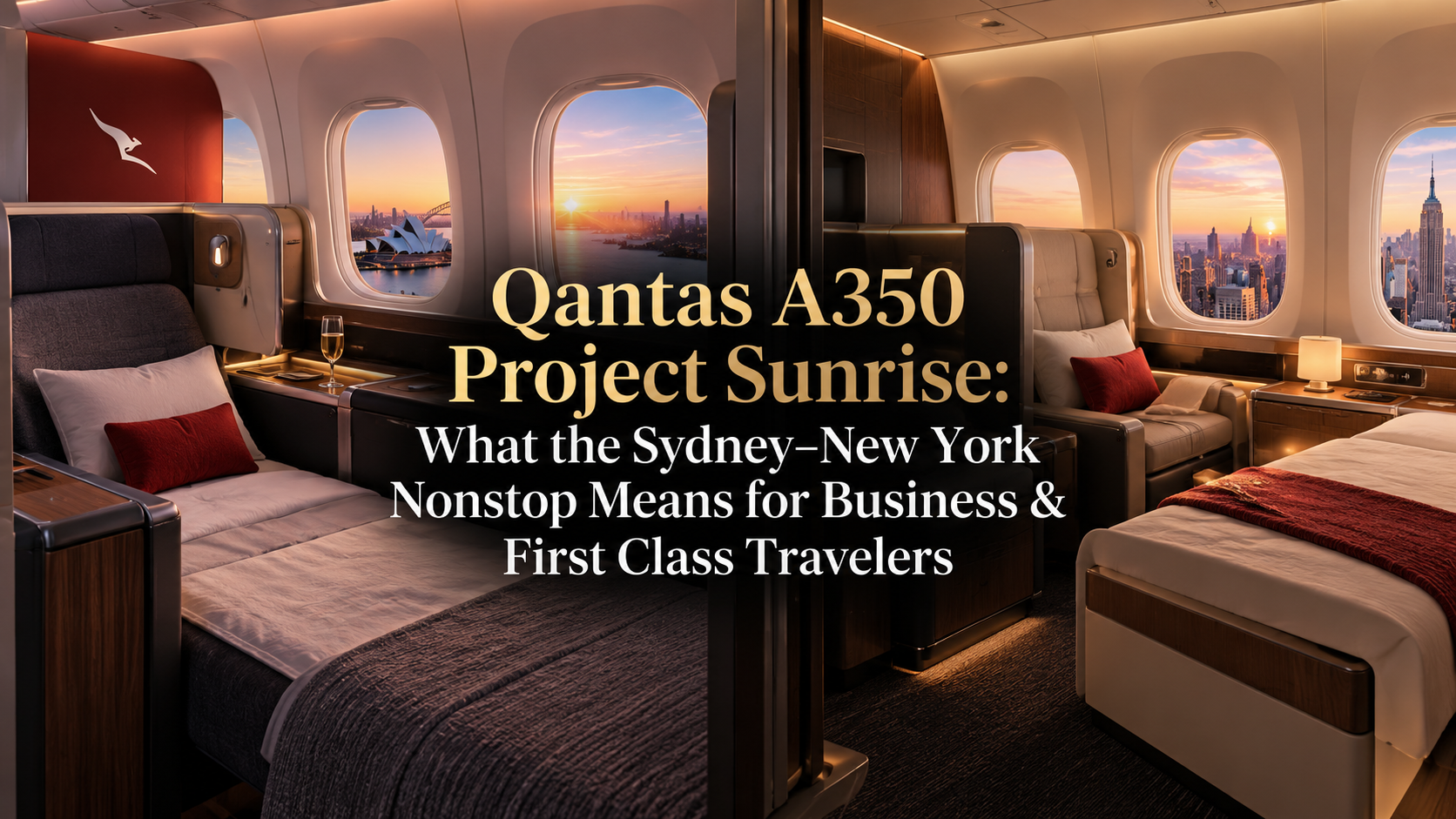
Flying between Sydney and New York already takes the better part of a day. Qantas currently operates the journey through Auckland, where passengers stop before continuing across the Pacific. Project Sunrise is designed to remove that stop completely.
For Business and First Class travelers, that means more than saving time. Qantas is building its Airbus A350-1000ULR around the demands of spending close to an entire day in the air, with private suites, lie-flat beds, free Wi-Fi, special lighting, flexible meal timing and a dedicated space for stretching and hydration.
Qantas' latest FY2026 roadmap places the Sydney–New York nonstop in 2028+, following the first Project Sunrise route between Sydney and London in October 2027. Qantas has not yet announced an exact New York launch date. Qantas says the new nonstop services could cut total point-to-point travel time by as much as four hours compared with one-stop journeys.
The important question, however, is not simply whether a 20-hour-plus nonstop sounds impressive. It is whether staying on one aircraft for that long is actually better than breaking up the trip—and whether Qantas' new Business and First Class cabins do enough to make it comfortable.
Here's what travelers should know.
What Is Qantas Project Sunrise, and What Changes for New York Travelers?
Project Sunrise is Qantas' plan to operate nonstop flights from Australia's east coast to destinations that currently require an intermediate stop, starting with London and New York.
Qantas ordered 12 Airbus A350-1000ULR aircraft for the program. The first aircraft, named Vega, is scheduled for delivery in April 2027. Sydney–London will be the first route, with daily nonstop service due to begin in October 2027 and tickets scheduled to go on sale in February 2027. Qantas' August 2026 investor presentation places Sydney–New York in the 2028+ stage of its roadmap, although an exact launch date has not yet been announced.
That distinction matters because older Project Sunrise articles often suggest the New York route will begin shortly after London in 2027. Based on Qantas' latest published roadmap, travelers should not plan around that earlier timeline.
Today, Qantas lists Sydney–New York as a route operating via Auckland. The Auckland–New York sector alone is about 16 hours and 15 minutes on QF3. Project Sunrise would remove the Auckland stop and turn Sydney–New York into a true nonstop journey.
For a Business Class traveler flying to an important meeting in New York, removing the connection means no second boarding process, no waiting during the stop and no need to interrupt a long sleep period simply because the aircraft has landed somewhere in between.
That convenience is the main promise of Project Sunrise.
Why the A350-1000ULR Is Different From a Normal Long-Haul Aircraft
Qantas isn't trying to fill the A350-1000ULR with as many passengers as possible.
The Project Sunrise aircraft will carry just 238 passengers:
| Cabin | Number of Seats |
|---|---|
| First Class | 6 suites |
| Business Class | 52 suites |
| Premium Economy | 40 seats |
| Economy | 140 seats |
| Total | 238 passengers |
More than 40% of the aircraft's seats are in premium cabins. Qantas describes the 238-seat layout as its lowest-density A350-1000 configuration, with the cabin specifically designed for ultra-long-haul flying.
Airbus has also adapted the aircraft for Project Sunrise. A recent Qantas fact sheet says the A350-1000ULR includes an additional 20,000-litre fuel tank and structural changes needed for these unusually long sectors.
For travelers, though, the fuel tank is not the interesting part.
The low-density layout is.
Putting only 238 passengers on an aircraft this large gives Qantas more room for premium suites, wider personal areas and the Wellbeing Zone. That becomes much more important when the flight isn't eight or ten hours, but potentially around 20 hours or more.
Inside Qantas A350 Business Class: What Do You Actually Get?
Qantas Project Sunrise Business Class will have 52 suites in a 1-2-1 layout, so every passenger gets direct aisle access.
The bigger change is privacy. For the first time in Qantas Business Class, every A350 suite will have a sliding door.
Here are the confirmed specifications:
| Qantas A350 Business Class Feature | Specification |
|---|---|
| Business suites | 52 |
| Layout | 1-2-1 |
| Suite width | 42 inches |
| Privacy wall | 47 inches |
| Seat width | 25 inches |
| Flat-bed length | 80 inches |
| Flat-bed width | 25 inches |
| Entertainment screen | 18 inches |
| Direct aisle access | Yes |
| Sliding privacy door | Yes |
| USB-A and USB-C | Yes |
| AC power | Yes |
| Wireless charging | Yes |
| Bluetooth audio | Yes |
The suite also includes a cushioned ottoman with storage underneath, a personal storage compartment with a mirror, a separate work or cocktail surface and an upholstered storage box.
Those details matter more on Project Sunrise than they would on a shorter flight.
Imagine you've eaten dinner, worked for three hours and now want seven or eight hours of uninterrupted sleep. A privacy door means you don't have passengers walking past an open seat all night. The extra storage means your phone, glasses, headphones and laptop don't need to stay scattered around the suite. When you wake up, you still have a separate surface available to work or eat without reorganizing everything around you.
The 80-inch bed sounds impressive, but it isn't actually the biggest upgrade.
Qantas already offers an 80-inch fully flat bed in Business Class on its Boeing 787 Dreamliner. The A350's real improvements are the wider seat, privacy door, larger screen, modern charging options, additional storage and a cabin designed from the start around ultra-long-haul travel.
Travelers planning a premium trip to Australia can also compare MyFlyYatra's business class flights to Australia to review different routes, airlines and connecting options before booking.
How Much Better Is Project Sunrise Business Class Than Qantas' Current 787 Business Class?
If you've already flown Qantas Business on a 787, don't expect the basic concept to feel completely unfamiliar.
Both products use a 1-2-1 layout. Both provide direct aisle access. Both turn into an 80-inch flat bed.
The improvements are in the details.
| Feature | Project Sunrise A350 Business | Current Qantas 787 Business |
|---|---|---|
| Layout | 1-2-1 | 1-2-1 |
| Flat-bed length | 80 inches | 80 inches |
| Seat width | 25 inches | 23–24 inches |
| Privacy door | Yes | No on current product |
| Entertainment screen | 18 inches | 16 inches |
| USB-C | Yes | Current product lists USB charging |
| Wireless charging | Yes | Not listed on current product |
| Direct aisle access | Yes | Yes |
| Extra work surface | Yes | More limited |
Qantas currently lists its 787 Business seat at 23–24 inches wide, with a 16-inch entertainment screen. The A350 increases the seat width to 25 inches, adds the sliding door and introduces a more complete mix of USB-C, wireless charging and dedicated storage.
So, no, the major story isn't that Project Sunrise finally gives Qantas passengers a flat bed. They already have one.
The better way to describe the upgrade is this: Qantas is taking a solid existing Business Class concept and making the personal space more private and practical for a much longer journey.
That difference may sound small on paper. After 15 or 18 hours onboard, it probably won't feel small.
Qantas A350 First Class vs Business Class: Is First Worth the Upgrade?
Project Sunrise First Class takes a different approach.
Instead of turning one seat into both your chair and bed, each of the six First Class suites has a separate 22-inch reclining armchair and an 80-inch bed.
The suite also has 57-inch-high walls, a sliding door, a full-length wardrobe, multiple storage areas and a 32-inch entertainment screen. There is enough room for two people to dine or sit together.
Here's how the two cabins compare.
| Feature | A350 Business | A350 First |
|---|---|---|
| Suites | 52 | 6 |
| Layout | 1-2-1 | 1-1-1 |
| Privacy door | Yes | Yes |
| Bed length | 80 inches | 80 inches |
| Separate bed and chair | No | Yes |
| Seat/armchair width | 25 inches | 22-inch separate armchair |
| Entertainment screen | 18 inches | 32 inches |
| Full-length wardrobe | No | Yes |
| Space to dine with another person | Limited | Yes |
| Direct aisle access | Yes | Yes |
The surprising part is that bed length alone doesn't separate First from Business. Both offer 80 inches.
First Class earns its advantage by giving the passenger distinct spaces.
You can work from the armchair while leaving the bed ready for sleep. You can wake up and have breakfast without turning your bed back into a normal seat. If you're traveling as a couple, one person can also join the other inside the suite for a meal.
For someone whose main goal is to sleep comfortably, arrive rested and have privacy, Business Class may already provide nearly everything needed.
First makes more sense when the extra personal space, separate bed, private wardrobe and ability to use the suite more like a small room have real value to you.
Until fares are released, however, it is too early to say whether First will represent good value compared with Business. Travelers considering the highest cabin can also compare MyFlyYatra's first class flights to Australia as Project Sunrise schedules and fares become available.
Sydney–New York Nonstop vs One Stop: Which Is Actually Better in Business Class?
A nonstop flight sounds automatically better. On a journey this long, the answer is more personal.
Qantas says Project Sunrise can reduce point-to-point travel time by up to four hours compared with a one-stop itinerary.
That is a meaningful saving. But a connection also gives you something a nonstop cannot: the chance to get off the aircraft.
| Consideration | Project Sunrise Nonstop | One-Stop Business Class |
|---|---|---|
| Total journey time | Potentially shorter | Usually longer |
| Connection required | No | Yes |
| Missed-connection risk | No | Possible |
| Sleep interruption | Lower | Higher |
| Mid-trip lounge visit | No | Possible |
| Opportunity to shower during journey | No | Possible with suitable lounge |
| Ability to walk around outside aircraft | No | Yes |
| Intermediate airport stop | None | Yes |
| Continuous time onboard | Very long | Split between flights |
Consider two travelers.
One passenger is flying from Sydney to New York for meetings and wants the shortest journey possible. They would rather sleep eight hours, work for part of the flight and arrive without dealing with another airport. Project Sunrise is a strong fit.
Another passenger struggles after 12 or 14 hours in the air. They value getting off the plane, walking through the terminal, taking a shower in a lounge and mentally resetting before the next flight. For them, a well-planned one-stop Business Class itinerary may still be more comfortable—even if it takes longer.
The useful question isn't simply, “Is nonstop better?”
It is: Would you rather save several hours and avoid a connection, or break an extremely long journey into two parts?
There is no universal answer.
Can Qantas Really Reduce Jet Lag on a 20+ Hour Flight?
This is where Project Sunrise becomes more interesting than a normal cabin upgrade.
Qantas has worked with researchers at the University of Sydney's Charles Perkins Centre on sleep, light exposure, meal timing, movement and circadian adjustment.
Instead of treating food, cabin lighting and sleep as separate parts of the service, Project Sunrise is attempting to coordinate them around the time zone passengers are flying toward.
Circadian Lighting Is More Than Mood Lighting
The A350 will use 12 specially developed lighting scenes, including modes called Awake, Sunset and Sunrise.
The University of Sydney says the lighting design followed more than 150 hours of testing in an Airbus A350 cabin mock-up. Researchers looked at wavelengths that affect the body's internal clock and helped develop lighting sequences intended to support adjustment toward destination time.
For example, the Awake setting uses more blue-enriched light to encourage alertness. Sunset gradually transitions the cabin toward darkness, while Sunrise moves passengers back toward daytime conditions.
That doesn't mean a light setting can magically remove jet lag.
It means Qantas is trying to control one of the signals your body uses to decide whether it should be awake or asleep.
What Did the Project Sunrise Test Flights Find?
Qantas and the Charles Perkins Centre tested parts of the concept during three research flights in 2019 from New York and London to Sydney.
Twenty-three passengers took part.
The intervention combined adjusted cabin lighting, planned meal timing, recommended sleep periods and physical activity. Preliminary findings reported longer estimated sleep during dark periods, better sleep quality, improved cognitive performance and lower self-reported jet lag after arrival.
There is an important limitation.
The researchers themselves say the results were promising but not conclusive. The study was small, and the findings were not peer-reviewed.
So travelers shouldn't expect Project Sunrise to make a 20-hour journey feel like a two-hour flight.
The more reasonable expectation is that better timing of light, food, sleep and movement may help your body handle the time-zone change more effectively.
What Is the Project Sunrise Wellbeing Zone?
Even in a Business Class flat bed, sitting or lying in roughly the same area for most of a 20-hour flight isn't ideal.
Qantas' answer is a dedicated Wellbeing Zone located between Premium Economy and Economy.
The area will have integrated stretch handles, guided movement exercises on a screen, a hydration station and refreshments. It is intended to give passengers somewhere to stand, stretch and move without simply walking repeatedly up and down the aisle.
Business Class passengers may wonder why they need it when they already have plenty of personal space.
Because a lie-flat bed solves the sleep problem. It doesn't solve the movement problem.
Imagine waking after a six-hour sleep block. Instead of sitting immediately back down to watch a movie for three more hours, you can leave the suite, stretch properly, drink some water and move around before returning.
That becomes much more useful as total flight time increases.
Can You Actually Work on a Project Sunrise Business Class Flight?
For business travelers, the answer should be yes—although real-world performance won't be known until the aircraft enters service.
That will also be a noticeable change from today's New York service. Qantas currently notes that QF3/QF4 on the Boeing 787 are not Wi-Fi connected, while the Project Sunrise A350 is planned to offer fast, free Wi-Fi across all cabins.
The privacy door could be just as valuable as the technology.
If you're preparing a presentation, answering emails or joining online meetings during part of the journey, being able to close the suite gives you a more controlled workspace.
A realistic schedule for a New York-bound business traveler might look like this: work for the first few hours, eat when it suits the planned sleep schedule, close the door and sleep, wake for a movement break, then spend the final part of the journey working and preparing for arrival.
That is a very different experience from trying to work continuously for 15 hours.
One caution: don't choose the flight assuming the Wi-Fi will support every type of work. Qantas has confirmed the connectivity plan, but speeds and reliability on an actual Project Sunrise service cannot be judged until passengers start using it.
How Meals, Sleep and Cabin Lighting Will Work Together
Food on an ultra-long flight isn't just about whether the menu looks impressive.
When you eat can affect when your body thinks it should sleep.
Qantas says A350 passengers will be able to pre-select meals before departure, while its latest Project Sunrise Business Class plans include flexible dining that allows meals to be timed around scientifically informed windows.
That could be more useful than another elaborate multi-course service.
Suppose your body thinks it is dinner time, but your destination is already moving toward morning. Eating a large meal, watching two movies and then trying to sleep whenever you finally feel tired may make adjusting harder.
Project Sunrise is designed to make the sequence more deliberate.
Lighting, meal service, entertainment and rest periods will be coordinated so passengers can better understand when it makes sense to eat, stay awake or sleep. Qantas also says its new entertainment system will work with those cabin schedules to help passengers plan the journey.
You can still choose what works for you. The difference is that the cabin will give you more guidance.
When Can You Book Qantas Project Sunrise to New York?
Not yet.
As of September 2026, the first Qantas A350-1000ULR is scheduled for delivery in April 2027.
Sydney–London will launch first in October 2027, with tickets due to go on sale in February 2027. Sydney–New York is confirmed as part of the Project Sunrise program, while Qantas' latest investor roadmap places the route in 2028+. An exact start date has not yet been announced.
Qantas has not yet published the information New York travelers will care most about: exact first-flight date, final schedule, Business Class fares, First Class fares or award-seat availability.
Until those details are released, treat any exact Sydney–New York Project Sunrise prices or launch dates published elsewhere as estimates unless they come from Qantas.
When bookings do open, don't look only at the headline fare.
Compare the fare rules, flexibility, aircraft assignment, mileage earning, award availability and the price gap between Business and First. A First Class fare can look attractive until you compare how much more you're paying for a separate bed and extra suite space over an already private Business Class product.
Who Should Choose Project Sunrise Business Class?
Project Sunrise Business Class makes the strongest case for travelers who place a high value on time, sleep and avoiding connections.
A consultant flying from Sydney to New York and heading into meetings soon after arrival may value four saved hours more than a lounge break in Auckland.
A leisure traveler who sleeps well on planes may also prefer getting into one Business Class suite, closing the door and staying there until New York rather than packing everything up during an intermediate stop.
It may be less attractive to someone who becomes restless on very long flights or likes breaking a trip with a proper walk, lounge visit and shower.
Price will also matter.
A nonstop Business Class fare doesn't automatically become the best choice if another high-quality airline offers a much cheaper one-stop itinerary. Travelers can also compare business class flights to Sydney when looking at different airlines, connection points and premium-cabin options. Total journey time, sleep, fare difference and the connection can matter as much as the cabin name.
Final Verdict: Does Project Sunrise Change Ultra-Long-Haul Business Class?
Yes—but not simply because Qantas has built a nicer seat.
The A350 Business suite is clearly an upgrade over the airline's current product. It is wider, more private, better equipped for charging and storage, and finally adds a sliding door.
First Class goes much further by giving just six passengers a separate bed, armchair, wardrobe and genuinely room-like personal space.
But the most interesting part of Project Sunrise is what happens outside the seat.
Qantas is trying to make lighting, meals, sleep, movement, entertainment and connectivity work together around one extremely long nonstop journey. That is what separates Project Sunrise from simply putting a premium cabin on a long flight.
For many Business Class travelers, avoiding the connection and potentially saving several hours will be enough to make Sydney–New York nonstop attractive.
Others may decide that 20-plus hours on one aircraft is simply too long and prefer a comfortable stop along the way.
Neither choice is wrong.
The better option depends on how well you sleep onboard, how quickly you need to arrive, what the final fares look like and how much you personally value an uninterrupted journey.
With Sydney–New York currently placed in Qantas' 2028+ roadmap, travelers still have time to compare their options before the final schedule and fares are announced. Once fares and schedules are released, MyFlyYatra can help compare Business Class and First Class flight options to find the combination of cabin, routing, schedule and price that makes the most sense for your trip.
Frequently Asked Questions
Sydney–New York is a confirmed Project Sunrise route, but it has not started operating yet. Sydney–London will launch first in October 2027. Qantas' latest FY2026 investor roadmap places Sydney–New York in 2028+, although an exact launch date has not yet been announced.
Qantas has not yet published the final commercial schedule for the nonstop Sydney–New York service. It will be an ultra-long-haul flight around the 20-hour range, but actual block time will depend on routing, winds and operating conditions. Qantas says Project Sunrise routes could save up to four hours compared with current one-stop journeys.
Yes. Each of the 52 Project Sunrise Business Class suites will have a sliding privacy door. This will be the first Qantas Business Class product to offer a door.
Yes. Each Business suite converts into an 80-inch-long and 25-inch-wide flat bed. The seat itself is also 25 inches wide.
The A350-1000ULR will have 52 Business Class suites arranged in a 1-2-1 configuration. Every passenger will have direct aisle access.
Yes. The aircraft will have only six enclosed First Class suites in a 1-1-1 configuration. Each suite has a separate 80-inch bed, a 22-inch reclining armchair, a full-length wardrobe and a 32-inch entertainment screen.
Qantas says the Project Sunrise A350 will offer fast, free Wi-Fi in all cabins, along with Bluetooth audio connectivity. Actual speeds and reliability will only be clear once the aircraft enters regular commercial service.
The Wellbeing Zone is a dedicated area where passengers can stand, stretch, hydrate and follow guided movement exercises. It includes integrated stretch handles, an on-screen movement program, a hydration station and refreshments.
What Customers Say About Us
We do our best to provide you the best experience ever
