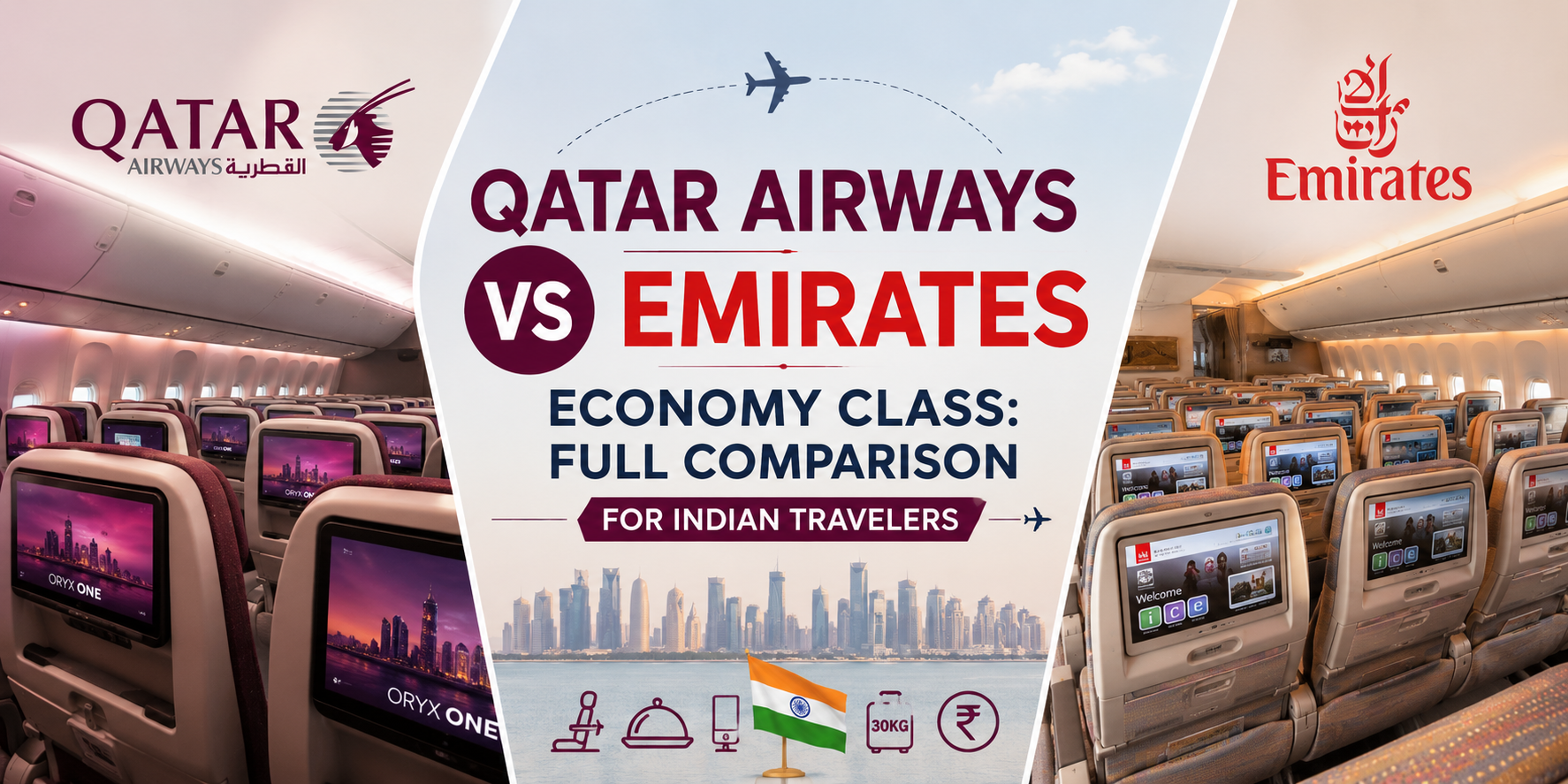
Economy class is getting “premium-ized” in 2026—but only if you pick the right airline for your route and traveler profile. With airfare prices still volatile post-pandemic and demand remaining high on India–Gulf–North America/Europe corridors, choosing between Qatar Airways and Emirates can easily swing your trip comfort (and total cost) by hundreds of dollars.
If you’re researching qatar airways vs emirates economy for an India trip—whether you’re an NRI flying from the USA or Canada to India, a student heading home for holidays, or a family planner optimizing baggage and connections—this guide breaks down what actually matters: seats, food, reliability, baggage, transit experience, loyalty value, and 2026 trends. You’ll also get practical “when to choose what” scenarios and a mistake-proof checklist.
Quick verdict: who wins for which Indian traveler?
There’s no universal winner in a Qatar vs Emirates review because the best choice depends on your departure city, tolerance for long layovers, baggage needs, and what you value more: ultra-smooth connections or big-airport convenience.
2026 market context: why this comparison matters more now
In 2026, the India–Middle East–North America/Europe network remains one of the world’s most competitive long-haul battlegrounds. That’s good news for Indian travelers: more capacity typically means more schedule options and better chances of sale fares—especially in shoulder seasons.
At the same time, traveler expectations are rising. According to IATA (2025), global passenger demand (RPK) grew ~10% year-over-year in 2024, indicating continued high load factors into 2025–2026 and more pricing pressure during peak periods. Meanwhile, Airports Council International (ACI) projected continued recovery and growth momentum through mid-decade, with global passengers expected to exceed 9 billion in 2025(ACI, 2024), which has kept hubs like DXB and DOH extremely busy in peak windows.
Practical implication: connection quality and disruption handling matter more than ever. A “slightly cheaper” fare can become expensive if misconnects trigger hotel nights, lost workdays, or last-minute re-ticketing.
Seat comfort & onboard experience: what you’ll actually feel for 8–16 hours
Legroom, seat width, and aircraft variability
Both airlines operate mixed fleets, so your comfort can vary meaningfully by aircraft type. Emirates Economy on the A380 is often perceived as more spacious and quieter than some older 777 configurations; Qatar’s A350/787 cabins are frequently praised for modern humidity/pressurization feel, which can reduce “long-haul fatigue” for some travelers.
As a benchmark, Skytrax’s 2025 World Airline Awards placed Qatar Airways as World’s Best Airline and also ranked it highly across service categories (Skytrax, 2025). While awards aren’t a guarantee of your exact seat, they reflect broad passenger sentiment at scale.
Food, service cadence, and hydration
On India-bound routes, both carriers cater heavily to Indian preferences (veg, Jain-style options on some routes with pre-order, and regional flavors). The biggest difference is usually service pacing: Qatar tends to run a slightly more “structured” service flow, while Emirates often leans into a more “high-volume” rhythm on busy Dubai banks.
Pro tip: If you’re sensitive to jet lag, prioritize flights that align with sleeping windows and pre-select meals (where available). Better sleep beats slightly better food.
Connections: Doha (DOH) vs Dubai (DXB) for India itineraries
For most Indian travelers flying internationally on these carriers, the hub experience is half the journey. Dubai is massive and extremely well connected; Doha is newer, compact-feeling, and often easier to navigate quickly.
Connection risk and misconnect prevention
Short layovers can be a blessing—until they aren’t. DOT consumer data consistently shows that delays can compound across complex itineraries; while DOT reporting is U.S.-carrier focused, the operational principle applies: tighter turns increase misconnect sensitivity. Where possible, aim for 2–3 hours on self-protection itineraries (especially with kids/elderly).
Family and elderly traveler considerations
Baggage, fees, and total trip cost: where “cheap” becomes expensive
Fare comparisons go wrong when travelers compare base price only. The real number is: ticket + baggage + seat selection + change fees + transit costs.
According to Idea Works Company’s 2024 ancillary revenue report, airlines globally generated over $100B in ancillary revenue (Idea WorksCompany, 2024), which shows how aggressively fees can shape your final cost—even in economy.
| Category |
Qatar Airways Economy (Typical) |
Emirates Economy (Typical) |
| Best for |
Efficient connections, consistent service |
High frequency via DXB, strong IFE |
| Key cost watch-outs |
Seat selection fees on some fares; stricter cheapest-fare conditions |
Seat selection fees on some fares; DXB peak-time pricing |
| Baggage strategy |
Compare piece vs weight concept by route; students should price extra bag upfront |
Same—route rules matter; prepay bags online where cheaper |
| Connection comfort |
Often smoother transfers at DOH |
DXB can be longer walks but more amenities |
Actionable tip: Before booking, screenshot or save the fare rules (changes/cancellations) and baggage allowance. If you’re traveling with gifts to India, price the itinerary assuming +1 checked bag and compare totals.
Loyalty value in 2026: Avios (Qatar) vs Skywards (Emirates)
For NRIs and frequent flyers, points can tilt the decision—especially if you’re mixing domestic legs in North America with international segments to India.
Benchmark reality check: redemption “sweet spots” are shrinking across the industry as dynamic pricing expands. McKinsey noted that airline loyalty economics have been shifting as programs modernize and optimize revenue (McKinsey, 2024). In 2026, the best practice is to earn where you fly most and redeem strategically (off-peak, flexible dates, mixed-cabin where allowed).
Pro tips & common mistakes to avoid (especially for India trips)
Which should you book in 2026? Real-world scenarios
Scenario A: USA/Canada-based NRI flying to Delhi/Mumbai for a wedding (fixed dates).Choose the itinerary with the most reliable connection window and best rebooking protection (often the carrier with more viable same-day alternatives on your corridor). If prices are close, prioritize less connection stress over marginal savings.
Scenario B: Student traveling with 2 bags + gifts. Price both airlines with the exact baggage you need. Often, the winner is the one with cheaper pre-paid extra bag and friendlier change rules in the lowest fare family.
Scenario C: Family with kids going to a tier-2 Indian city (e.g., BLR/AMD/CCU via hub).Pick the carrier with the simplest onward connection and the best arrival time. Also consider whether your layover allows meal breaks and bathroom resets without rushing.
Conclusion: the smart way to choose (and book) in 2026
If you want a fast, traveler-specific recommendation for your exact dates and Indian destination—especially if you’re balancing baggage, budget, and comfort—book with MyFlyYatra at and explore flights to india. We’ll help you get it right, and if things go sideways due to weather, strikes, or snowstorms, we’re here to get it right or make it right.
FAQs:
It depends on your route and priorities. Qatar often wins on transfer smoothness at Doha and perceived service consistency, while Emirates often wins on frequency via Dubai and entertainment. Compare aircraft type, layover duration, and total trip cost (including baggage) before deciding.
Pricing fluctuates heavily by season and departure city, so there’s no permanent winner. The “cheaper” ticket can become costlier after baggage, seat fees, and change rules. Always compare the all-in total for the same dates and baggage needs.
Doha (DOH) is often easier for quick, low-stress transfers, while Dubai (DXB) offers massive flight frequency and amenities. If you’re traveling with elders or kids, prioritize the hub with the most comfortable layover time and simplest gate transfers.
Legroom varies by aircraft and seat row more than by brand. Check the aircraft type on your booking screen and use a seat map tool to compare pitch and layout before selecting seats. If you’re tall, paying for extra-legroom rows can be the best ROI.
Many travelers prefer the A380 due to cabin spaciousness and quieter feel, but configuration matters. If comfort is a top priority, try to pick flights operated by the A380 when available on your route. Always verify aircraft type because swaps can happen.
Aim for a 2–3 hour layover if you’re traveling with family, checked bags, or during peak seasons. Avoid the tightest legal connection unless you have strong flexibility and carry-on-only luggage. Keep essential items in your cabin bag in case of disruptions.
Yes—both carriers typically offer Indian-friendly meal options on many routes. The safest approach is to request special meals at booking or well before departure, especially during peak travel periods. Carry snacks if you have strict dietary needs.
Neither is universally better—baggage rules depend on route (piece vs weight concept) and fare brand. Students should compare the pre-paid extra baggage cost and change rules upfront. Often, the winner is the itinerary with the lowest total after adding one extra checked bag.
Look at schedule frequency on your specific corridor and the fare conditions. Emirates can be strong on high-frequency DXB banks; Qatar can be strong with streamlined connections through DOH. If your dates are risky, consider paying slightly more for a fare with lower change penalties.
MyFlyYatra can compare routing, connection windows, and total trip cost (including baggage) and help you avoid common pitfalls that lead to missed connections or expensive changes. If anything goes wrong, support is available 9 a.m. to 9 p.m. (EST), 7 days, plus an Emergency Travel Center within 24 hours of departure or while traveling at 1-888-413-5701.