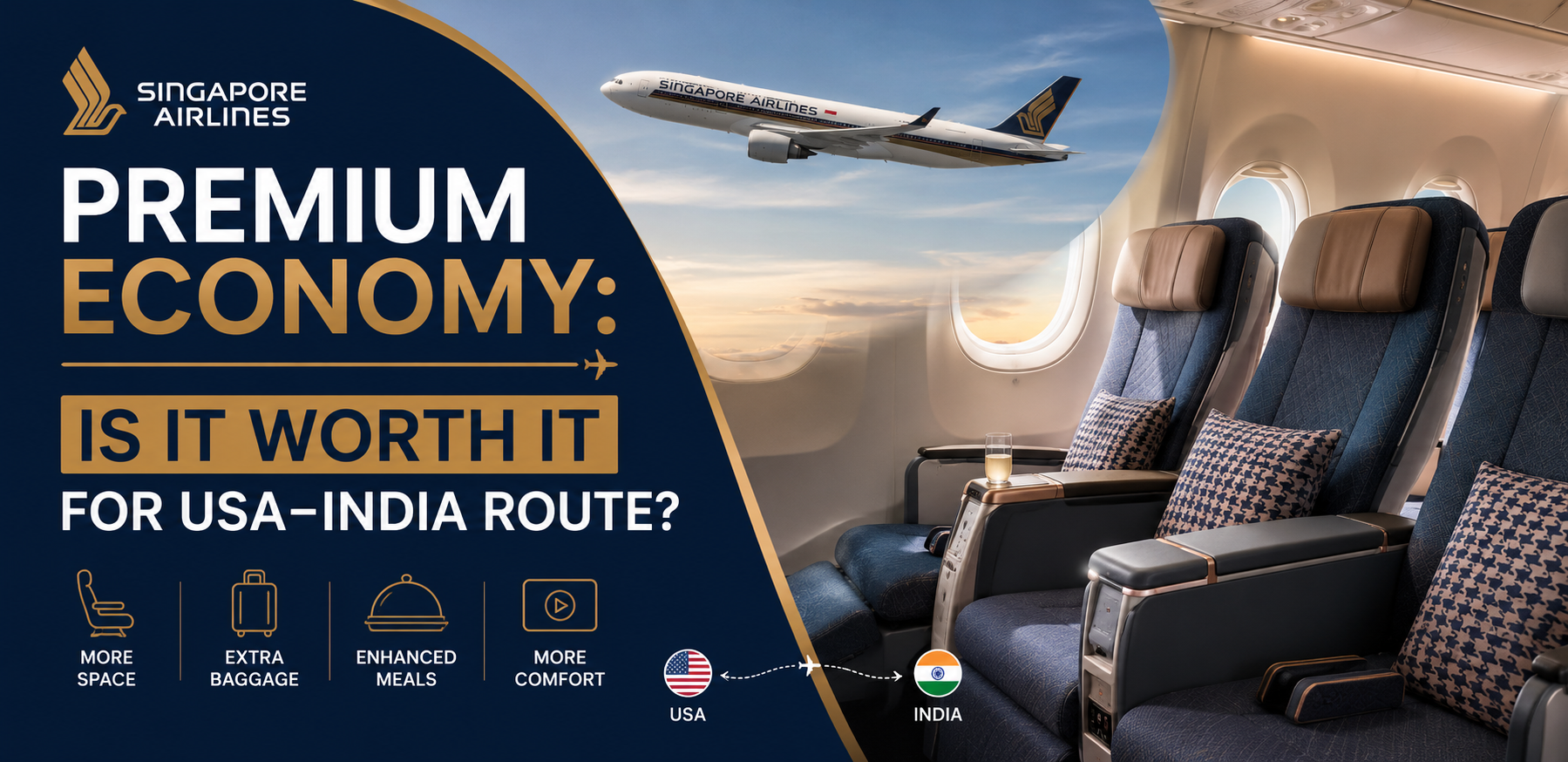
On ultra-long trips like USA–India, comfort isn’t a luxury—it’s a performance strategy.A 15–22 hour travel day (often with a connection) can mean arriving ready for work, family, or exams—or losing 1–2 days to jet lag and back pain. If you’re comparing cabins, Singapore Airlines Premium Economy India USA is one of the most searched “middle-ground” options in 2026 because it promises a meaningful step up from Economy without Business Class pricing.
In this guide, you’ll get a practical, expert breakdown of what you really gain (seat, service, baggage, and ground experience), what you don’t, how it compares with other choices, and when the upgrade is objectively worth paying for—especially for NRIs in the USA and Canada who fly to India often.
What “Premium Economy” really means on Singapore Airlines (and what it doesn’t)
Premium Economy is best understood as a seat-and-space upgrade with selective service enhancements, not a “light Business Class.” Singapore Airlines Premium Economy generally offers a wider seat, more pitch, and better recline than Economy, plus cabin zoning that tends to feel calmer on long sectors.
Core on-board differences that matter on USA–India
What Premium Economy does NOT solve
Seat, sleep, and jet lag: the upgrade ROI for long-haul travelers
The practical question isn’t “Is Premium Economy good?” It’s: Does it reduce travel fatigue enough to justify the premium? On USA–India routings via Singapore, you’re usually dealing with two long segments, which magnifies the value of extra space.
Why comfort upgrades matter more in 2026
Airlines have continued densifying cabins to manage costs, and many travelers report Economy feeling tighter than it did pre-2020. Meanwhile, health-aware travel has become mainstream: sleep, hydration, and reduced stress are now viewed as productivity inputs—especially for high-income professionals.
There’s also a measurable macro trend: premium leisure and “bleisure” demand remains elevated. IATA reported that global passenger demand (RPKs) grew 11.6%in 2024 vs 2023, showing continued strength in long-haul travel (IATA, 2025). In parallel, Airlines for America reported the U.S. airline industry moved a record ~1.0 billion passengers in 2024, reinforcing how crowded peak travel windows can be (Airlines for America, 2025).
Actionable takeaway:If you’re flying during peak periods (May–Aug, mid-Dec to mid-Jan), the cabin experience gap between Economy and Premium Economy can widen simply because flights are fuller and overhead bin competition is intense.
Singapore Airlines review India: route experience via Singapore (SIN)
A “Singapore Airlines review India” for USA-based travelers is really a review of the connection experience through Changi (SIN)plus two long flights. Changi remains one of the world’s most efficient hubs, and operationally it’s a strong midpoint for routing to multiple Indian metros.
Connection planning: the hidden value lever
Pro tip for NRIs: If you’re traveling with elders, call your booking partner to add wheelchair/Special Assistance well in advance. It reduces stress at SIN and can materially improve the end-to-end trip.
Price vs value: when Premium Economy is worth paying for (with benchmarks)
Premium Economy value hinges on the price gap versus Economy and your personal “sleep requirement.” As a rule of thumb in 2026, Premium Economy tends to be worth it when the upgrade cost is cheaper than the “cost of recovery” (lost workday, hotel day-use, medical discomfort, or burnout).
Inflation has cooled compared to 2022–2023, but travel pricing remains dynamic. The UNWTO highlighted that international tourism has broadly returned to near pre-pandemic levels, keeping pressure on long-haul fares during peak periods (UNWTO, 2024). Also, U.S. DOT data continues to show cancellations and delays remain a non-trivial factor on complex itineraries, which increases the value of flexible tickets and reliable rebooking support (U.S. Department of Transportation, 2025).
| Decision factor |
Economy |
Premium Economy |
Best for |
| Sleep quality potential |
Low–medium (tight pitch, less recline) |
Medium (more space, better recline) |
Professionals, students who need to function next day |
| Comfort over 2 long segments |
More fatigue accumulation |
Lower fatigue accumulation |
Families, older travelers, frequent flyers |
| Upgrade price tolerance (rule of thumb) |
Base fare |
Worth it when upgrade is ~15–35% over Economy on total trip |
Value seekers who can’t justify Business |
| Ground benefits (lounge/priority) |
Limited |
Some priority elements on certain fares/routes; lounge often extra |
Travelers optimizing airport stress |
Practical rule:If Premium Economy is within ~15–35%of Economy on your total itinerary cost, it’s usually a rational buy for USA–India. If it’s 50–80% more, you’re often better off either staying in Economy and investing in comfort tools—or jumping to discounted Business Class if a deal is close.
What changed in 2026: trends impacting Premium Economy decisions
In 2026, travelers are making cabin choices based on three shifts: (1) higher premium-cabin demand, (2) more dynamic pricing, and (3) disruption planning. Premium Economy is increasingly used as a “strategic compromise”—especially by corporates that tightened travel policies but still need employees functional on arrival.
Trends to watch this year
MyFlyYatra angle (what matters in real life):If weather, strikes, or misconnects happen, having a team available 9am–9pm (EST), 7 daysand an Emergency Travel Center (1-888-413-5701)within 24 hours of departure can be the difference between “stuck for 2 days” and “rebooked quickly.”
Pro tips and common mistakes to avoid when booking Premium Economy
Common mistakes to avoid
Pro tips (high-impact)
Conclusion: the 2026 verdict for USA–India flyers
If you’re deciding between Economy, Premium Economy, and discounted Business Class for your next USA–India trip via Singapore, MyFlyYatra can help you compare options with real-world tradeoffs—comfort, timing, and price—so you don’t overpay or underbuy. Explore premium airfare options or call our team (9am–9pm EST, 7 days). For urgent travel issues within 24 hours of departure or while traveling, contact our Emergency Travel Center: 1-888-413-5701.
FAQs:
It’s worth it when the price premium is moderate and you’ll benefit from extra space on two long segments. For professionals, older travelers, and students needing to function quickly after landing, the fatigue reduction can justify the cost.
The biggest difference is seat comfort: more width, pitch, and recline in Premium Economy. You may also see upgraded dining/amenities, but you still won’t get lie-flat sleep or guaranteed lounge access.
Usually not by default; lounge access depends on your frequent-flyer status, ticket type, or paid lounge options where available. Always confirm the specific fare inclusions before booking.
For many travelers, yes—especially if you value a strong hub connection through Singapore (SIN) and consistent service. The key is choosing connection times that match your stamina and onward travel plans in India.
A practical benchmark is paying roughly 15–35%more than Economy on the total itinerary. If the premium is significantly higher, compare against discounted Business Class deals or optimize Economy with better timing and comfort tools.
If your budget allows, it can be a smart upgrade because it reduces fatigue and makes long segments more manageable. For families with elders or small kids, the comfort and calmer cabin environment can improve the entire trip.
It can be a good stepping stone, but it won’t replicate Business Class sleep. If your top priority is arriving fully rested, Business Class still wins decisively.
Be flexible with travel dates, avoid peak weekends, and compare total trip value (timing, layover length, baggage, change rules). Booking with a specialist platform that monitors premium fares can also uncover better pricing than DIY searching.
If your itinerary is on one ticket, the airline typically rebooks you to the next available option. For complex disruptions (weather, strikes), having an agency support team can speed up rebooking and reduce out-of-pocket surprises.
If the Premium Economy price gap is small, Premium Economy usually offers a bigger comfort jump than just extra-legroom Economy seats. If the gap is large, extra-legroom + smart timing can be the better value.