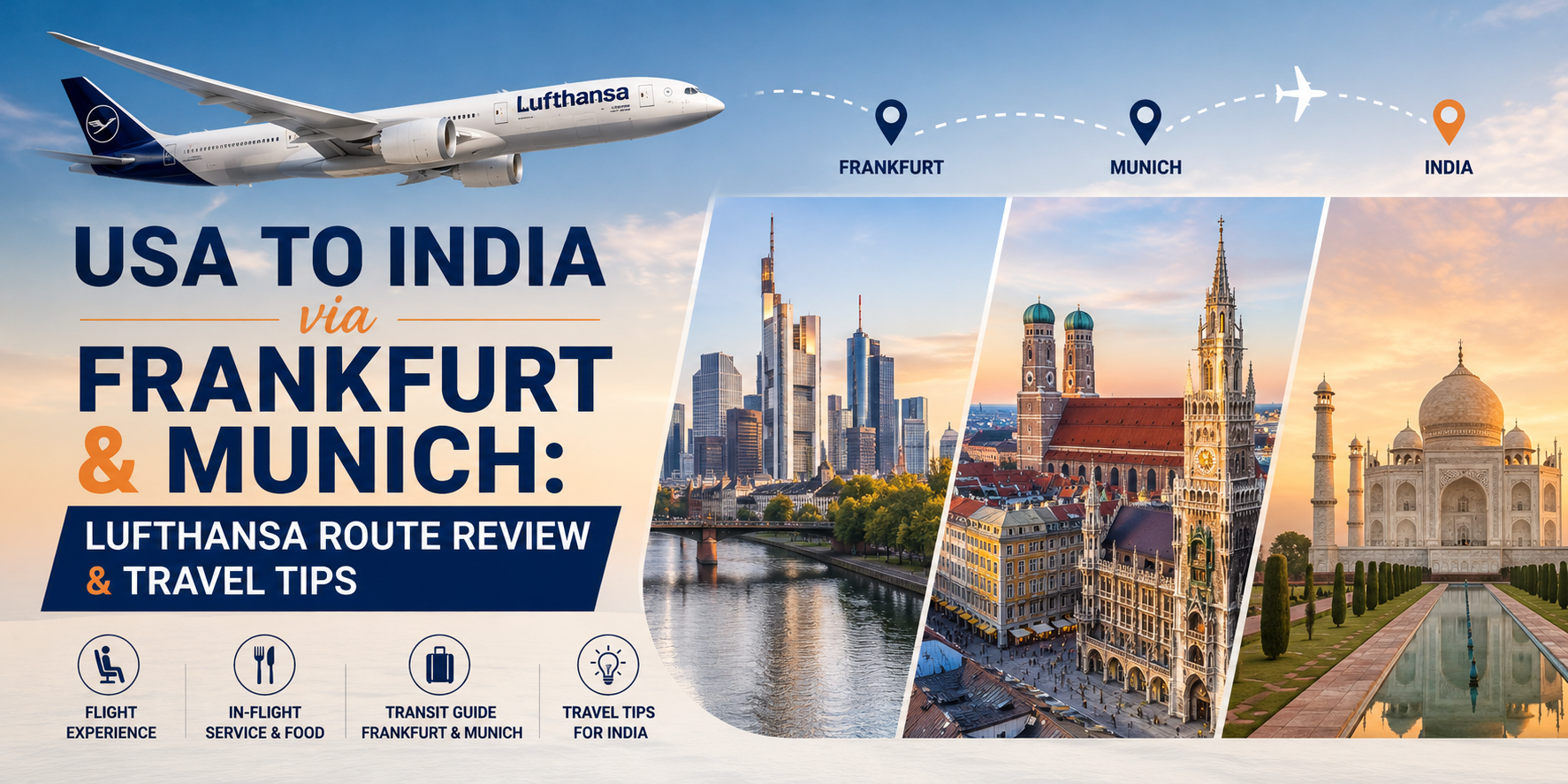
Germany is still the most “reliable connector” to India for many North America–based flyers—especially when you want a premium cabin experience without Middle East stopovers. In 2026, usa india travel via frankfurt munichis popular with NRIs, students, and business travelers because Lufthansa’s hubs can offer strong schedule options, consistent premium products, and easy onward connections to India via Lufthansa and partner airlines.
But the details matter: minimum connection times, terminal transfers, baggage re-check rules on mixed tickets, and how Lufthansa handles delays all affect whether you arrive refreshed—or stressed. This guide breaks down the Lufthansa experience hub-by-hub, explains what’s changed in 2026, and shares practical booking and day-of-travel tactics to reduce missed connections and maximize value—especially for business class deal seekers using MyFlyYatra.
Why Frankfurt (FRA) and Munich (MUC) still work for India connections in 2026
For USA-to-India itineraries, FRA and MUC sit in a “sweet spot”: long-haul arrivals from North America land early enough to connect to evening India departures, and the hubs are designed for international-to-international transfers with minimal re-screening in many cases.
Capacity and demand patterns also favor these routings. India remains one of the fastest-growing aviation markets; IATA projects India will become the third-largest air passenger market by 2030(IATA, 2023), and that growth continues to shape Europe–India schedules in 2026. Meanwhile, operational reliability has become a bigger purchase driver: on-time performance is now a top airline selection factor, with global OTP often hovering in the low-to-mid 80% range for leading carriers (Cirium, 2025).
Who benefits most from a Germany connection
Lufthansa Frankfurt India route: what to expect at FRA (transfers, terminals, and timing)
Frankfurt is Lufthansa’s largest hub and often the most schedule-rich for India. The tradeoff is scale: FRA is busy, walking distances are longer, and during peak waves it can feel crowded.
Connection flow basics (USA → FRA → India)
Most USA arrivals connect airside to India departures. You’ll typically clear security screening during the transfer, but you generally do notclear immigration if you remain airside on an international connection. If your itinerary involves separate tickets or a terminal change, build more buffer.
How much connection time to plan
For risk management in 2026, aim for:
Why the extra margin? Disruptions remain non-trivial across Europe. Eurocontrol has repeatedly flagged staffing constraints and peak-season congestion as drivers of delays in Europe (EUROCONTROL, 2024).
Munich (MUC) vs Frankfurt (FRA): which is easier for families and premium flyers?
Munich is often the smoother experience: a more compact hub, shorter walks, and a calmer premium feel. If you’re traveling with parents, small children, or you’re simply prioritizing a low-stress connection, MUC can be a strong pick—assuming the schedule and fare cooperate.
| Factor |
Frankfurt (FRA) |
Munich (MUC) |
| Hub size & walking distances |
Large; longer walks are common |
More compact; typically shorter transfers |
| Schedule depth to India |
Usually higher (more waves/options) |
Solid but often fewer options than FRA |
| Stress level for families/elders |
Moderate to high at peak times |
Often lower due to layout |
| Buffer recommended (practical) |
2:00–3:00+ |
1:45–2:30 (still add time if separate tickets) |
Practical rule:choose FRA for the best odds of finding a great fare and flight time; choose MUC when connection simplicity is worth more than having lots of fallback options.
Cabin experience: what Lufthansa business class feels like on this routing
Lufthansa’s long-haul business class value on USA–Germany–India depends on aircraft type and whether your trip includes partner-operated segments. Your comfort can vary between the transatlantic flight and the Europe–India leg.
What premium travelers should check before booking
Service consistency matters, too. Lufthansa Group has continued investing in premium and operational improvements as competitive pressure rises from Gulf carriers and nonstop offerings. Globally, premium leisure demand remains strong—business class is no longer “only business.” For context, leisure travel continued to account for the majority of travel volume while “bleisure” remained a durable trend (Deloitte, 2025).
Booking strategy in 2026: how to get better fares and fewer headaches
If you want value, the “best” itinerary is rarely the shortest—it’s the one with the most resilient ticket rules and the least operational risk.
Pro tips that usually save money (and sleep)
Actionable workflow:shortlist 2 FRA options + 2 MUC options, then rank them by (1) layover time, (2) single-ticket protection, (3) arrival time in India, (4) upgrade possibilities, and (5) total trip duration.
What’s changed in 2026: disruption planning, EU passenger rights, and airport operations
In 2026, smart travelers plan for volatility: weather events, labor actions, and airspace constraints can cascade into missed connections. European network performance continues to be shaped by peak-day congestion and ATC capacity limits (EUROCONTROL, 2024). That makes connection strategy more important than ever.
EU261 compensation: helpful, but don’t rely on it
EU passenger rights (EU261) can provide compensation for eligible delays/cancellations under certain conditions, but it doesn’t replace good planning. The best “insurance” is choosing a protected itinerary and a connection buffer that matches your risk tolerance.
MyFlyYatra’s disruption-first approach (why it matters)
Common mistakes to avoid (especially for students and family itineraries)
Edge case:If you’re traveling with elderly parents and mobility is a concern, request assistance in advance and pick MUC when possible; if FRA is unavoidable, add extra layover time and choose flights that minimize gate-to-gate distance.
Conclusion: the smartest way to fly USA → Germany → India in 2026
If you’re comparing itineraries for your next India trip—whether it’s a family vacation, a student holiday return, or a business-class upgrade—MyFlyYatra can help you shortlist the best usa india travel via frankfurt munichoptions and secure competitive premium fares. Visit or call us to lock in a routing that’s comfortable, protected, and priced right.
Sources: IATA (2023); Cirium (2025); Deloitte (2025); EUROCONTROL (2024).
FAQs:
Often, yes—especially in business class when nonstop inventory is tight. The best savings typically appear when you’re flexible by a few days and book a single protected ticket. Pricing varies heavily by season (summer and December peaks tend to be highest).
Munich is typically easier and less stressful due to a more compact layout. Frankfurt often wins on schedule depth and fallback options if something goes wrong. If you’re risk-averse, pick the hub that gives you a longer, more realistic connection time.
Plan 2:00–2:30 hoursat Frankfurt for most travelers, and 1:45–2:30at Munich as a practical buffer. Add time if you have separate tickets, checked baggage, or are traveling with kids/elders. During peak months, longer is safer.
It depends on your passport, route, and whether you stay airside. Rules can change, so verify with official sources and your airline before booking. If you’re unsure, MyFlyYatra can help you sanity-check the itinerary before purchase.
If all flights are on one ticket, the airline generally rebooks you to the next available option. If you booked separate tickets, you may be treated as a “no-show” for the onward flight and have to buy a new fare. This is why single-ticket itineraries matter.
It can be a strong option thanks to lounge access, consistent service standards, and broad connectivity. Your seat and comfort depend on aircraft type and flight number, so check the seat map before confirming. Also weigh layover length—too short adds stress, too long reduces the premium feel.
Yes, especially when traveling off-peak and booking early. Students should prioritize flexible change rules and protected connections to avoid expensive last-minute rebuys. If budget allows, consider occasional upgrades on the longest segment for maximum comfort.
Carry-on only reduces risk during tight connections, but it’s not always realistic for long India trips. If you check bags, ensure your itinerary is on one ticket and give yourself adequate connection time. Always keep essentials (meds, chargers, a change of clothes) in your carry-on.
Start with nonstop options to FRA or MUC from major hubs, then compare total trip time and layover realism. Sometimes a short domestic positioning flight improves pricing but adds misconnection risk if on separate tickets. If you position, build a big buffer or overnight.
Yes—MyFlyYatra supports travelers 9am–9pm EST, 7 days, and our Emergency Travel Center is available for urgent issues within 24 hours of departure or while traveling at 1-888-413-5701. This support is especially valuable during storms, strikes, and missed connections. We focus on getting it right—or making it right.