


Airport Transit Visa Guide: Do You Need One for Layovers on the Way to India?
Search Cheap Flights
SAVE UP TO 40%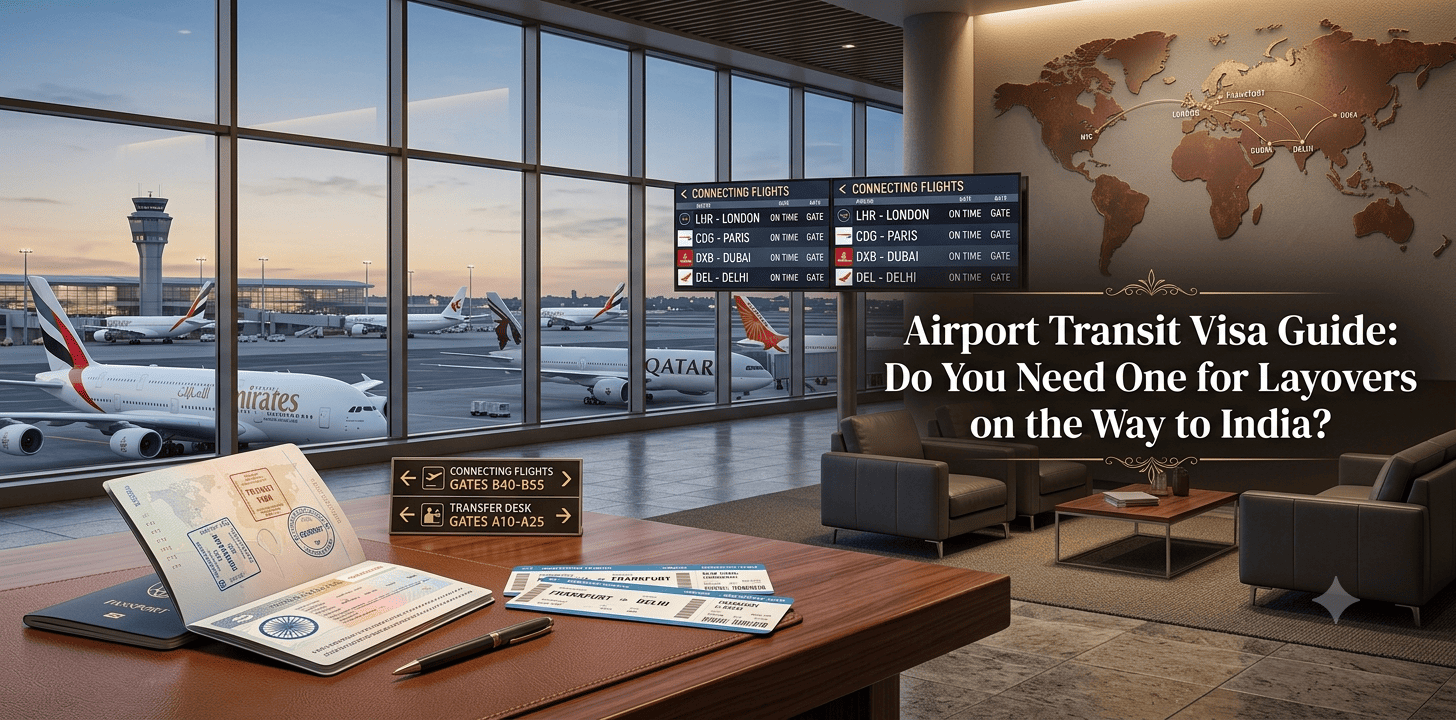
Here's a question that catches travellers off guard at the check-in counter: "Do you have a transit visa for your layover?" Because almost every journey from the USA to India connects through a third country — London, Frankfurt, Dubai, Doha — the transit visa question is one that every NRI should answer before booking, not at the airport. Get it wrong and you can be denied boarding, even though you're only changing planes and never leaving the airport.
The good news: for most NRIs, the answer is far simpler than it looks — and often, you need no transit visa at all. This guide explains the connecting flight visa rules clearly: the one concept that decides everything, the exemption most NRIs already qualify for, and a hub-by-hub breakdown for the UK, Schengen, Dubai, and Doha. And since choosing the right connection can sidestep the whole issue, we'll show where Myflyyatra fits in when booking your flights to India.
Important: Transit visa rules depend on your exact nationality, the documents you hold, your route, and the transit country — and they change fast (several major rules changed in 2026 alone). This is a general guide. Always verify your specific situation with the official government source, embassy, or your airline before booking and before you fly.
The Master Rule: Airside vs Landside
Before any hub-specific detail, understand this one distinction, because it decides almost everything:
- Airside transit: You stay inside the international transit area of the airport, never pass through immigration, don't collect your bags, and don't change to a landside terminal. You simply walk from one gate to your next.
- Landside transit: You pass through immigration and technically enter the country — to change airports, to collect and re-check your baggage, or to leave and explore during a long layover.
Landside transit almost always requires a proper entry visa. Airside transit sometimes requires a special "airport transit visa" — but only for certain nationalities at certain hubs. So the first question is never just "do I need a transit visa," it's "am I staying airside or going landside?"
The NRI Superpower: Your US Visa or Green Card
Here's the single most useful fact in this entire guide, and it applies to most NRIs flying from the USA: if you hold an Indian passport plus a valid US visa or US green card, you are exempt from most transit visa requirements.
- It exempts you from the UK's airside transit visa (DATV).
- It exempts you from the Schengen airport transit visa (ATV).
- It gets you a visa on arrival in the UAE if you want to leave the airport in Dubai.
Valid visas or residence permits for Canada, Australia, New Zealand, or the Schengen area generally work the same way. So before you assume you need to apply for anything, check what's already in your passport — your US documents likely do the heavy lifting. (These exemptions are specific and conditional, so still confirm for your route.)
Hub-by-Hub: Do You Need a Transit Visa?
United Kingdom (London Heathrow, Manchester)
The UK is the strictest common hub. Indian passport holders are on the UK's transit-visa-required list, whichmeans you need a Direct Airside Transit Visa (DATV) even to wait in the terminal between flights — unless you're exempt.
- DATV (airside, up to 24 hours):around £41.50, applied for online through UK Visas & Immigration, with biometrics. Apply several weeks ahead — processing can take weeks, so don't leave it late.
- Visitor in Transit Visa (landside — changing airports, collecting and re-checking bags, or passing immigration):around £64, valid up to 48 hours.
- Exemption: Indians holding a valid US, Canadian, Australian, New Zealand, EU/EEA/Schengen, or UK visa or residence permit (including a US green card) are exempt from the DATV for airside transit.
- 2026 change: The UK ended its Transit Without Visa (TWOV) scheme on 25 February 2026, removing an old landside shortcut. Verify current rules on the official UK visa checker.
Bottom line: transit the UK airside only if you hold a qualifying exemption or a DATV — and if you'll go landside, you need the Visitor in Transit Visa.
Schengen Area (Frankfurt, Amsterdam, Paris, Munich)
Historically, Indian nationals needed a Schengen Airport Transit Visa (ATV, Type A) to transit airside through some Schengen airports — but this is easing rapidly in 2026:
- France removed the ATV requirement for Indians from 10 April 2026 — you can now transit airside through Paris CDG and other French airports with no transit visa. Germany announced a similar change in early 2026.
- Requirements still vary by the specific Schengen country of your layover airport, so check for your exact hub — the list isn't uniform.
- Exemption: In all cases, Indians holding a valid US, Canadian, Japanese, or Schengen visa or residence permit are exempt from the Schengen ATV.
- To leave the airport and enter Schengen during a long layover, you need a full Type C short-stay Schengen visa — the airport transit rules don't cover stepping outside.
- Watch out: an itinerary routing through two different Schengen airports (say, Amsterdam then Paris) can trigger a visa requirement — confirm before booking.
Dubai & the UAE (DXB, Abu Dhabi)
The Gulf hubs are the easiest, which is a big reason they're so popular for USA–India connections:
- Airside transit needs no visa — you can connect through Dubai or Abu Dhabi without any transit visa at all.
- To leave the airport during your layover: Indians holding a valid US visa (with sufficient validity) or a US green card — as well as UK or EU visas — can get a visa on arrival in the UAE. Otherwise, a 48-hour (free) or 96-hour (paid) transit visa, or a tourist visa, is available.
Doha & Qatar (Hamad International)
Doha is arguably the most transit-friendly hub for Indians:
- Airside transit needs no visa.
- Qatar grants Indian passport holders a free visa on arrival, so you can leave the airport and explore Doha on virtually any layover with no advance planning.
Other common hubs like Istanbul (Turkey) and Singapore also allow airside transit without a visa for Indians (with their own rules for leaving the airport), making the Gulf and these Asian hubs the smoothest choices overall.
The Baggage Trap: Through-Checked vs Collect-and-Recheck
Here's a subtle way people accidentally end up needing a visa: baggage. If your bags are through-checked to your final destination on a single ticket, you stay airside and don't touch immigration. But if you have to collect and re-check your bags at the connecting airport (common on separate tickets), you're forced landside — which can trigger a landside entry-visa requirement you didn't plan for. Booking a single ticket with through-checked baggage keeps you airside and avoids the trap.
What If You Travel on a US Passport (OCI)?
If you're a US citizen travelling on a US passport with an OCI card, transit is far simpler — a US passport is strong, and airside transit through these hubs generally requires no visa. Just note landside rules can still differ (for example, the UK requires an ETA for non-visa nationals going landside), so check your specific hub if you plan to leave the airport.
How to Check & Apply
- 1. Confirm airside vs landside for your exact itinerary (including whether bags are through-checked).
- 2. Check what's in your passport — a valid US visa or green card may exempt you entirely.
- 3. Use the official government checker for your transit country (for the UK, gov.uk/check-uk-visa) — never rely on memory or a forum.
- 4. Apply early if you need one — the UK DATV in particular can take weeks, so build in a buffer.
- 5. Carry your proof — your exempting visa/green card, confirmed onward ticket, and destination visa/OCI — to show at check-in and transit.
Tips to Avoid Transit Visa Hassles
- Favour Gulf hubs (Dubai, Doha, Abu Dhabi) — no airside transit visa, and easy to step out if you hold a US visa.
- Book a single ticket with through-checked baggage so you stay airside.
- Keep your layover airside — resist the urge to go landside unless you have the right visa.
- Carry your US visa/green card — it's your exemption for most hubs.
- erify before you book, especially for UK routings, and re-check close to travel since rules are changing.
Frequently Asked Questions
Usually no — but some hubs (notably the UK for Indian passport holders) require an airport transit visa even for airside connections, unless you hold an exemption like a valid US visa or green card.
For Indian passport holders, largely yes — it exempts you from the UK DATV and the Schengen ATV, and gets you a UAE visa on arrival. Always confirm for your route.
Not for airside transit. To leave the airport, Indians can get a UAE visa on arrival (with a US/UK/EU visa) and a free visa on arrival in Qatar.
It's easing — France dropped the requirement in April 2026 and Germany announced the same — but it varies by country, and a valid US/Schengen visa exempts you. To leave the airport, you need a Type C Schengen visa.
Book a single ticket with through-checked bags, connect through a Gulf hub, stay airside, and carry your US visa/green card as proof.
Final Word
The transit visa question sounds scary, but for most NRIs flying to India it comes down to two things: are you staying airside, and do you hold a US visa or green card? Answer those and the path is usually clear — the Gulf hubs let you connect visa-free, your US documents exempt you from the strict ones, and staying airside avoids the rest. Verify your exact route with the official source before you book, let Myflyyatra help you choose a connection that keeps things simple, and your layover on the way home becomes a non-event — exactly as it should be..
This article is general information, not immigration or legal advice. Transit visa rules depend on your nationality, documents, and route; they vary by country and change frequently (several rules changed in 2026). Always confirm your specific requirements with the official government authority, embassy, or your airline before booking and before travelling.
What Customers Say About Us
We do our best to provide you the best experience ever
