


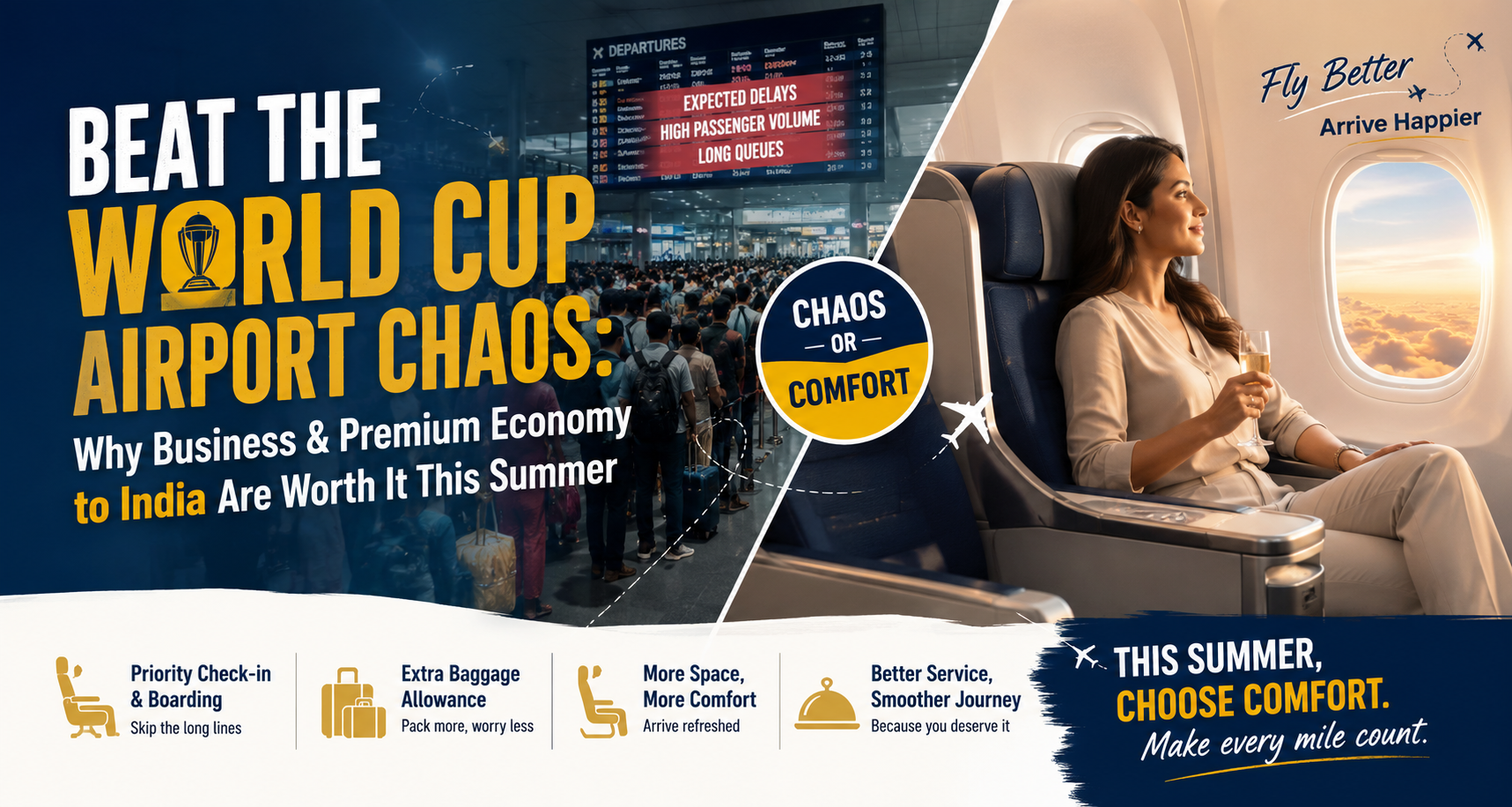
If you're flying to India between now and mid-July 2026, the journey starts long before you reach the gate — and this year, the airport itself is the hardest part of the trip. The 2026 FIFA World Cup runs from June 11 to July 19 across 16 host cities in the United States, Mexico, and Canada. It has landed squarely on top of the busiest stretch of the travel calendar, and the result is the most congested North American summer in living memory. For anyone routing to Delhi, Mumbai, Bengaluru, Amritsar, or Hyderabad through a major US or European hub, the question is no longer just "which airline?" It's "how do I get through the airport with my sanity intact?"
After fifteen years of booking and flying these routes, here's my honest take: this is the one summer where paying up for premium economy or business class stops being an indulgence and starts being a logistics decision. Let me explain why — with the actual numbers, not marketing copy.
The perfect storm: why summer 2026 is different
This isn't ordinary peak-season grumbling. Three things are stacking on top of each other.
First, raw volume. The TSA has openly warned that several days this summer could become the busiest screening days in its history, surpassing the records set across June, July, and August of 2025. At Seattle-Tacoma alone, officials noted that the airport's eight highest-volume days ever all occurred last summer — and that 2026 is expected to top them.
Second, a staffing crisis. A prolonged federal funding lapse left TSA officers working without pay for months earlier this year. Callout rates spiked dramatically at some hubs, hundreds of officers resigned, and the agency's acting administrator told Congress the country faces a genuine shortage heading into the tournament. Because new recruits need four to six months of training, replacements simply won't be certified in time. At Dallas-Fort Worth and Houston's George Bush Intercontinental — both major gateways for India traffic — security waits have at times stretched toward four hours.
Third, the World Cup itself layers waves of international fans onto already-record crowds, with immigration and customs halls feeling it most around match days. And if your itinerary crosses Europe, the EU's biometric Entry/Exit System is now generating long queues at Schengen hubs, while ongoing Gulf airspace management has kept some long-haul routings longer than usual.
Translation: the old "arrive two hours early" rule is dead. Three to three-and-a-half hours is the new domestic baseline, and four hours is sensible for international departures. That's the backdrop against which premium cabins suddenly look very different.
Where premium cabins actually earn their money this summer
People assume you pay for business class because of the lie-flat bed. The bed is lovely, but in a chaotic summer the ground experience is where the value really shows up.
Priority check-in and bag drop. Both business and premium economy on most India carriers get dedicated counters. When the standard queue is snaking back into the terminal, a separate line is worth more than any amenity kit.
Fast-track security and immigration. This is the single biggest reason to pay up in 2026. Many premium fares include access to expedited screening lanes, and on Air India, even passengers who upgrade at the airport are entitled to priority immigration and security wherever those lanes are available. Shaving even twenty minutes off a four-hour line can be the difference between making your gate and rebooking.
Lounge access as a delay shock-absorber. Business class includes lounge access at departure and connecting hubs almost universally; on Air India, premium-tier loyalty members and business passengers get it too. When storms trigger ground stops — as they did across the Northeast and Texas in mid-June, cancelling and delaying thousands of flights — a lounge turns a miserable five-hour wait into a productive or restful one, with real food, Wi-Fi, showers, and a seat that isn't on the floor by gate B12.
Generous baggage. Diaspora travelers heading home rarely pack light. Business class to India typically allows two checked bags at 32kg each on US, Canada, and Europe routes, versus the 23kg single-bag economy reality. For a family carrying gifts, that alone offsets a chunk of the fare gap — and it spares you the check-in-counter haggling that clogs the queue.
Arriving able to function. A lie-flat seat on a 14-to-16-hour haul means you land in Delhi or Mumbai ready for a morning of meetings or a wedding, rather than wrecked. For business travelers, that's not comfort — it's the entire point of the trip not being wasted.
Premium economy vs business: which one is right for you?
Here's the honest framing, because they are not the same product and the price gap is large.
Business class is the full package: lie-flat bed, direct aisle access on most widebodies, lounge access, two heavy bags, priority everything, and on-demand dining. If you're traveling for work, can't afford to arrive depleted, or simply value sleep on an ultra-long-haul, it's the strategic buy. On Air India's flagship Delhi–JFK, Delhi–EWR, and Delhi–London routes you'll even find lie-flat business on the newest retrofitted aircraft, with first class on a handful of Boeing 777-300ERs.
Premium economy is the value sweet spot — and India is one of the few markets where it's genuinely well executed. Air India markets it as "India's only Premium Economy," and the hard product backs that up: Recaro seats with roughly 38 inches of pitch, wider seats, adjustable headrests and leg rests, a TUMI amenity kit, full-course regional dining, and — crucially for this summer — dedicated check-in counters and priority boarding. It's currently on routes like Delhi–Tokyo, Mumbai–Frankfurt, and Bengaluru–London, plus a growing list of others. You won't get a flat bed or guaranteed lounge access, but you get the ground-experience perks that matter most during the chaos, at a fraction of business-class pricing.
My rule of thumb: if the airport stress is your main worry, premium economy already solves most of it. If the flight itself — sleep, recovery, productivity — matters as much as the terminal, business class is the one to book.
Is it actually worth the money?
Frame it as cost-per-problem-avoided rather than cost-per-mile. In a normal summer, the premium is comfort. This summer, you're also buying a faster path through understaffed security, a lounge to absorb weather delays that are hitting daily, priority rebooking if your flight is one of the cancellations, and baggage allowance that removes a friction point at the counter. For a once-a-year trip home or a high-stakes business journey, missing a connection because of a four-hour line is its own expensive disaster — rebooking fees, a lost night, a missed event.
A few practical tips to get the value without overpaying:
- Watch for airline sales. Air India has run limited-period business and premium-economy sales through 2026, including discounted business fares on select India–UK routes for small groups. Booking direct on the airline's app also earns bonus loyalty points.
- Consider the airport upgrade window. Air India lets eligible ticket holders upgrade at the airport from four hours before departure until check-in closes, space permitting — useful if a cash fare is steep but a same-day upgrade appears.
- Pick the calmer gateway. Most host cities have a quieter second airport. If your routing is flexible, the less-congested option can matter more than the carrier.
- Build the buffer anyway. Premium lanes help, but they don't make the crowds disappear. Give international departures four hours this summer, full stop.
The bottom line
The 2026 World Cup will be remembered for the football. For a lot of travelers, though, the trip will be decided in the terminal — and the terminals are overloaded in a way they simply weren't a year ago. You don't have to spend the summer at home. You do have to be deliberate. For the India routes specifically, premium economy and business class aren't just nicer ways to fly this year; they're the most reliable way to move through an airport system under genuine strain. The match ticket gets fans into the stadium. A premium cabin gets you to India with your trip — and your patience — still intact.
Fares, schedules, and airline policies change frequently, especially during a peak event summer. Always confirm current prices, baggage rules, and route availability directly with the airline before booking.
What Customers Say About Us
We do our best to provide you the best experience ever
