


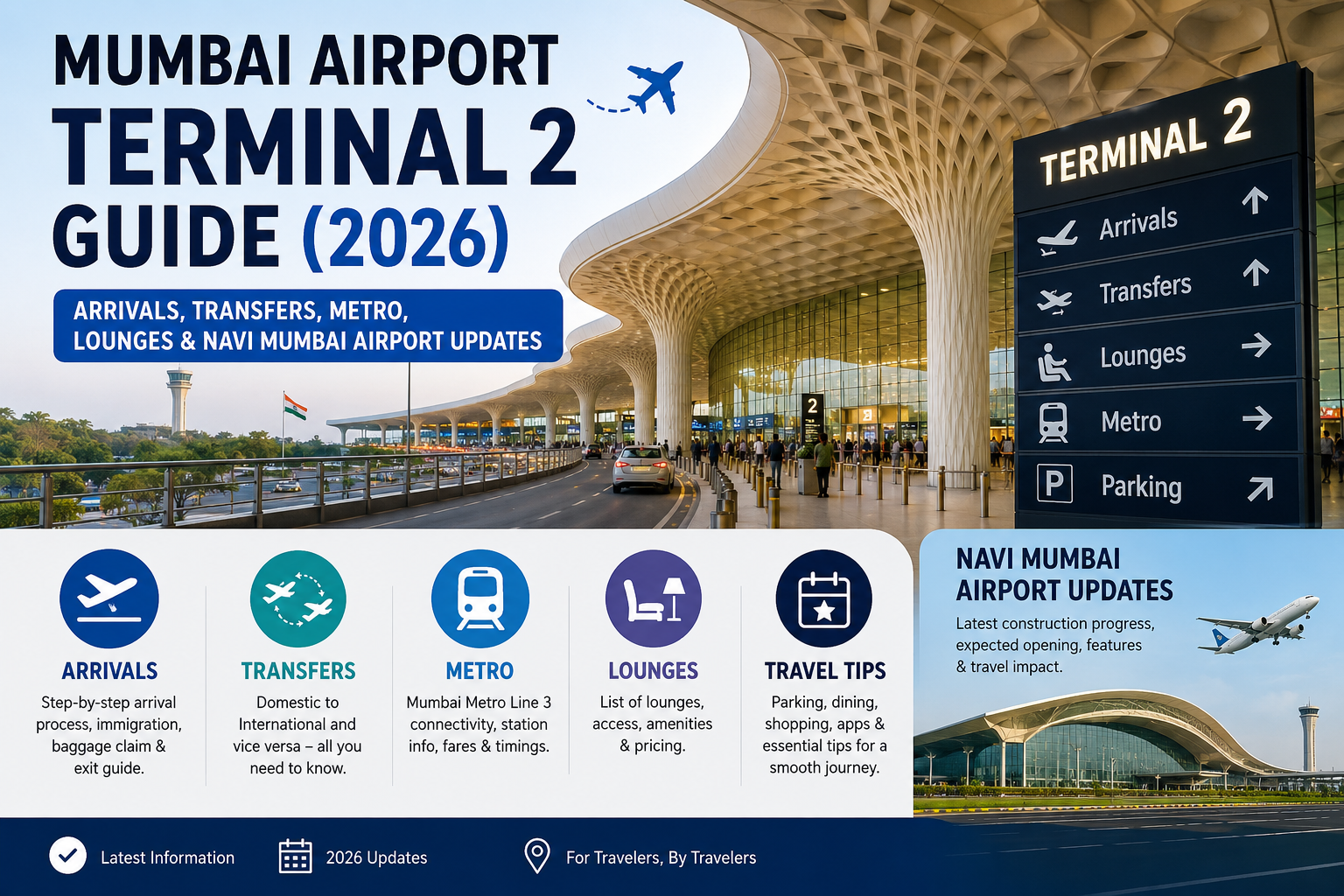
Chhatrapati Shivaji Maharaj International Airport (BOM) is one of India's busiest airports. A smooth landing at Terminal 2 (T2) can save you 30–90 minutes of stress, especially if you have a connecting flight to another Indian city. Mumbai is also growing as a premium travel hub. Lounge demand is high, and immigration lines can get long at peak hours. Around the world, air travel kept rising in 2024, with international demand up about 13% year over year (IATA, 2025). India's big city airports have felt that same pressure.
This Mumbai Airport Terminal 2 guide explains the real arrival flow, what happens at international arrivals, how a domestic transfer works, which lounges are worth your time, and how to reach the airport by Metro. It also covers the big 2026 changes — including the new Navi Mumbai International Airport — plus simple "if this, then that" tips you can actually use.
Terminal 2 at a glance: layout and why it matters
Mumbai has two passenger terminals:
- T2 (Sahar, Andheri East): all international flights, plus full-service domestic flights.
- T1 (Santacruz): most low-cost domestic flights.
The two terminals are not connected. They sit about 4 km apart, and you cannot walk between them. This one fact causes most of the confusion at Mumbai Airport. The key planning point is simple: not every domestic flight uses T2. Your connection plan depends on whether your next flight leaves from T2 or T1.
T2 opened in 2014 and is one of India's most awarded terminals. It has a famous 3-km art wall called Jaya He, wide retail and dining areas, and modern lounges. Departures are on the upper level (Level 4) and arrivals are on the lower level (Level 2).
Which airlines use T2 vs T1 (2026)
Terminal assignments can change with the season or for operational reasons. Always check your e-ticket, then check again on the airline app on travel day. As a general guide for 2026:
| Terminal | Who usually flies here |
|---|---|
| T2 | All international airlines (Emirates, Qatar Airways, British Airways, Singapore Airlines, Lufthansa, United, and more), Air India full-service domestic, and IndiGo's international flights |
| T1 | Most low-cost domestic flights — IndiGo (many flights), SpiceJet, Akasa Air, Air India Express, Star Air, Alliance Air |
One tricky point: IndiGo flies from both terminals. Its domestic flights mostly use T1, while its international flights use T2. Never assume — read your boarding pass.
T2 facilities travelers use most
- Immigration and e-gates for fast entry and exit.
- Baggage claim and airline baggage desks.
- Lounges (international and domestic sides).
- Duty-free shops at both arrivals and departures.
- Food courts and cafés, before and after security.
- SIM card counters, ATMs, and currency exchange in the arrivals hall.
- Pranaam meet-and-assist service for help from kerb to gate.
- Prepaid taxi, app cab, and Metro access for getting into the city.
Mumbai international arrivals: step-by-step process (T2)
Arriving into BOM T2 from overseas is simple, but timing swings a lot by arrival wave. Late-night and early-morning peaks are common. For comparison, U.S. CBP says international travelers can spend up to 30–60 minutes in primary processing during busy waves at major hubs (CBP, 2024). Mumbai's lines behave in a similar way, depending on staffing and how many flights land at once.
Step 1: Deplane and walk to immigration
Follow the "Arrivals / Immigration" signs. The walk can take 5–15 minutes depending on your gate. If your connection is tight, move quickly and keep your documents in hand.
Step 2: Immigration
Keep your passport, visa or OCI card, and arrival details ready. Immigration officers may ask your reason for visiting, duration of stay, and your address in India. If you are using an e-Visa, ensure the approval PDF is saved on your phone so it can be accessed offline if needed.
Step 3: Baggage claim
Baggage arrival time varies based on the flight and carousel congestion. If your baggage does not arrive, go to your airline’s baggage service desk before exiting customs. File a Property Irregularity Report (PIR) and keep your baggage tag stubs for tracking.
Step 4: Customs and exit
Customs in India operates a green/red channel system. Use the green channel if you have nothing to declare. Use the red channel if you are carrying dutiable goods, items above permitted limits, gold beyond allowances, or high-value electronics intended for resale. Declaring items upfront helps avoid penalties and delays. When in doubt, refer to the official Indian Customs (CBIC) guidelines before traveling.
Domestic transfer: how connections work from T2 (and T1)
The biggest mistake at BOM is assuming a domestic connection is always in the same terminal. Sometimes you must move between terminals, re-check your bags, and clear security again.
Scenario A: International arrival → domestic departure from T2
This is the easiest case. After customs, follow signs for domestic departures. Go to check-in or bag drop if needed, then security, then your gate. If you have a single ticket (one booking all the way through), ask your airline at the start whether your bags are checked through to your final city. Rules change by airline agreement and fare type.
Scenario B: International arrival → domestic departure from T1
If your domestic flight leaves from T1, plan extra time. You will usually need to:
- Clear immigration, collect your bags, and exit customs at T2.
- Take the free inter-terminal shuttle (or a cab) to T1.
- Check in or drop your bags with the domestic airline at T1.
- Clear security again and walk to your gate.
Buffer tip: For T2→T1 transfers on separate tickets, many experienced travelers leave 4–5 hours total. Add even more during monsoon or holiday peaks.
Scenario C: Domestic arrival → international departure from T2
If you land into T2 and fly out internationally from T2, you stay inside the same terminal, but you still go through international check-in and immigration. If you land into T1, you must move to T2 before you start.
The free inter-terminal shuttle
A free shuttle bus runs between T1 and T2 around the clock. It comes about every 10 minutes and the ride takes 15–20 minutes. Add wait time and traffic, and plan at least 45–60 minutes for the full transfer. At departures, take the lift to the arrivals level and look for the shuttle signage.
How to get to and from Mumbai T2 (2026)
This is the part most guides skip — and it can save you the most time.
Mumbai Metro (Aqua Line 3) — the traffic-beater
Mumbai's first underground Metro, the Aqua Line 3, now has a station built right next to T2: CSMIA T2 station. A short 100-metre foot overbridge links the station straight to the terminal, so you skip the busy roads. The line also has a stop at T1.
- Fares: about ₹10 to ₹70, based on distance.
- Frequency: trains roughly every 5 minutes at peak times.
- Connects to: BKC, CSMT, Churchgate, Cuffe Parade, SEEPZ, and Marol Naka (where you can change to Metro Line 1).
During heavy traffic — common in mornings and evenings — the Metro is often the fastest and cheapest way to the airport.
Taxis and app cabs
Prepaid taxi counters and app-cab pickup zones (Uber and Ola) are available at arrivals. App cabs are usually cheaper, but pickup points may require a short walk from the terminal exit. Follow signage for the designated app-cab zones.
Buses
BEST operates air-conditioned buses connecting the airport with areas such as Thane, Borivali, South Mumbai, and Andheri (bookable via the Chalo app). NMMT also runs services connecting Navi Mumbai to the airport.
Parking
T2 offers parking for around 1,500 cars. General parking starts at approximately ₹160, with premium parking priced higher. Rates increase with duration, so it is advisable to check current tariffs if planning a long stay.
DigiYatra at T2: skip the document lines
DigiYatra is India's face-scan boarding system. Once you sign up, you walk through automatic e-gates using your face instead of showing your ID and boarding pass again and again. Mumbai T2 has expanded its e-gates and added more at the security check area, which can save regular travelers 15–20 minutes at busy times.
How it works:
- Download the DigiYatra app (Android or iOS) and register once using your ID (Aadhaar).
- Add your flight details before you reach the airport.
- At T2, look into the face camera at the e-gate to enter, then again at security.
A few things to know:
- It works for domestic departures from T2 right now. International DigiYatra is being rolled out.
- Your face data is stored on your phone and is deleted within 24 hours of your flight.
- Not registered yet? You can sign up at the kiosk at Gate 2, T2. Staff in jackets marked "Digi Buddy" can help.
- Tip: Turn your screen brightness up. Mumbai scanners may struggle to read dim boarding passes.
Lounges at Mumbai T2: what's worth it in 2026
Lounges are most useful for long-haul premium travelers (like US–India flights), red-eyes, and families who need a clean place to rest and reset. Lounges everywhere are busier these days, partly because more people now carry premium credit cards (Skift, 2024). The trick is picking the right lounge and visiting outside peak waves.
Main lounges at T2
- Adani Lounge – East (International): After immigration, Level 4, near Gate 45. International cuisine, showers, and runway views.
- Adani Lounge – West (International): International side, near Gates 85–86. A second premium option past duty-free.
- Adani Lounge (Domestic T2): Domestic side, Level 3, near Gates 44–45. For domestic T2 flights only.
- Plaza Premium Lounge: A popular contract lounge with hot meals, showers, and fast Wi-Fi.
- Air India Maharaja Lounge: For Air India Business Class and Star Alliance Gold members.
- Meghavi Air Spa Lounge: Massage and wellness spots inside T2 (near Gates 49, 85, and 47) — useful after a long flight.
How you can get in
- Business or First Class ticket on your airline.
- Airline status (such as Star Alliance Gold for the Maharaja Lounge).
- Premium credit/debit cards via Priority Pass, DragonPass, or LoungeKey networks.
- Paid walk-in, often around ₹2,800–₹4,250 for a 2-hour visit, or about $55.
2026 note: Lounge access rules in India changed a lot recently. Many banks moved from the old DreamFolks model to direct deals with lounge operators, and Adani lounges added DragonPass. Don't rely on "any card, any lounge." Check your card's lounge rules in your bank app the night before you fly.
What to expect
Most major lounges offer hot food, drinks, Wi-Fi, and quiet seating. Shower availability and wait times change through the day. If you need a shower before a long domestic hop (say BOM→BLR) after a US flight, go to the lounge early.
Quick comparison table
| Your need | Best time to use a lounge | Check before you enter | Backup plan |
|---|---|---|---|
| Shower after long-haul | Arrive early (60–90 min buffer) | Shower queue, towel rules | Airport hotel day-room |
| Work call / laptop focus | Mid-day or off-peak | Quiet seating, Wi-Fi speed | Café + phone hotspot |
| Family with kids | Before boarding | Space, food, crowding | Gate area + snacks |
| Quick meal + recharge | 30–45 minutes | Distance to gate, last call | Grab-and-go near gate |
Need a hand from kerb to gate? Try Pranaam
Pranaam is CSMIA's meet-and-assist service. It offers porter help, fast-track security, buggy rides, and a personal helper from the entrance to your gate. Packages start around ₹1,500 per person and can be booked online. It's handy for elderly travelers, families with kids, or tight connections.
Timing, security, and queue strategy (realistic 2026 planning)
Good timing is the difference between a calm connection and a missed flight. Security screening stays tight worldwide — TSA screened more than 3 million people in a single day during peak 2024 travel (TSA, 2024). At BOM T2, waits change a lot by departure wave.
Recommended time cushions by trip type
- Domestic departure, same terminal: arrive 2 hours early.
- International departure: arrive 3 hours early.
- International → domestic, same terminal (T2→T2), single ticket: aim for 3 hours of connection time.
- International → domestic, terminal change (T2→T1) or separate tickets: plan 4–5+ hours.
- Monsoon season or holiday peaks: add at least 30–60 extra minutes.
Fast decision rule: should you risk a tight connection?
If you are landing in monsoon months, flying on a separate ticket, or switching terminals, do not book "minimum connection time" trips. One delay can cause you to miss a re-check-in cutoff and lose your seat, especially on full domestic routes.
Big 2026 change: Navi Mumbai International Airport (NMIA)
The Mumbai region now has two major airports. The new Navi Mumbai International Airport (NMIA) in Ulwe started commercial flights on 25 December 2025. It is run by Adani Airports and is growing fast — from a handful of routes to dozens of domestic destinations through the summer 2026 schedule. International flights (starting with Gulf and Southeast Asia routes) are planned for 2026 as well.
Why this matters for your trip:
- It’s a dual-hub system. Like London’s Heathrow and Gatwick, Mumbai’s existing airport (BOM/CSMIA) is not shutting down. Both airports will operate side by side.
- NMIA connectivity is improving. Navi Mumbai International Airport (NMIA) connects to Mumbai via the Atal Setu sea bridge, which can significantly reduce travel time from South Mumbai. A future metro link is also planned for later in the decade.
- BOM remains the primary international hub in 2026. Chhatrapati Shivaji Maharaj International Airport (BOM), especially T2, continues to handle most long-haul international flights, including major US–India routes.
- Always compare both airports before booking. A flight from NMIA may be closer depending on where you live, but for many parts of Mumbai—especially the western suburbs—it may add extra time and cost.
Connection warning: BOM and NMIA are different airports, far apart. If your two flights use different airports, treat them as fully separate trips. Don't book tight connections between BOM and NMIA.
Recent trends shaping BOM T2 in 2026
Three forces shape the T2 experience this year: more passengers, more digital tools, and more premium demand. Global air travel grew strongly in 2024, with total traffic up about 10% versus 2023 (IATA, 2025), which pushes busy hubs to fine-tune staffing and queues. Airlines are also leaning into premium cabins, and "bleisure" (business + leisure) travel stays strong (McKinsey, 2024).
What travelers will notice most
- Faster entry with DigiYatra e-gates for those who sign up.
- A direct Metro link to T2, which beats road traffic.
- Busier lounges, so timing your visit matters.
- A second airport option (NMIA) for some routes.
- Longer immigration waves at late-night and early-morning peaks.
How to adapt in 2026
Use airline apps for live gate and terminal updates, and keep your documents saved offline. If you fly premium or business class to/from the US with a domestic connection, avoid ultra-tight layovers. Comfort and reliability usually beat saving ₹2,000–₹5,000 on the fare.
Pro tips and common mistakes at Mumbai T2
What frequent flyers do
- Register for DigiYatra before travel. Sign up in advance to skip document queues and use faster biometric-enabled entry lanes.
- Use Metro Line 3 (Aqua Line) during peak hours. The direct metro to T2 is often faster and more reliable than road traffic during rush periods.
- Double-check your terminal. Verify the departure terminal on your e-ticket and re-confirm it on your airline app on the day of travel.
- Plan longer layovers for terminal changes or separate tickets. Build sufficient buffer time when switching between terminals or booking non-connected flights.
- Save visa documents offline. Keep your e-Visa or visa PDF downloaded so it can be accessed without internet at immigration.
- Use lounges early if needed. Arrive early to use lounge facilities such as showers and rest areas before onward connections.
- Confirm baggage through-routing rules early. Check whether your bags are checked through at the start of your journey, not when you arrive in Mumbai.
Mistakes that cost time or money
- Assuming all domestic flights depart from T2. Many domestic flights operate from T1, so always verify your terminal before travel.
- Booking too-tight connections with terminal changes. Avoid short layovers when switching between terminals, as transfers can take significant time.
- Confusing BOM and NMIA. Chhatrapati Shivaji Maharaj International Airport (BOM/CSMIA) and Navi Mumbai International Airport (NMIA) are separate airports and should not be treated as interchangeable.
- Skipping the baggage desk when a bag is missing. Do not exit customs without reporting missing baggage at the airline’s baggage service desk.
- Ignoring monsoon delays (June–September). Always include extra buffer time during the monsoon season due to possible weather and traffic disruptions.
- Relying on “any card, any lounge” access. Lounge access rules have changed in 2025–26, so always confirm eligibility with your card provider or lounge before travel.
Conclusion
Mumbai T2 is a strong gateway, and your experience depends on three things: planning your connection, knowing your terminal, and timing the queues. Plan around peak arrival waves, know whether your onward flight leaves from T2 or T1, use the Metro to beat traffic, and sign up for DigiYatra — and BOM can feel surprisingly smooth. Keep an eye on the new Navi Mumbai Airport too, since it may suit some of your routes in 2026.
If you're planning a premium trip — especially a US–India business class flight with a domestic connection — it helps to have an expert check your routing, layover times, and fare rules. MyFlyYatra can help you compare business-class itineraries that balance comfort, reliable connections, and total trip value for 2026–2027.
FAQs
It depends on the arrival wave, staffing, and whether you have checked bags. Many travelers clear immigration, baggage, and customs in 45–120 minutes, but peak periods run longer. If you have a tight domestic connection, don't plan under 2.5–3 hours in the same terminal.
On a single ticket with bags checked through, you may not need to re-check — confirm this at your starting airport. On separate tickets, assume you must collect your bags at T2 and re-check for the domestic leg. Always check the domestic airline's bag-drop cutoff.
Clear immigration, collect bags, and exit customs at T2, then take the free inter-terminal shuttle (or a cab) to T1. At T1, check in or drop bags, then clear security again. Plan 4–5 hours if your flights are on separate tickets.
T2 has the Adani Lounge East and West (international), the Adani Lounge (domestic), Plaza Premium, the Air India Maharaja Lounge, and the Meghavi Air Spa. Access is via Business/First tickets, airline status, or premium cards through Priority Pass, DragonPass, or LoungeKey. Check your card's rules first.
They can be — especially on long layovers, red-eyes, or when you need reliable Wi-Fi and clean restrooms. If you'll only be there 20–30 minutes, a quick meal near the gate may be better value. For families, the space and comfort often make it worth it.
For T2→T2 on a single ticket, aim for 3 hours. For a terminal change or separate tickets, plan 4–5+ hours. Add more in monsoon season or during big holidays.
Yes. The Aqua Line 3 has a station right next to T2, linked by a short foot overbridge. Fares run about ₹10–₹70, and trains come roughly every 5 minutes at peak. It's often faster than the road in heavy traffic.
DigiYatra is a face-scan system that lets you skip document checks at entry and security. It works for domestic departures from T2 and can save 15–20 minutes at busy times. Sign up on the app before you fly.
Yes, SIM counters are usually in the arrivals area, though pricing and activation time vary. If you need data right away for cabs or calls, set up an eSIM before you leave home (if your phone supports it). Keep your passport handy for registration.
No. NMIA is a separate, brand-new airport in Ulwe. BOM (CSMIA) and NMIA run as a two-airport system. They are far apart, so never connect between them on a tight schedule.
On a single ticket, contact the airline or transfer desk as soon as you land — the operating carrier usually rebooks you. On separate tickets, message the domestic airline right away and be ready to buy a new ticket if you miss the cutoff. Booking resilient connections up front avoids this stress.
T2 is modern and has services, but seating fills up and comfort varies by night. For layovers over about 6 hours, many travelers prefer a nearby airport hotel or day room. With an early domestic departure, predictable rest beats staying airside.
Business class cuts fatigue, so you arrive in better shape for the onward leg. It usually adds better baggage allowance and lounge access too, which makes long connections easier. To compare premium fares and smarter routings, platforms like MyFlyYatra can help.
