

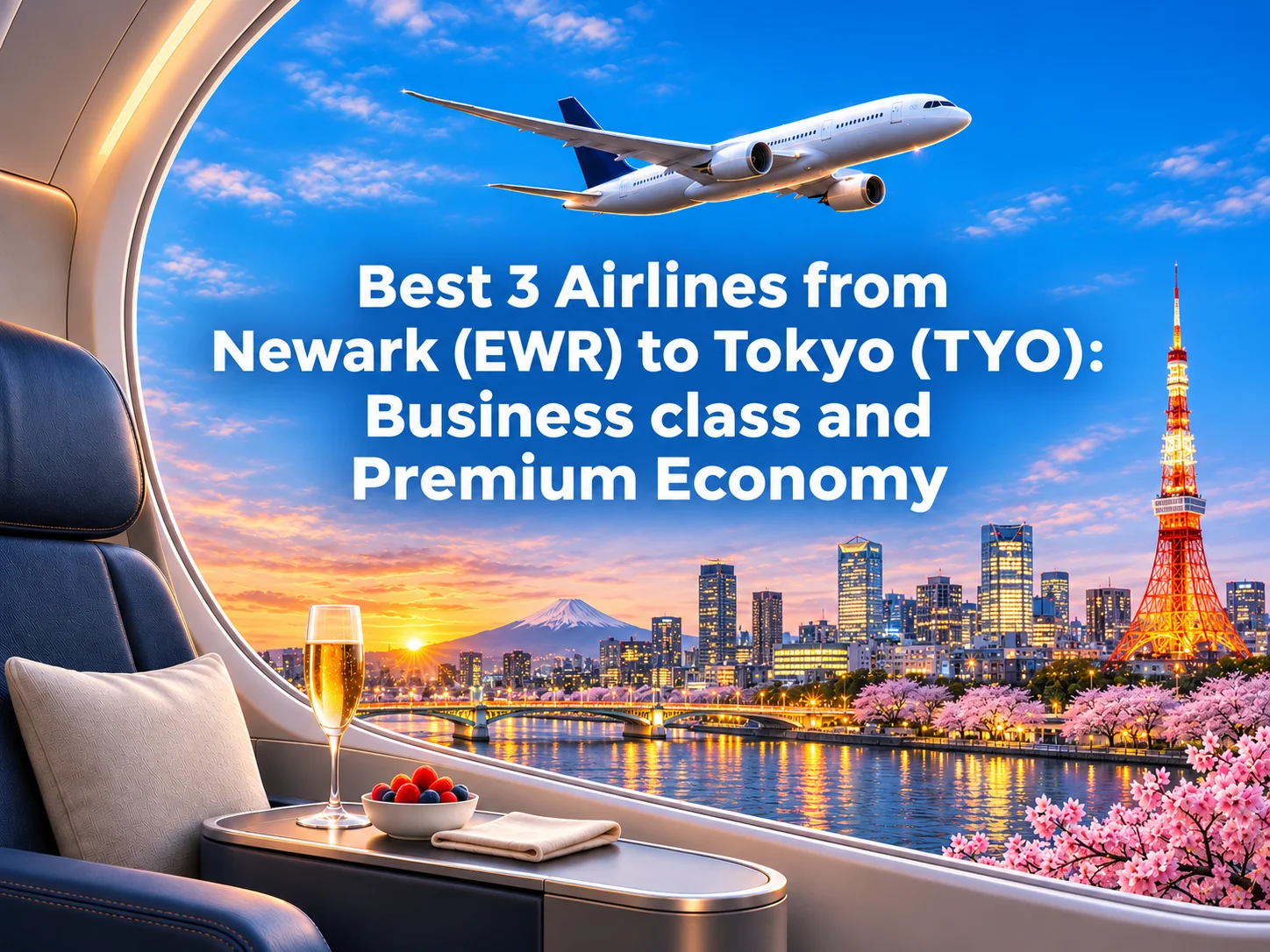
Best 3 Airlines from Newark (EWR) to Tokyo (TYO): Business Class and Premium Economy
Quick Verdict
Check the Japanese arrival airport before sorting by price. Haneda and Narita have different ground journeys even when both display Tokyo.
United nonstop to Tokyo is a baseline; ANA via a U.S. hub and Air Canada via Vancouver widen the premium-cabin options. A connection through Vancouver could make sense for inventory, but Tokyo airport and fare-basis details still deserve attention.
Expert Comparison
The EWR–TYO market is best assessed around a Tokyo itinerary where Haneda and Narita access can outweigh small seat differences. For a traveler departing from the New York metropolitan area, the key trade-off is not a superficial cabin label but the ability to complete the journey with a protected connection, a useful arrival time and a seat suited to the longest overnight segment. Shinjuku offices, Tokyo Station rail connections and Disney-area hotels have different arrival-side needs. An attractive headline price loses meaning if the flight's timing undermines the original purpose of the trip.
The first airline worth analyzing is United Airlines, with nonstop to tokyo on selected services. Its Business product is marketed as United Polaris; lie-flat Polaris seats on equipped international widebodies. On this route, its appeal centers on operational simplicity and the strength of a U.S.-based hub network, but that advantage must be checked against the schedule into Tokyo and the ground arrangements after landing. A connection through Vancouver could make sense for inventory, but Tokyo airport and fare-basis details still deserve attention.
Another strong comparison is ANA, with via chicago (ord); connecting itinerary. Its Business product is marketed as ANA Business / THE Room where fitted; lie-flat Business; THE Room is aircraft-specific. On this route, its appeal centers on Japanese service and carefully timed transfers at Tokyo gateways, but that advantage must be checked against the schedule into Tokyo and the ground arrangements after landing. Do not assume a Tokyo metropolitan airport code guarantees the airport closest to your booked hotel.
The third candidate changes the calculation: Air Canada, with via vancouver (yvr). Its Business product is marketed as Signature Class; lie-flat Signature Class on eligible long-haul aircraft. On this route, its appeal centers on Canadian hub connections with a different fare and timing pattern, but that advantage must be checked against the schedule into Tokyo and the ground arrangements after landing. The airport selected on arrival, tokyo rail networks and possible domestic onward flights should also be considered before making a fare-only decision.
Premium Economy deserves a different comparison from Business on this journey. The shortlist covers United Airlines (United Premium Plus), ANA (ANA Premium Economy), Air Canada (Premium Economy). A dedicated premium recliner is not the same as an extra-legroom Economy seat, and a regional or domestic connector may not provide an equivalent cabin. For Tokyo, inspect the longest sector separately and compare the time you can actually rest against the price difference. The airport selected on arrival, tokyo rail networks and possible domestic onward flights can magnify the value of arriving well rested.
An insider purchasing angle for Tokyo is the period around sakura season, Golden Week and the autumn foliage window. Those dates can change both the traveler mix and the inventory offered in each cabin. Do not assume a Tokyo metropolitan airport code guarantees the airport closest to your booked hotel. Compare at least three nearby departures, keep the return date fixed during a first comparison, and recheck connections after applying an airline or website filter. Choosing a more expensive nonstop can still be the cheaper decision once an extra hotel night or onward transfer is counted.
For Tokyo, compare business class flight deals when lie-flat rest is the priority, and premium economy flight deals when a dedicated recliner offers better value. These are comparison resources, not guaranteed inventory or live fare quotes.
Business Class
Airline Comparison
Three Tokyo itineraries compared by lie-flat suitability, lounge access, routing and modeled round-trip fares.
| AIRLINE | PRODUCT | SEAT TYPE | LOUNGE | ALLIANCE | TYPICAL FARE |
| United Airlines | United Polaris | Lie-flat Polaris seats on equipped international widebodies | Polaris Lounges where eligible | Star Alliance | $2,600–$5,700 |
| ANA | ANA Business / THE Room where fitted | Lie-flat Business; THE Room is aircraft-specific | ANA / Star Alliance lounges where eligible | Star Alliance | $2,650–$5,900 |
| Air Canada | Signature Class | Lie-flat Signature Class on eligible long-haul aircraft | Maple Leaf / Signature access where eligible | Star Alliance | $2,300–$5,300 |
Product Details
United Airlines United Polaris Tokyo routing: Nonstop to Tokyo on selected services. ✓ Product: Lie-flat Polaris seats on equipped international widebodies. ✓ Value angle: operational simplicity and the strength of a U.S.-based hub network. ✓ Lounge: Polaris Lounges where eligible. ✓ Verify: operating aircraft, fare rules, transfer protection and checked baggage. Estimated round trip: $2,600–$5,700 | ANA ANA Business / THE Room where fitted Tokyo routing: Via Chicago (ORD); connecting itinerary. ✓ Product: Lie-flat Business; THE Room is aircraft-specific. ✓ Value angle: Japanese service and carefully timed transfers at Tokyo gateways. ✓ Lounge: ANA / Star Alliance lounges where eligible. ✓ Verify: operating aircraft, fare rules, transfer protection and checked baggage. Estimated round trip: $2,650–$5,900 |
Air Canada Signature Class Tokyo routing: Via Vancouver (YVR). ✓ Product: Lie-flat Signature Class on eligible long-haul aircraft. ✓ Value angle: Canadian hub connections with a different fare and timing pattern. ✓ Lounge: Maple Leaf / Signature access where eligible. ✓ Verify: operating aircraft, fare rules, transfer protection and checked baggage. Estimated round trip: $2,300–$5,300 |
Premium Economy
Airline Comparison
A route-by-route look at genuine premium recliners for Tokyo; unavailable cabins are identified rather than assigned invented prices.
| AIRLINE | PRODUCT | SEAT TYPE | LOUNGE | ALLIANCE | TYPICAL FARE |
| United Airlines | United Premium Plus | Dedicated recliner on eligible sectors; check each flight | No access by cabin alone; status rules apply | Star Alliance | $1,600–$3,500 |
| ANA | ANA Premium Economy | Dedicated recliner on eligible sectors; check each flight | No access by cabin alone; status rules apply | Star Alliance | $1,300–$3,250 |
| Air Canada | Premium Economy | Dedicated recliner on eligible sectors; check each flight | No access by cabin alone; status rules apply | Star Alliance | $1,400–$3,100 |
Product Details
United Airlines United Premium Plus Tokyo routing: Nonstop to Tokyo on selected services. ✓ Product: the long-haul premium recliner can vary by aircraft. ✓ Value angle: operational simplicity and the strength of a U.S.-based hub network. ✓ Lounge: Premium Economy fare alone usually excludes lounge access. ✓ Verify: operating aircraft, fare rules, transfer protection and checked baggage. Estimated round trip: $1,600–$3,500 | ANA ANA Premium Economy Tokyo routing: Via Chicago (ORD); connecting itinerary. ✓ Product: Premium Economy availability depends on the long-haul aircraft. ✓ Value angle: Japanese service and carefully timed transfers at Tokyo gateways. ✓ Lounge: Premium Economy fare alone usually excludes lounge access. ✓ Verify: operating aircraft, fare rules, transfer protection and checked baggage. Estimated round trip: $1,300–$3,250 |
Air Canada Premium Economy Tokyo routing: Via Vancouver (YVR). ✓ Product: confirm Premium Economy on the transoceanic segment. ✓ Value angle: Canadian hub connections with a different fare and timing pattern. ✓ Lounge: Premium Economy fare alone usually excludes lounge access. ✓ Verify: operating aircraft, fare rules, transfer protection and checked baggage. Estimated round trip: $1,400–$3,100 |
Business Class vs Premium Economy: What Changes on the Way to Tokyo?
Sleep, work and first-day energy
Business Class may provide a fully flat sleep surface on the qualifying long-haul aircraft, while Premium Economy provides additional width, recline and personal space. For Tokyo, the useful question is whether a better night of rest materially improves a Tokyo itinerary where Haneda and Narita access can outweigh small seat differences. The shorter the uninterrupted sleep window, the more important service timing and seat placement become.
Connections, aircraft and ground time
The route comparison has to account for the airport selected on arrival, Tokyo rail networks and possible domestic onward flights. A connection through Vancouver could make sense for inventory, but Tokyo airport and fare-basis details still deserve attention. If the booked itinerary contains several sectors, confirm whether the premium cabin applies to the whole trip; a long-haul Business flight can be paired with domestic First or standard Economy, and Premium Economy may exist only on the longest flight.
Where the incremental fare earns its keep
For a traveler whose schedule includes Shinjuku offices, Tokyo Station rail connections and Disney-area hotels have different arrival-side needs., the difference between cabins should be weighed against transfer fatigue, the risk of arriving late and hotel costs. A lie-flat bed has practical value when a full workday begins immediately, but a well-timed true Premium Economy nonstop or efficient one-stop may be the better purchase when flexibility is high. Do not assume a Tokyo metropolitan airport code guarantees the airport closest to your booked hotel.
Booking Strategy: Newark to Tokyo
1. Search EWR–TYO return flights for the same date pair in both cabins, and record the operating airline and aircraft shown on each segment.
2. Compare the three routing patterns carefully: Nonstop to Tokyo on selected services; Via Chicago (ORD); connecting itinerary; Via Vancouver (YVR); disregard itineraries with risky self-transfers.
3. Check demand around sakura season, Golden Week and the autumn foliage window and move the outbound travel date a few days when possible.
4. Plan for the airport selected on arrival, Tokyo rail networks and possible domestic onward flights; protect any train, ferry, meeting, cruise or independently booked domestic flight.
5. Reconfirm the real Premium Economy seat, lounge eligibility, baggage policy and transit documents before paying.
6. Use flexible fare conditions if the purpose of the Tokyo trip may change, and treat every fare in this guide as a planning estimate rather than a live offer.