

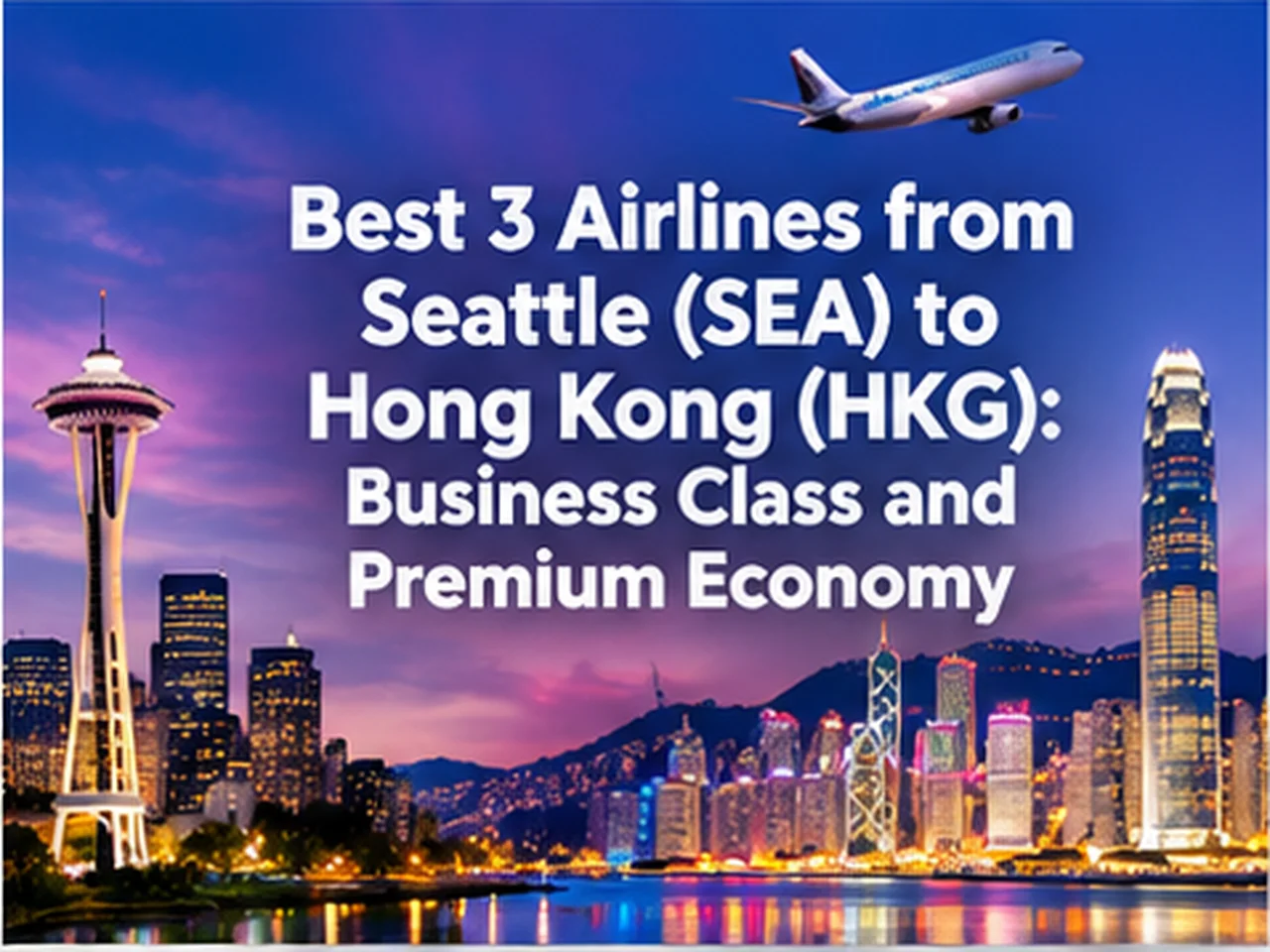
Best 3 Airlines from Seattle (SEA) to Hong Kong (HKG): Business Class and Premium Economy
Quick Verdict
For Seattle travelers considering Hong Kong, the smartest premium fare is the one that protects arriving in time for a Central meeting or a same-day Airport Express journey. Cathay Pacific’s 2026 nonstop launch makes Hong Kong a true one-flight option from Seattle, with two Taipei-based alternatives that can make sense for network or price preferences. Our three-airline shortlist is Cathay Pacific, EVA Air and China Airlines; they are compared as actual routing choices, not as interchangeable nonstop services.
This is a cathay nonstop versus taipei connections market. Business Class should be evaluated as a sleep-and-lounge purchase, while Premium Economy is a separate reclining seat category. The arrival airport is Hong Kong International; compare its local transport options as well as departure schedules. Every fare below is a modeled round-trip planning estimate in USD rather than an available ticket quote.
Expert Comparison
The premium-cabin market between Seattle–Tacoma and Hong Kong should be judged as a complete itinerary rather than by an airline logo. For this destination, an attractive Business Class search result can conceal a time-consuming transfer or an inconvenient late arrival. Evaluate the real operating aircraft, flight duration and available change protection before drawing conclusions from cabin branding. A competitive ticket is one that combines the desired seat with a flight schedule that respects the purpose of the trip.
At the Business Class end, Cathay Pacific presents Cathay Pacific Business and the prospect of the SEA–HKG nonstop plus onward Asia network. Its practical routing is nonstop sea–hkg, which matters because the airport express efficiently reaches hong kong station, but add airport formalities and city transfer time before committing to tight appointments. EVA Air responds with Royal Laurel: Taipei hub transfers and a practical flat-bed Pacific segment. These are different travel propositions even when the fare totals are close. In both cases, a lie-flat description must be checked against the specific widebody and its seat map; hard-product names alone do not guarantee a suite door.
The third option, China Airlines, uses via taipei tpe and brings Taipei-based connectivity with a quieter night-flight cabin. That can be compelling if the timetable fits Hong Kong, but its main weakness may be check the Taipei transfer and long-haul seat type. The best value calculation assigns a real cost to every extra transfer: time on foot in an unfamiliar terminal, lost sleep during a short layover and the possibility that a delayed inbound flight makes the final segment unusable. A cheaper fare is not necessarily a cheaper trip when a hotel night is lost.
Premium Economy deserves its own comparison rather than being marketed as an affordable Business bed. On the Hong Kong journey, Cathay Pacific sells Cathay Pacific Premium Economy, while EVA Air offers Premium Economy; China Airlines brings Premium Economy where its itinerary and equipment allow. Each is designed around more room and a better-defined service than ordinary Economy, not the flat mattress associated with Business. Check whether the short onward asia leg has the same marketed cabin; mixed-cabin itineraries must therefore be read one sector at a time.
A purchasing strategy for Hong Kong begins with Lunar New Year periods, major trade fairs and summer family travel. Compare at least three nearby departure dates, note the exact flight numbers and record whether the airline is operating the flight or simply marketing a partner service. Extend the comparison beyond touchdown to immigration, baggage collection and the practical ground leg. Limited premium inventory can amplify event-related swings, but there is no dependable universal day for buying the cheapest ticket.
When weighing the final quote, ask whether the Business fare buys genuine sleep and lounge access on the long sector, or whether Premium Economy offers enough comfort at a lower total. Review the refund rules, seat selection charges and baggage conditions on the full Hong Kong routing. The fare bands in this guide are editorial estimates varied by airline; inventory, taxes and aircraft substitutions may produce much higher or lower real prices.
For Hong Kong prices, compare business class flight deals for lie-flat options and premium economy flight deals for the dedicated recliner cabin; verify the actual cabin on each booked flight.
Business Class
Airline Comparison
Three Hong Kong options compared on seat type, eligible lounge access, alliance and illustrative return fare. Any connection is stated as such.
| AIRLINE | PRODUCT | SEAT TYPE | LOUNGE | ALLIANCE | TYPICAL FARE |
| Cathay Pacific | Cathay Pacific Business | Fully flat Business seat on A350 long-haul flights | Cathay or oneworld lounge where eligible | oneworld | $2,650–$5,800 |
| EVA Air | Royal Laurel | Fully flat long-haul Business pod | EVA / Star Alliance partner lounge if eligible | Star Alliance | $3,300–$5,550 |
| China Airlines | Premium Business | Long-haul lie-flat suite on equipped aircraft | China Airlines lounge where eligible | SkyTeam | $3,500–$6,150 |
Product Details
Cathay Pacific Cathay Pacific Business Nonstop SEA–HKG. A Hong Kong choice for the SEA–HKG nonstop plus onward Asia network. ✓ Seat: Fully flat Business seat on A350 long-haul flights ✓ Route: Nonstop SEA–HKG; check every operating carrier ✓ Eligible lounge: Cathay or oneworld lounge where eligible ✓ Before purchase: seat layouts can differ on connecting onward flights Estimated round trip: $2,650–$5,800 Best for travelers who value the SEA–HKG nonstop plus onward Asia network. | EVA Air Royal Laurel Via Taipei TPE. A Hong Kong choice for Taipei hub transfers and a practical flat-bed Pacific segment. ✓ Seat: Fully flat long-haul Business pod ✓ Route: Via Taipei TPE; check every operating carrier ✓ Eligible lounge: EVA / Star Alliance partner lounge if eligible ✓ Before purchase: connection time at Taipei can erase a headline fare advantage Estimated round trip: $3,300–$5,550 Best for travelers who value Taipei hub transfers and a practical flat-bed Pacific segment. |
China Airlines Premium Business Via Taipei TPE. A Hong Kong choice for Taipei-based connectivity with a quieter night-flight cabin. ✓ Seat: Long-haul lie-flat suite on equipped aircraft ✓ Route: Via Taipei TPE; check every operating carrier ✓ Eligible lounge: China Airlines lounge where eligible ✓ Before purchase: check the Taipei transfer and long-haul seat type Estimated round trip: $3,500–$6,150 Best for travelers who value Taipei-based connectivity with a quieter night-flight cabin. | |
Premium Economy
Airline Comparison
Three Hong Kong options compared on seat type, eligible lounge access, alliance and illustrative return fare. A premium seat may cover only the long-haul sector on a connecting booking.
| AIRLINE | PRODUCT | SEAT TYPE | LOUNGE | ALLIANCE | TYPICAL FARE |
| Cathay Pacific | Cathay Pacific Premium Economy | Dedicated A350 Premium Economy recliner | Usually no lounge solely with PE | oneworld | $1,800–$3,200 |
| EVA Air | Premium Economy | Dedicated long-haul recliner with more space | Usually no lounge solely with PE | Star Alliance | $1,550–$3,500 |
| China Airlines | Premium Economy | Wide reclining long-haul seat on select aircraft | Usually no lounge solely with PE | SkyTeam | $1,650–$3,200 |
Product Details
Cathay Pacific Cathay Pacific Premium Economy Nonstop SEA–HKG. The a350 premium cabin without a second airport transfer on eligible aircraft. ✓ Seat: Dedicated A350 Premium Economy recliner ✓ Premium sector: verify the exact aircraft via nonstop sea–hkg ✓ Ground access: PE alone usually does not include a lounge ✓ Before purchase: Premium Economy may not be sold on every short onward leg Estimated round trip: $1,800–$3,200 Best for travelers seeking the A350 premium cabin without a second airport transfer. | EVA Air Premium Economy Via Taipei TPE. A well-established long-haul premium recliner on eligible aircraft. ✓ Seat: Dedicated long-haul recliner with more space ✓ Premium sector: verify the exact aircraft via via taipei tpe ✓ Ground access: PE alone usually does not include a lounge ✓ Before purchase: check whether the short onward Asia leg has the same marketed cabin Estimated round trip: $1,550–$3,500 Best for travelers seeking a well-established long-haul premium recliner. |
China Airlines Premium Economy Via Taipei TPE. Enhanced space on the pacific crossing on eligible aircraft. ✓ Seat: Wide reclining long-haul seat on select aircraft ✓ Premium sector: verify the exact aircraft via via taipei tpe ✓ Ground access: PE alone usually does not include a lounge ✓ Before purchase: Taipei–destination connections may be in Economy Estimated round trip: $1,650–$3,200 Best for travelers seeking enhanced space on the Pacific crossing. | |
Business Class vs Premium Economy: What Changes on the Way to Hong Kong?
Sleep quality and usable journey time
A lie-flat Business seat can be material on Hong Kong itineraries that cross the ocean overnight. Premium Economy trades that bed for a wider reclining chair. The practical advantage depends on arriving in time for a Central meeting or a same-day Airport Express journey; if you land late or immediately continue to another city, the better sleeping arrangement can be worth more than a minor difference in inflight food.
Connections and terminal privileges
The three selected itineraries are nonstop sea–hkg, via taipei tpe and via taipei tpe. A connection can introduce a short segment without a dedicated Premium Economy cabin. Business lounge rights depend on the operated flight, fare and status, while Premium Economy alone usually brings no complimentary lounge admission. Confirm what is included before assuming that every airport stop offers the same privileges.
Where the price difference pays off
For Hong Kong, compare the fare gap against actual hours in the premium long-haul seat, connection reliability and time available after reaching Hong Kong International. Neither class automatically guarantees a direct route or flexible ticket. The most defensible upgrade is one that improves the specific travel day rather than simply elevating the cabin name.
Booking Strategy: Seattle to Hong Kong
1. Search the complete SEA–HKG itinerary with comparable dates and round-trip fare rules; do not compare one airline’s one-way fare to another’s return price.
2. Check nonstop versus connecting descriptions for Hong Kong and identify the aircraft used on the longest flight, especially when a premium ticket includes a short feeder sector.
3. Compare dates around Lunar New Year periods, major trade fairs and summer family travel; save the actual flight numbers, baggage allowances and cancellation rules before deciding which fare is best.
4. Evaluate when you can actually leave Hong Kong International after passport control and bags, then plan transfers around the earliest realistic airport exit—not the scheduled touchdown.
5. For Hong Kong Premium Economy bookings, inspect every segment for a dedicated cabin; an extra-legroom Economy seat is not the same recliner product.
6. Recheck the Hong Kong operating schedule and seat map before payment, since equipment substitutions, codeshares and fare inventory can change after the initial search.