

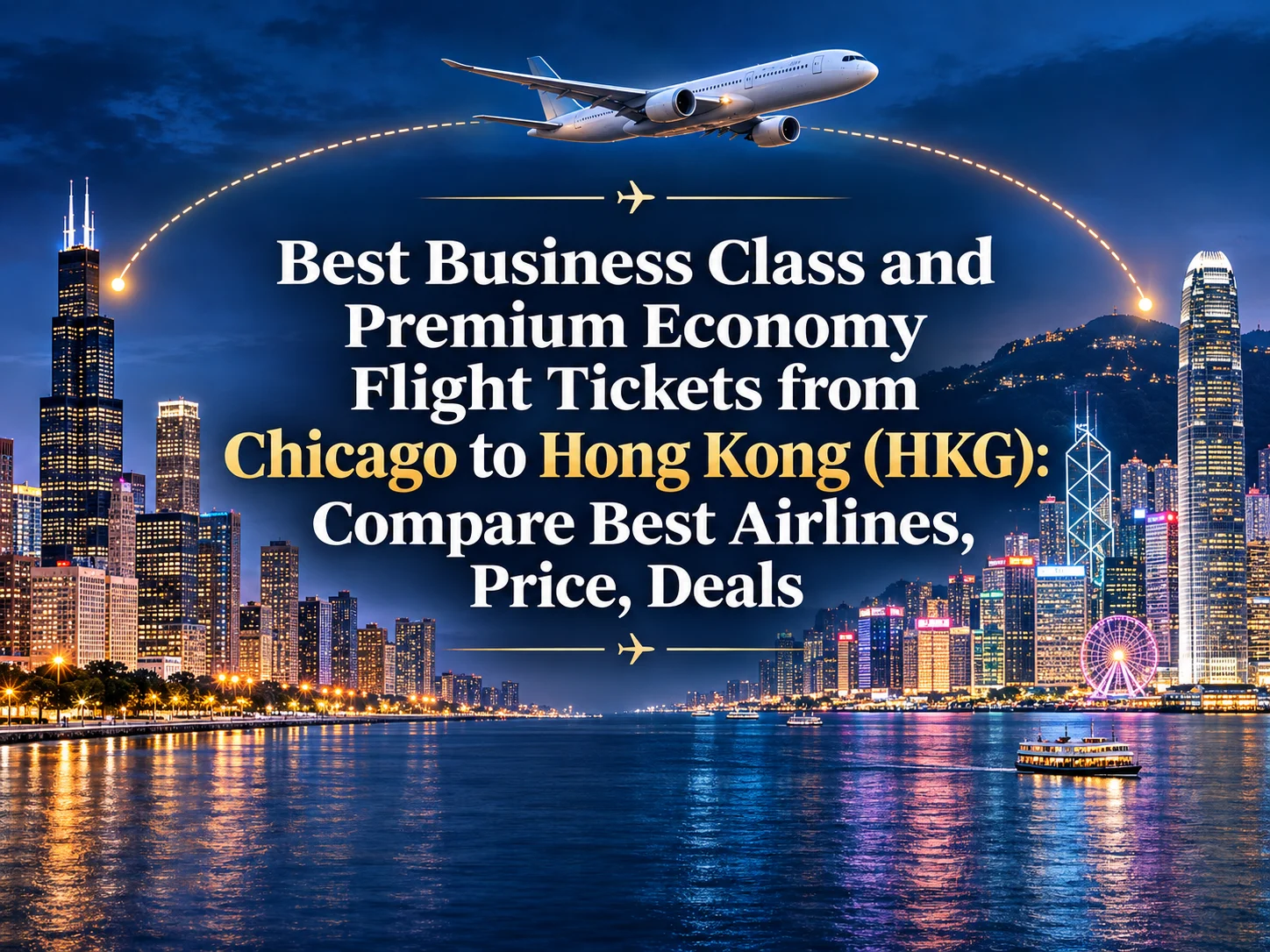
Best Business Class and Premium Economy Flight Tickets from Chicago to Hong Kong (HKG): Compare Best Airlines, Price, Deals
Chicago to Hong Kong has practical nonstop choices, so the best premium ticket depends on more than the lowest number shown in a search result. For this market, the fare headline is only the first filter. The better decision usually comes from balancing the overnight seat, total elapsed time, departure window, arrival hour and how much risk the connection adds. This guide compares 4 useful airlines without forcing every destination into the same carrier list, and it separates Business Class value from Premium Economy value so travelers can judge the cabin they will actually fly.
Cost (Fare Range)
A sensible Chicago–Hong Kong premium budget starts at roughly $1,560–$3,650 for Premium Economy and $2,680–$5,970 for Business Class. First Class, when genuinely available on the chosen long-haul aircraft, may sit around $6,410–$12,070. Instead of treating the lowest observed fare as normal, use these bands to judge whether a deal is unusually strong, merely average, or expensive for the travel period.
Most Popular Routes and Fares
ORD–HKG nonstop on Cathay Pacific is a useful benchmark, with Business planning around $2,519–$5,492 and Premium Economy, where genuinely sold, around $1,466–$3,394. ORD–TPE–HKG on EVA Air is a useful benchmark, with Business planning around $2,599–$5,731 and Premium Economy, where genuinely sold, around $1,505–$3,522. ORD–HND/NRT–HKG on ANA is a useful benchmark, with Business planning around $2,680–$5,970 and Premium Economy, where genuinely sold, around $1,544–$3,650. ORD–ICN–HKG on Korean Air is a useful benchmark, with Business planning around $2,760–$6,208 and Premium Economy, where genuinely sold, around $1,583–$3,777. Treat these as route-level budgeting examples rather than guaranteed inventory; exact travel dates and cabin availability decide the live price.
Quick Verdict
Start with Cathay Pacific if only nonstop and the cleanest itinerary. Compare it against EVA Air when premium alternative through taipei. ANA can become the better-value play when useful when japan connections price aggressively, while the remaining option is best treated as a schedule or alliance benchmark.
For Premium Economy, do not assume every carrier in a Business Class shortlist offers a true separate cabin. On Chicago–Hong Kong, the safest comparison is to inspect each segment individually and confirm that the longest flight is ticketed in a genuine Premium Economy cabin rather than extra-legroom Economy.
Expert Comparison
Start by comparing elapsed time and cabin continuity. A premium ticket loses much of its value when the longest sector is downgraded, the connection is excessively long, or the arrival time creates an unnecessary hotel night.
Cathay Pacific: ORD–HKG nonstop is worth comparing because only nonstop and the cleanest itinerary. In Business, expect lie-flat business on a350-class service; the Premium Economy proposition is dedicated premium economy. Nonstop frequency should still be checked by date. Lounge access should be confirmed against the exact fare rather than inferred from the airline name alone.
EVA Air: ORD–TPE–HKG is worth comparing because premium alternative through taipei. In Business, expect lie-flat royal laurel seat; the Premium Economy proposition is dedicated premium economy on ord–tpe. Adds a connection to a route with a nonstop choice. Lounge access should be confirmed against the exact fare rather than inferred from the airline name alone.
ANA: ORD–HND/NRT–HKG is worth comparing because useful when japan connections price aggressively. In Business, expect lie-flat business on transpacific sector; the Premium Economy proposition is premium economy on eligible aircraft. Total time is longer than Cathay nonstop. Lounge access should be confirmed against the exact fare rather than inferred from the airline name alone.
Korean Air: ORD–ICN–HKG is worth comparing because seoul connection can offer schedule flexibility. In Business, expect lie-flat prestige product on applicable aircraft; the Premium Economy proposition is premium-style product availability varies. Do not assume a standardized PE cabin on every sector. Lounge access should be confirmed against the exact fare rather than inferred from the airline name alone.
When comparing cabins, review premium economy flight deals for a wider recliner and upgraded ground/meal benefits, then compare business class flight deals when a lie-flat seat, lounge access and better overnight rest matter more on the Chicago–Hong Kong journey. Always verify the operating aircraft before treating an indicative fare as directly comparable.
Business Class
Airline Comparison
Business Class from Chicago to Hong Kong should be screened on seat type, routing, lounge access and total travel time. The figures below are indicative USD round-trip planning ranges, deliberately varied by airline and not presented as live bookable prices.
| AIRLINE | PRODUCT | SEAT TYPE | LOUNGE | ALLIANCE | TYPICAL RETURN FARE |
| Cathay Pacific | Business | Lie-flat Business on A350-class service | Cathay lounges | oneworld | $2,492–$5,432 |
| EVA Air | Royal Laurel | Lie-flat Royal Laurel seat | EVA lounges | Star Alliance | $2,559–$5,641 |
| ANA | Business Class | Lie-flat Business on transpacific sector | ANA lounges | Star Alliance | $2,626–$5,850 |
| Korean Air | Prestige Class | Lie-flat Prestige product on applicable aircraft | Korean Air lounges | SkyTeam | $2,693–$6,059 |
Product Details
Cathay Pacific | Business
Routing: ORD–HKG nonstop
Seat: Lie-flat Business on A350-class service
Travel advantage: Only nonstop and the cleanest itinerary
Lounge or cabin caveat: Cathay lounges
What to verify: Nonstop frequency should still be checked by date
Round-trip budget: $2,492–$5,432
Use this carrier as a seat-and-schedule comparison rather than assuming brand reputation settles the decision. A slightly older Business product can still be the smarter ticket when it cuts several hours from the journey or arrives at a more usable time.
EVA Air | Royal Laurel
Routing: ORD–TPE–HKG
Seat: Lie-flat Royal Laurel seat
Travel advantage: Premium alternative through Taipei
Lounge or cabin caveat: EVA lounges
What to verify: Adds a connection to a route with a nonstop choice
Round-trip budget: $2,559–$5,641
Before payment, compare the exact seat map and fare conditions. On long-haul travel, privacy, aisle access and change flexibility can be worth more than a small difference in headline price.
ANA | Business Class
Routing: ORD–HND/NRT–HKG
Seat: Lie-flat Business on transpacific sector
Travel advantage: Useful when Japan connections price aggressively
Lounge or cabin caveat: ANA lounges
What to verify: Total time is longer than Cathay nonstop
Round-trip budget: $2,626–$5,850
This option works best when the connection and arrival time align with the purpose of the trip. The strongest reason to pay for Business Class is the ability to protect sleep and working time on the longest sector, not simply the premium meal service.
Korean Air | Prestige Class
Routing: ORD–ICN–HKG
Seat: Lie-flat Prestige product on applicable aircraft
Travel advantage: Seoul connection can offer schedule flexibility
Lounge or cabin caveat: Korean Air lounges
What to verify: Do not assume a standardized PE cabin on every sector
Round-trip budget: $2,693–$6,059
Use this carrier as a seat-and-schedule comparison rather than assuming brand reputation settles the decision. A slightly older Business product can still be the smarter ticket when it cuts several hours from the journey or arrives at a more usable time.
Premium Economy
Airline Comparison
Premium Economy on Chicago–Hong Kong needs a segment-by-segment check. Some airlines provide a dedicated long-haul cabin, while others in the route comparison may offer no true Premium Economy at all. The table makes that distinction explicit rather than labeling every upgraded Economy product as PE.
| AIRLINE | PREMIUM PRODUCT | SEAT / AVAILABILITY | LOUNGE ACCESS | STATUS | TYPICAL RETURN FARE |
| Cathay Pacific | Premium Economy | Dedicated Premium Economy | Usually not from PE fare alone | True PE on eligible long-haul aircraft | $1,435–$3,358 |
| EVA Air | Premium Economy | Dedicated Premium Economy on ORD–TPE | Usually not from PE fare alone | True PE on eligible long-haul aircraft | $1,482–$3,485 |
| ANA | Premium Economy | Premium Economy on eligible aircraft | Usually not from PE fare alone | True PE on eligible long-haul aircraft | $1,528–$3,613 |
| Korean Air | Premium Economy / extra-comfort varies | Premium-style product availability varies | Usually not from PE fare alone | Verify carefully / may not be true PE | $1,575–$3,741 |
Product Details
Cathay Pacific | Premium Economy
Routing: ORD–HKG nonstop
Seat: Dedicated Premium Economy
Travel advantage: Only nonstop and the cleanest itinerary
Lounge or cabin caveat: Premium Economy alone generally does not guarantee Business lounge access.
What to verify: Nonstop frequency should still be checked by date
Round-trip budget: $1,435–$3,358
Premium Economy is most compelling when the fare sits much closer to Economy than Business. Compare seat pitch, width, recline, meal service and baggage together; one extra checked bag or a better change rule can materially improve the real value.
EVA Air | Premium Economy
Routing: ORD–TPE–HKG
Seat: Dedicated Premium Economy on ORD–TPE
Travel advantage: Premium alternative through Taipei
Lounge or cabin caveat: Premium Economy alone generally does not guarantee Business lounge access.
What to verify: Adds a connection to a route with a nonstop choice
Round-trip budget: $1,482–$3,485
Do not buy purely from the cabin label shown on a search engine. Open the segment details, identify the aircraft and verify the seat map so the premium is paying for a genuine separate cabin rather than a preferred Economy row.
ANA | Premium Economy
Routing: ORD–HND/NRT–HKG
Seat: Premium Economy on eligible aircraft
Travel advantage: Useful when Japan connections price aggressively
Lounge or cabin caveat: Premium Economy alone generally does not guarantee Business lounge access.
What to verify: Total time is longer than Cathay nonstop
Round-trip budget: $1,528–$3,613
For travelers who do not need a flat bed, this can be the value sweet spot. The key is confirming that the wider recliner is installed on the longest sector and that the itinerary is not quietly mixing standard Economy into the part of the trip where comfort matters most.
Korean Air | Premium Economy / extra-comfort varies
Routing: ORD–ICN–HKG
Seat: Premium-style product availability varies
Travel advantage: Seoul connection can offer schedule flexibility
Lounge or cabin caveat: Premium Economy alone generally does not guarantee Business lounge access.
What to verify: Do not assume a standardized PE cabin on every sector
Round-trip budget: $1,575–$3,741
Premium Economy is most compelling when the fare sits much closer to Economy than Business. Compare seat pitch, width, recline, meal service and baggage together; one extra checked bag or a better change rule can materially improve the real value.
Which Cabin Fits a Hong Kong Journey?
Prioritize sleep when the longest sector is overnight
Business Class earns its premium most clearly when the Chicago–Hong Kong itinerary includes a long overnight sector and the next day matters. A flat bed can be more valuable than extra dining or amenity-kit features.
Use Premium Economy when space matters more than a bed
A wider recliner and smaller cabin can make Chicago–Hong Kong much easier without the full Business Class price. It is often strongest for leisure travelers with flexible first-day plans.
Treat the connection as part of the product
For one-stop itineraries, airport layout, transfer time and protection on a single ticket should be compared with the seat itself. An elegant cabin cannot fully compensate for a poor connection.
Check the return journey separately
The return from Hong Kong to Chicago may use a different aircraft, departure time or even connection point. Verify both directions instead of assuming the outbound product repeats on the way home.
Booking Strategy: Chicago to Hong Kong
Compare the shortest practical routing first, then test whether saving money is worth adding a connection.
Open the aircraft seat map before paying; product names alone are not enough to identify privacy, aisle access or Premium Economy layout.
Check the Hong Kong arrival time against hotel check-in, rail connections, business meetings or onward domestic travel.
Read change and cancellation rules before focusing on lounge access or meal descriptions; flexibility can be the most valuable premium feature.
Confirm checked-baggage allowance on the marketed fare and verify whether every segment is on one protected ticket.
For Premium Economy, inspect every sector for mixed-cabin warnings and make sure the longest flight is in the cabin you are paying for.