

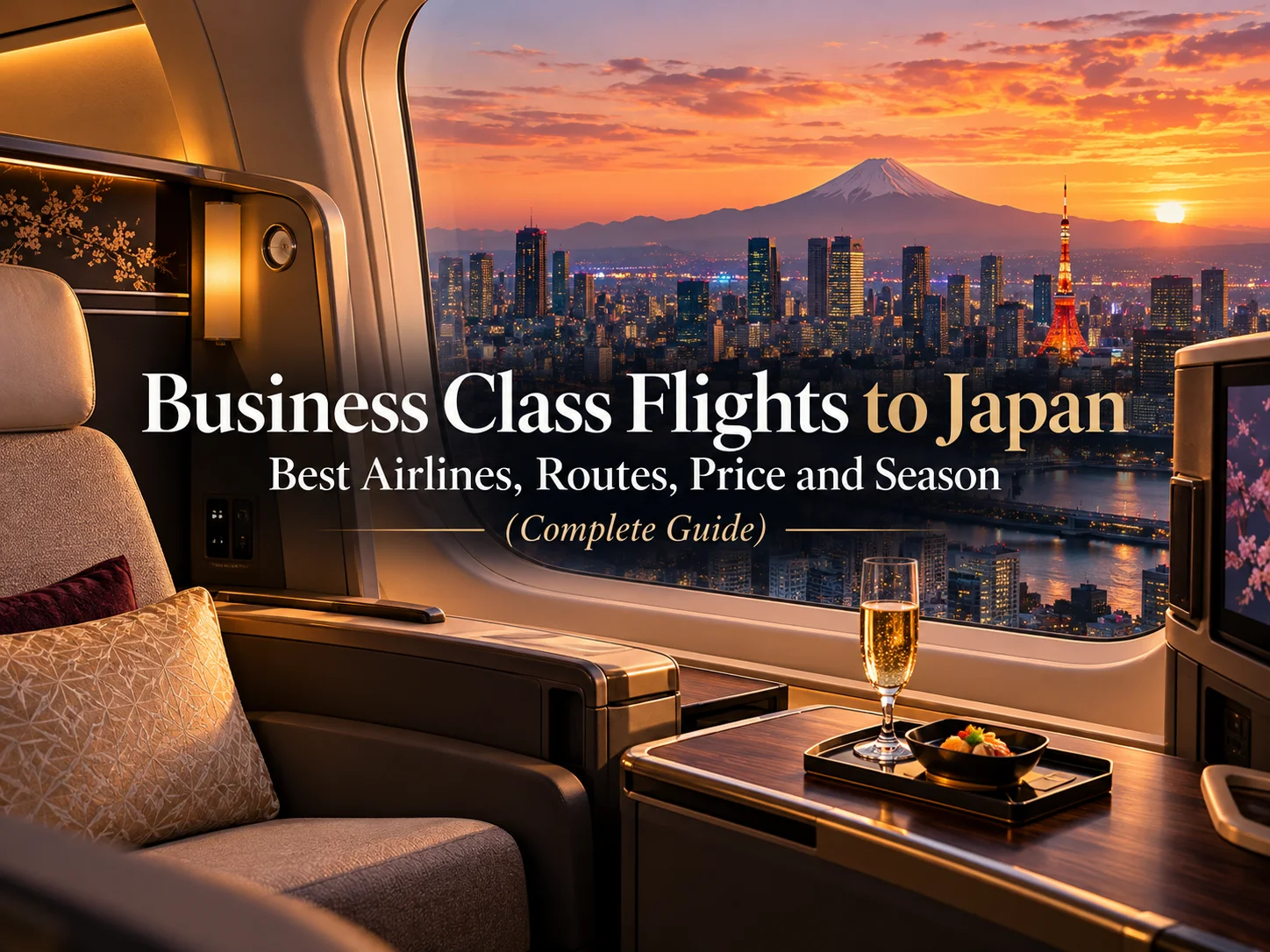
Business Class Flights to Japan – Best Airlines, Routes, Prices and Seasons (Complete Guide)
Japan is not one destination with one airport. A trip might begin with a board meeting in Tokyo, continue by rail to Kyoto, include food markets in Osaka, then finish among Hokkaido’s mountains or Okinawa’s beaches. Each plan calls for a different arrival strategy. Business Class flights to Japan can make the long Pacific crossing comfortable, but the best international airport is the one that fits the entire trip, not simply the first result returned by a flight search.
Travelers from the United States have an extensive range of nonstop Business Class flights into Tokyo, plus important alternatives that bypass Tokyo and arrive in Osaka. Airlines such as Japan Airlines, ANA, United, Delta and American compete across different US gateways; connecting tickets can also pass through Seoul, Taipei, Vancouver or other Asian hubs. The challenge is balancing the quality of a flat-bed seat with the destination, connection time, rail transfer and domestic cabin that follow.
This complete country-wide guide examines six airlines, American departure points, Tokyo and regional airports, sample round-trip Business Class budgets, travel seasons, booking windows and ten original questions. It is written primarily for USA-origin travelers. The fare bands below are illustrations for planning, not current quotations, and specific flight numbers, aircraft assignments and connecting services must be checked before purchasing.
Why Choose Business Class Flights to Japan?
1. Preserve Energy for a Multi-City Itinerary
A traveler landing after twelve or fourteen hours may need to board a bullet train, navigate station platforms or reach a smaller Japanese city the same day. Being able to sleep horizontally on the main international leg may make the difference between a usable arrival day and a lost day of the holiday. Prioritize uninterrupted rest when the itinerary includes an immediate onward journey.
2. Make Long-Distance Travel More Productive
US–Japan trips frequently involve crossing many time zones, especially from the East Coast. A quiet working area, a proper seat table and predictable power access can help travelers prepare presentations or organize travel documents. A private suite offers different practical benefits from a spacious open seat; review the exact aircraft instead of relying on cabin marketing.
3. Simplify Departure and Arrival Logistics
Premium check-in, priority baggage options and eligible lounge access can make complicated intercontinental trips easier. However, an international Business Class entitlement does not automatically transfer to every regional flight or low-cost domestic carrier. Confirm the allowance and fare type for the whole reservation when bringing winter sports equipment or several bags.
4. Match Premium Comfort to Japan’s Geography
Japan extends from northern Hokkaido to subtropical Okinawa. A premium flight into Tokyo may not be the most practical choice for a Kyoto wedding, a manufacturing visit near Nagoya or a ski holiday in Niseko. Comparing Kansai, Chubu, New Chitose and Naha against Haneda and Narita can save considerable ground travel time despite a less obvious itinerary on the booking screen.
Best Airlines for Business Class Flights to Japan
The strongest cabin depends on the operating aircraft, date and route. The following airlines deserve consideration for their genuine long-haul Business Class products or sensible connecting options; none should be assumed available nonstop on every date.
Business Class Airlines to Japan: Quick Comparison
| Airline | Business Class Product / Route | Best Advantage | Best Fit |
| Japan Airlines (JAL) | Japanese hospitality and direct access to Kansai | A350-1000 private suites on selected flights | Kyoto/Osaka visitors and travelers combining premium international comfort with Japanese connections |
| All Nippon Airways (ANA) | Premium Tokyo gateways and Japan domestic reach | THE Room on selected 777 aircraft | Passengers building a long Japanese itinerary on a Star Alliance or ANA-centered ticket |
| United Airlines | Polaris and the nonstop San Francisco–Osaka option | United Polaris beds | West Coast and Midwest travelers with Osaka or Kyoto as the first destination |
| Delta Air Lines | Delta One for travelers with a Tokyo-centered gateway | Delta One flat beds | Passengers whose closest international hub offers a good Delta nonstop to Tokyo |
| American Airlines | Flagship Business and JAL partnership choices | Flagship Business | American-loyal travelers connecting through major US hubs |
| Korean Air | One-stop access through Seoul to regional Japan | Prestige Class on eligible long-haul aircraft | Travelers reaching Kyushu, central Japan or Kansai through a single international connection |
1. Japan Airlines (JAL) – Japanese hospitality and direct access to Kansai
Japan Airlines is a particularly relevant carrier for an itinerary that extends beyond Tokyo. In addition to its transpacific flights into Haneda and Narita, it operates Los Angeles–Kansai service on scheduled dates, allowing travelers to begin in Osaka or Kyoto without a Tokyo transfer. Its Airbus A350-1000 features private Business Class suites on selected long-haul routes; other JAL widebodies use different seat designs. Expect Japanese and international dining choices, thoughtful service and eligible lounges, but confirm the exact aircraft and route. JAL also has a substantial domestic network, with cabin products that are not identical to its international suites.
Key Business Class highlights:
A350-1000 private suites on selected flights
Los Angeles–Kansai option
Japanese dining
domestic Japan network
Best for: Kyoto/Osaka visitors and travelers combining premium international comfort with Japanese connections.
Booking consideration: Do not assume the LAX–KIX flight operates every day of the year or that domestic Class J means a lie-flat Business cabin.
2. All Nippon Airways (ANA) – Premium Tokyo gateways and Japan domestic reach
ANA is a strong option for the passenger who wants to reach Japan through a major international gateway and connect onward on a coordinated domestic itinerary. It operates US links to Haneda and Narita from cities including Los Angeles, San Francisco, New York, Chicago, Seattle, Houston and Washington, D.C. The sought-after THE Room cabin is found on selected configured aircraft, not every flight. ANA domestic premium seating is a separate short-haul product; even when its booking display uses a First Class label, that does not promise the same lie-flat seat as a transpacific Business Class suite.
Key Business Class highlights:
THE Room on selected 777 aircraft
broad US–Tokyo network
onward Japan flights
Japanese and Western meals
Best for: Passengers building a long Japanese itinerary on a Star Alliance or ANA-centered ticket.
Booking consideration: Review the cabin name, aircraft and baggage rules separately on international and domestic legs.
3. United Airlines – Polaris and the nonstop San Francisco–Osaka option
United is notable because its Japan network includes a San Francisco–Kansai nonstop, a useful alternative to landing in Tokyo for western Japan. Its Polaris cabin provides fully flat seating on eligible long-haul aircraft, and MileagePlus members can combine the international journey with a wide American domestic feeder network. For travelers based inland, routing via San Francisco may be simpler than a complicated sequence of connections on both sides of the ocean. Not every United-marketed leg is Polaris, and partner flights operated by ANA may use a very different seat or service model.
Key Business Class highlights:
United Polaris beds
San Francisco–Kansai nonstop
US feeder connectivity
Star Alliance partner options
Best for: West Coast and Midwest travelers with Osaka or Kyoto as the first destination.
Booking consideration: Check whether the transpacific operating carrier is United or ANA and confirm the long-haul seat map.
4. Delta Air Lines – Delta One for travelers with a Tokyo-centered gateway
Delta One is a practical premium-cabin choice for travelers who start from Atlanta, Detroit, Minneapolis–St. Paul, Seattle or Los Angeles and prefer a US airline. Delta’s major Japan operation centers on Tokyo Haneda, from which an onward Japanese domestic flight or rail journey may be necessary. Selected widebody aircraft have Delta One suites with privacy doors, while other configurations differ. The important Japan-wide comparison is whether the benefit of a convenient US departure outweighs a later transfer to Kansai, Hokkaido or Kyushu.
Key Business Class highlights:
Delta One flat beds
SkyMiles
selected private suites
US hub connections
Best for: Passengers whose closest international hub offers a good Delta nonstop to Tokyo.
Booking consideration: Do not assume a Delta One suite or a one-ticket Japan domestic continuation on every advertised itinerary.
5. American Airlines – Flagship Business and JAL partnership choices
American can be appealing to travelers who use Dallas/Fort Worth, Los Angeles or New York JFK and want to earn or redeem AAdvantage miles. Eligible widebody Flagship Business flights offer flat beds on the long Pacific leg. Its relationship with Japan Airlines also brings extra choices: an American-marketed itinerary can contain a JAL-operated aircraft, potentially with a different seat layout or an onward connection to Osaka, Nagoya or another city. Some flights listed under one airline code are operated by the other, so review the operator and cabin against each segment before payment.
Key Business Class highlights:
Flagship Business
AAdvantage
US connecting network
JAL partnership access
Best for: American-loyal travelers connecting through major US hubs.
Booking consideration: Codeshares are not cabin guarantees; always identify the actual aircraft and operator.
6. Korean Air – One-stop access through Seoul to regional Japan
Korean Air offers a different solution for passengers whose destination is not Tokyo or Osaka. Connections through Seoul Incheon can lead to Japanese gateways such as Fukuoka, Nagoya or Kansai, depending on the date and flight inventory, avoiding some Tokyo airport and domestic-airline combinations. The intercontinental Prestige Class product varies by aircraft and may include suites or other full-flat configurations. Korean domestic or short Asian segments will often have a smaller premium seat, so a lower fare should be evaluated along with the transit time at Incheon and whether every segment is protected on one ticket.
Key Business Class highlights:
Prestige Class on eligible long-haul aircraft
Seoul hub
access to regional Japanese airports
onward itineraries
Best for: Travelers reaching Kyushu, central Japan or Kansai through a single international connection.
Booking consideration: A good fare through Seoul is valuable only if the schedule and transfer length support the final destination.
Best Business Class Routes From the USA to Japan
Flight schedules for Japan vary by season, and the following table describes useful US gateway choices rather than guaranteed departures for every date. Always check the operating airline and whether each flight is nonstop or connecting.
Popular US–Japan Business Class Routes
| US Departure | Arrival | Example Airlines | Route Guidance |
| Los Angeles LAX | HND / NRT / KIX | JAL, ANA; other Tokyo carriers | JAL serves Kansai on scheduled dates; confirm frequency |
| San Francisco SFO | HND / NRT / KIX | United, ANA, JAL | United nonstop to Osaka Kansai; Tokyo alternatives |
| New York JFK | HND | JAL, ANA, American | Nonstop Tokyo entry; connect by rail/air onward |
| Chicago ORD | HND / NRT | ANA, United, JAL | US Midwest gateway, then regional Japan connections |
| Dallas/Fort Worth DFW | HND | JAL, American | Useful for Texas and southern US feeder itineraries |
| Seattle SEA | HND / NRT | ANA, Delta, JAL | Pacific Northwest options with onward transfers |
| Boston BOS | NRT | JAL | Tokyo arrival followed by rail or domestic connection |
| San Diego SAN | NRT | JAL | West Coast Japan service; date-dependent frequency |
| Houston IAH | HND | ANA, United | Star Alliance Tokyo gateway; check current operation |
| Honolulu HNL | HND / NRT / KIX / NGO | JAL, ANA; other carriers | Some direct access to Kansai and Chubu; schedule varies |
Business Class Flights From Los Angeles to Japan
LAX is one of the most flexible American departure points because Tokyo is served by numerous carriers while Japan Airlines also offers flights to Kansai International on relevant days. If the first hotel is in Kyoto or Osaka, price LAX–KIX before accepting a Tokyo flight. A shorter flight to Tokyo is not a bargain once a second flight and airport transfer are added. Aircraft choice can differ even among flights operated by the same airline.
Business Class Flights From San Francisco to Japan
SFO offers a valuable alternate entry into western Japan with United’s nonstop to Osaka Kansai. Travelers continuing to Kobe, Nara or Kyoto may save time by skipping Tokyo entirely. ANA and JAL Tokyo services remain useful for a multicity trip that begins in the capital. Compare arrival hours, aircraft and connection implications, rather than ranking every nonstop solely on cost.
Business Class Flights From New York to Japan
A New York departure offers premium nonstop access to Tokyo Haneda, including selected modern private suites. For an itinerary centered on Kyoto, the decision is between connecting from Tokyo and flying through an alternative US or international hub that reaches Kansai. At the East Coast stage length, a well-designed sleeping seat may be more important than an additional onboard service.
Business Class Flights From Chicago to Japan
ORD functions as a practical hub for passengers in the Midwest, giving access to ANA, JAL and United Tokyo services. A traveler going to Nagoya should compare high-speed rail from Tokyo with an additional Japanese domestic flight, as schedule alignment affects the true door-to-door journey. A one-ticket air connection can be convenient but still deserves a generous transfer window.
Business Class Flights From Dallas/Fort Worth to Japan
American and Japan Airlines support important transpacific itineraries through Dallas/Fort Worth. Some flights use different aircraft generations and may be operated by a partner despite the marketing code. This is a useful gateway for Houston-region alternatives or smaller southern markets, especially when the Japan itinerary includes a JAL domestic continuation.
Business Class Flights From Seattle to Japan
Seattle gives Pacific Northwest residents direct access to Japan without routing through California. ANA, Delta and JAL provide different aircraft, arrival airports and alliance connections. For Hokkaido travel, a transfer through Tokyo may work well, but the schedule should be judged by the final arrival time at New Chitose rather than the first Tokyo landing.
Business Class Flights From Honolulu to Japan
Travelers starting in Hawaii can explore JAL routes beyond Tokyo, including Osaka Kansai and Nagoya Chubu, subject to schedule. For a western Japan vacation, this can eliminate a mainland US detour or a Tokyo transfer. Compare the international flight cabin carefully: shorter segments and differing aircraft may not offer the exact same premium product advertised elsewhere.
Business Class Flights From US East Coast to Osaka and Kyoto
Travelers from Boston, Atlanta or Washington may find that an efficient connection to LAX or SFO followed by a Kansai nonstop is more logical than Tokyo plus another domestic flight. The tradeoff is a longer US positioning segment. Look at total travel hours, the risk of missed transfers and the first night’s hotel location.
Business Class Flights From US gateways to Fukuoka and Kyushu
Fukuoka has excellent domestic and regional Asian connections, and its airport is unusually close to central Hakata. US travelers can connect via Tokyo, Seoul or another Asian hub depending on the airline. This is often more practical than landing in Tokyo and making an extended journey southwest by train when Fukuoka is the primary destination.
Business Class Flights From US gateways to Sapporo, Okinawa and Hiroshima
Sapporo New Chitose (CTS) is useful for Hokkaido ski and summer trips, while Naha (OKA) is the principal airport for Okinawa vacations. Hiroshima can be reached by domestic flight or rail from Kansai and other cities. For these journeys, the longest international seat matters, but so does the timing of the final leg: late arrivals can make a same-day resort or ferry transfer impractical.
Connecting Business Class Flights to Japan
Most US–Japan nonstops reach Tokyo. A passenger whose plans concentrate on Osaka, Kyoto, Nagoya, Fukuoka, Sapporo or Okinawa should compare three broad options: a direct flight to the appropriate regional Japanese gateway where available; a Tokyo arrival followed by domestic air or rail; or one international connection through a hub such as Seoul Incheon (ICN), Taipei Taoyuan (TPE) or Vancouver (YVR). Different combinations become attractive for different origin airports.
Example itineraries include New York JFK → Tokyo Haneda → Sapporo New Chitose; Atlanta → Seoul Incheon → Fukuoka; Chicago → Tokyo Haneda → Naha; and Los Angeles → Osaka Kansai nonstop. These are routing examples, not assurances that every flight combination is sold on the same date or at the same fare.
When connecting in Tokyo, distinguish Haneda from Narita. A connection requiring a change of airports is not equivalent to an ordinary airside transfer. You may need to enter Japan, reclaim luggage, cross metropolitan Tokyo, and clear security again. A same-airport connection generally avoids the cross-city drive, but domestic transfer procedures and immigration requirements still affect your buffer.
A separate-ticket itinerary is especially risky after an overnight transpacific flight. If the first flight is delayed, the next airline may treat you as a no-show. Compare protected itineraries, checked-bag handling and the earliest domestic departure you can realistically meet. For rail travel after landing, avoid the tightest possible reservation until you know your airport processing time.
Rail can outperform short domestic flights on some city pairs after ground transfer and airport processing are counted. Kyoto has no airport of its own: many visitors use Kansai International and rail or road transport. Nagoya, by contrast, has Chubu Centrair (NGO), which can make good sense for central Japan if the itinerary reaches it without excessive layovers.
Are Connecting Business Class Flights to Japan Cheaper?
A connection can expose a different premium fare bucket, but the cheapest result may hide a European short-haul cabin, added airport time or a second immigration queue. Compare the fare only after checking every segment, total elapsed hours, terminal changes, baggage protection and the value of a nonstop to your plans in Japan.
Business Class Flights to Japan: Tokyo and Regional Japanese Airports
For a smooth arrival, treat the airport and ground transfer as part of the premium journey, not as an afterthought. The choices below are operationally different and can change your first day.
Japan Airport and Ground-Access Comparison
| Factor | Primary / Preferred | Alternative / Consideration |
| Tokyo region | Haneda HND: usually convenient for central Tokyo | Narita NRT: broader options on some routes, longer city transfer |
| Osaka / Kyoto / Nara | Kansai International KIX: key long-haul entry | Itami ITM: mainly domestic, often convenient once within Japan |
| Nagoya / central Honshu | Chubu Centrair NGO: central Japan gateway | Tokyo or Kansai plus rail, if flight timings work |
| Hokkaido / ski resorts | New Chitose CTS: Sapporo-region access | Tokyo domestic connection or selected Asian-hub routing |
| Kyushu / southern Japan | Fukuoka FUK: easy access to Hakata | Kansai or Tokyo plus rail/air for other Kyushu cities |
| Okinawa | Naha OKA: Okinawa main-island airport | Domestic connection; onward island flight/ferry may be needed |
Choose Kansai When Western Japan Comes First
For travelers who start in Kyoto, Osaka or Nara, arriving at KIX can save the additional Tokyo–Kansai leg and provide a straightforward surface transfer. Kyoto itself has no commercial international airport. Time your KIX arrival against the final express train or bus, especially for late evening landings and reservations outside the main cities.
Choose Regional Airports When Japan Extends Beyond the Golden Route
For a Nagoya manufacturing visit, NGO may be the logical endpoint. A Sapporo ski trip should be priced through CTS, including sports-luggage fees and transfers to Niseko or Furano. Fukuoka’s airport has quick access to central Hakata, while flights to Okinawa generally use OKA. The right airport is a trip-level decision, not a prestige ranking between Tokyo and everyone else.
How Much Do Business Class Flights to Japan Cost?
The following ranges are planning estimates per adult for round-trip USA-origin Business Class travel, expressed in US dollars. They are not current fare quotes, verified promotions or guarantees. Taxes, operating date, origin, seat inventory and ticket rules can change the payable price considerably.
Estimated Round-Trip Business Class Airfares to Japan
| Fare / Travel Scenario | Illustrative USD Round Trip |
| Exceptional sale or carefully timed connecting itinerary | $2,800–$4,200 |
| Competitive lower-range round trip | $4,200–$5,800 |
| Typical mid/high-range premium budget | $5,800–$7,800 |
| Peak season, flexible, or scarce premium inventory | $7,800–$11,500+ |
| Regional Japan itinerary with added sectors | Often above comparable Tokyo-only ticket |
Pricing note: the examples above describe budgeting bands only; a live ticket may be lower or higher, and airline products are not equivalent.
What Makes Some Japan Business Class Tickets More Expensive?
The destination airport changes the equation. Tokyo has the most transpacific capacity, while an itinerary to Sapporo, Fukuoka or Naha may require additional flights and a smaller pool of through fares. Peak cherry blossom departures, Golden Week, year-end family travel and Hokkaido ski weekends can absorb premium inventory. Aircraft matters as well: sought-after suites may be attractive at a higher price, but a cheaper older configuration can still provide a fully flat bed. Taxes, carrier surcharges, refund rules, advance purchase, weekend stays and availability all influence the quote. A data point from a fare-search platform is a snapshot, not a rate card: KAYAK has published US–Japan return Business Class averages around the mid-$5,000s, while other platforms show different samples. No source guarantees that an average fare will be available for your dates.
Should You Book a One-Way or Round-Trip Japan Business Fare?
A one-way long-haul Business Class fare can be disproportionately expensive compared with a round trip, particularly on legacy airlines. If your plan is Tokyo in and Osaka out, search a proper multi-city/open-jaw ticket instead of buying unrelated one-way international tickets first. Compare that arrangement with a Tokyo round trip plus domestic transport and account for luggage, rail fees and extra hotel nights. Awards booked with miles have different rules, so evaluate them separately.
Cheapest and Most Expensive Seasons for Business Class Flights to Japan
Seasonal demand reflects school holidays, local events, corporate travel and available airline capacity rather than a universal cheapest booking month. The outlook below is qualitative, so compare exact travel days before deciding.
Japan Business Class Seasonal Price Guide
| Travel Period | Demand Driver | Practical Outlook |
| January–February | Ski holidays in the north, calmer cultural cities | Winter is not uniformly low season. |
| March–April | Cherry blossoms move north through the country | Sakura travel increases demand in southern and central Japan, but bloom dates vary by latitude and annual weather. |
| Late April–May | Golden Week and spring travel across Japan | Golden Week concentrates domestic journeys around late April and early May, tightening hotels, trains and internal flights even when your intercontinental ticket seems reasonable. |
| June–August | Rainy season, summer festivals and school vacations | Early summer brings the rainy season to much of mainland Japan, while Hokkaido can offer pleasant outdoor weather. |
| September–October | Early autumn, typhoon risk and changing colors | These months can offer interesting opportunities between high-summer and major late-autumn sightseeing crowds. |
| November–December | Autumn foliage in central Japan and holiday demand | Kyoto’s late-autumn gardens and the cultural attractions of Tokyo or Osaka draw travelers well into November. |
1. January–February: Ski holidays in the north, calmer cultural cities
Winter is not uniformly low season. Tokyo, Kyoto and Osaka may see less demand outside New Year, while Hokkaido powder snow and the Sapporo Snow Festival can be busy and expensive. Start with destination-specific search dates: a bargain to Tokyo is not enough if flights and hotels near ski resorts are at peak rates. Snow and winter road conditions also affect same-day transfers.
2. March–April: Cherry blossoms move north through the country
Sakura travel increases demand in southern and central Japan, but bloom dates vary by latitude and annual weather. Kyoto and Tokyo may be busy while Hokkaido blossoms appear much later. Premium fares are often firmer around school breaks and popular blossom periods. Build flexibility around where and when you want to see flowers rather than locking an entire vacation to an assumed peak date.
3. Late April–May: Golden Week and spring travel across Japan
Golden Week concentrates domestic journeys around late April and early May, tightening hotels, trains and internal flights even when your intercontinental ticket seems reasonable. A Kyoto itinerary booked through Osaka can still face crowded rail corridors. Once the holiday period ends, selected dates may be more flexible, but event calendars and regional weather continue to matter.
4. June–August: Rainy season, summer festivals and school vacations
Early summer brings the rainy season to much of mainland Japan, while Hokkaido can offer pleasant outdoor weather. July and August attract festivals, international family trips and strong domestic demand; August Obon dates are particularly active. Travelers heading to Osaka or Hiroshima should also prepare for heat and humidity. Okinawa is appealing for beaches but summer typhoon disruption is possible.
5. September–October: Early autumn, typhoon risk and changing colors
These months can offer interesting opportunities between high-summer and major late-autumn sightseeing crowds. Hokkaido cools sooner and autumn foliage begins in northern and higher-elevation areas before reaching Tokyo and Kyoto. Typhoon season can affect flights and ferries, especially in southern Japan. Compare insurance protection and connection buffers instead of shopping solely on the cheapest calendar square.
6. November–December: Autumn foliage in central Japan and holiday demand
Kyoto’s late-autumn gardens and the cultural attractions of Tokyo or Osaka draw travelers well into November. Early December may present useful gaps in some markets, but year-end holidays create another premium-cabin rush. Hokkaido shifts toward ski season, and different regions of Japan can have entirely different demand levels on the same dates. Consider multi-city pricing if the trip spans both sightseeing and winter sports.
When Is the Best Time to Book Business Class Flights to Japan?
No fixed number of days before departure guarantees the lowest premium fare. Use the appropriate monitoring window below to compare aircraft, schedule and refundable conditions; book when the complete itinerary meets your needs.
Suggested Booking Windows
| Travel Situation | Recommended Planning Approach |
| Sakura holiday in Tokyo/Kyoto | Start monitoring around 6–10 months before travel; be flexible about precise dates |
| Golden Week or year-end family travel | Research around 6–10 months ahead; also book domestic legs and lodging |
| Hokkaido ski trip | Start around 5–9 months ahead; coordinate flights, equipment and transfers |
| Shoulder-season cultural trip | Compare 3–6 months ahead and track alternative arrival cities |
| Flexible multi-city itinerary | Search open-jaw and regional-airport combinations before deciding |
How to Find Cheaper Business Class Flights to Japan
1. Search Japan as a Country, Then Price the Actual City
A nationwide search can reveal cheap gateways, but a final-city quote is more useful. Compare Tokyo (TYO) with Osaka Kansai (KIX), Nagoya (NGO), Sapporo (CTS) and Fukuoka (FUK) according to the actual itinerary. Include transportation from the airport to the first hotel rather than treating every airport as equally convenient.
2. Check Both Los Angeles–Kansai and San Francisco–Kansai
These nonstop routes can save travelers heading to Osaka or Kyoto from a Tokyo transfer. JAL has scheduled LAX–KIX service, and United flies SFO–KIX on published October 2026 schedules. A one-stop routing from your hometown into one of those gateways may be the fastest overall combination, even if the headline fare is not the lowest.
3. Use Open-Jaw Tickets for Trips Across Japan
If the itinerary starts in Tokyo, continues to Hakone and Kyoto, and ends in Osaka, entering via Tokyo and leaving from Kansai can eliminate backtracking. Search multi-city instead of two unrelated single fares. A suitable open-jaw ticket may also pair arrival at Narita with a return from Osaka, depending on airline ticketing.
4. Compare Rail and Domestic Flights in Total Time
Airport security, baggage claim and transport to town change the apparent speed advantage of a short domestic flight. For Tokyo–Kyoto, high-speed rail often offers a practical alternative. For Sapporo or Okinawa, flying is commonly more sensible. Price seat reservations, rail passes when relevant, luggage handling and the time required to reach the station.
5. Confirm Which Segment Has the Flat Bed
An itinerary sold as Business Class to Japan may include a fully flat US–Tokyo segment followed by a domestic premium recliner or ordinary Economy seat. International long-haul lounges and baggage allowances may not transfer automatically. Inspect each leg and avoid assuming a Japanese domestic First Class or Class J label is equivalent to a widebody suite.
6. Consider a Carefully Timed Asian Connection
Seoul Incheon and Taipei Taoyuan can connect to regional Japanese cities that require extra backtracking from Tokyo. When the through fare is materially lower, compare Korean Air, EVA Air and eligible partner itineraries. The best connection is neither the shortest nor the cheapest if it creates a risky terminal transfer or a late arrival without ground transport.
7. Separate Lie-Flat Seat Value From Full-Service Perks
ZIPAIR markets a ZIP Full-Flat seat, but its service bundles and fees differ from traditional full-service Business Class. Paid checked bags, lounge access, meals, seat selection and flexibility can alter the final cost. It can be a legitimate alternative for a traveler who mainly needs a flat bed, but should not be presented as an identical product to ANA, JAL or Polaris.
What Is Included in Business Class Flights to Japan?
Business Class Seat and Sleeping Experience
Most mainline transpacific Business Class itineraries on eligible widebody aircraft provide a full-flat sleeping position. However, a JAL A350-1000 suite, an ANA THE Room seat and a United Polaris seat differ in dimensions, privacy, storage and layout. A published seat photograph may show an aircraft type not assigned to your departure. Reconfirm the plane and seating chart close to travel.
Business Class Meals
JAL and ANA frequently showcase Japanese meal options alongside international selections, while American and Korean carriers have their own menus. Special meals usually need an advance request, subject to airline rules. For a long itinerary with multiple flights, do not assume the same dining choice appears on regional legs, or that a late-night flight serves dinner at the same time as a daytime service.
Business Class Lounge Access
Eligible premium tickets often provide access to relevant departure lounges and sometimes a partner lounge at a connection point. Lounge privileges can depend on the marketed fare, operating airline and alliance agreement. A low-cost flat-bed seat or a separate domestic ticket may not grant the expected entry. Check airport and terminal carefully when using Tokyo, Kansai or Incheon.
Business Class Baggage Allowance
Luggage entitlements vary by airline, route, membership tier and ticket. The distinction matters when a ski trip includes equipment, when large suitcases are carried on a Shinkansen or when a domestic connection follows a long-haul arrival. Check baggage weight, dimensional restrictions and whether all sectors are protected under the same reservation; the international allowance may not apply to unrelated domestic tickets.
Is Business Class to Japan Worth the Extra Money?
Business Class May Be Worth It If:
Business Class is often most valuable for passengers crossing the Pacific before immediately continuing to a client meeting, several hours of train travel, a family event or a complex itinerary with children. A restful long-haul cabin may reduce fatigue, and premium airport support can simplify a multi-segment trip. It is less compelling if you spend the entire first day recovering anyway or if buying Business would substantially restrict the remainder of the journey. Compare the overall benefit against the hotel, meals, rail and experiences you would give up.
When Premium Economy Could Be Better Value
Premium Economy may deliver useful added width and recline for far less than a true lie-flat cabin. For people who sleep comfortably in a recliner, the difference may not justify thousands of extra dollars. A hybrid itinerary can be sensible: pay for a premium long-haul flight on the overnight or longest segment while using rail or Economy domestically. Do not describe Premium Economy as a guaranteed full-flat experience.
Tips for a More Comfortable Flight to Japan
These practical steps can help ensure the quality of the flight carries through to your arrival experience:
Build the first 24 hours around the real Japanese arrival date; westbound flights from the US usually cross the International Date Line.
For a ski trip, verify oversize luggage policies before selecting the cheapest regional connection.
Use a through-ticket when possible, especially when arriving with checked bags and taking a domestic flight.
Keep a generous margin for immigration and the first Shinkansen departure after arrival.
For Kyoto or Nara, compare KIX arrivals against Tokyo-to-Kansai transfers before booking.
Check the seasonal airport access plan for Okinawa ferries, Hokkaido resort buses and late-night train services.
Confirm whether the Business Class seat shown in the booking photo is really on your operating aircraft.
If visiting several regions, consider arriving in one city and returning from another instead of retracing the journey.
Keep a backup connection plan when weather, typhoons or winter snow might affect onward journeys.
Final Thoughts: Choosing the Best Business Class Flight to Japan
A Japan-wide Business Class plan should begin with a map, not a ranking of glamorous airline suites. JAL, ANA, United, Delta, American and Korean Air offer different strengths, while the right international gateway may be Tokyo, Osaka or an Asian connection into another part of Japan. The highest-value ticket is the one that delivers a comfortable transpacific seat and an efficient journey to the actual first destination. Verify the operator, season, fare rules and domestic transfer before paying, and your premium trip can feel smoother from the first airport to the final Japanese city.