

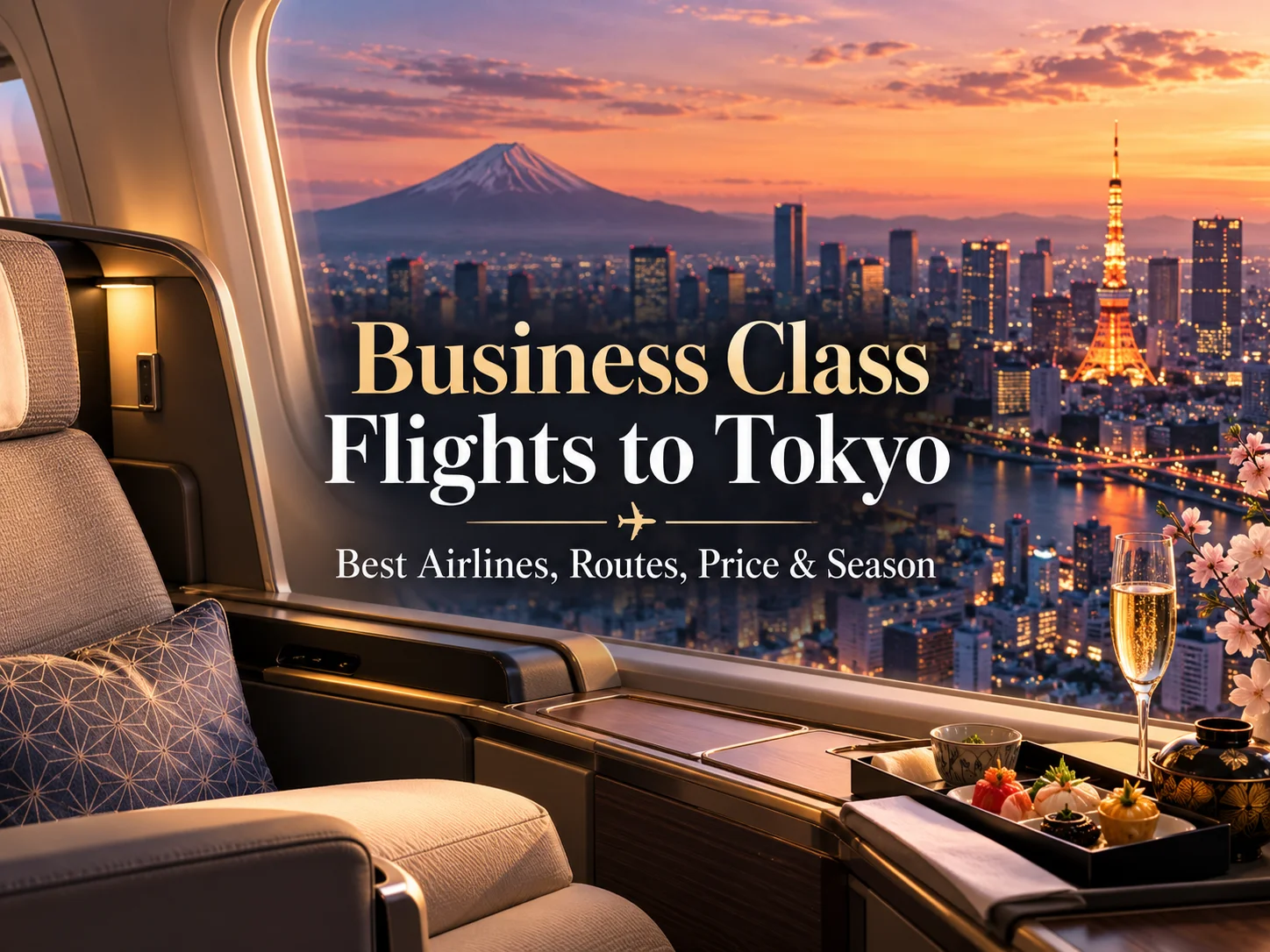
Business Class Flights to Tokyo – Best Airlines, Routes, Prices and Seasons (Complete Guide)
Tokyo is one of the world's most exciting destinations, combining futuristic technology, centuries-old traditions, world-class restaurants, luxury hotels and remarkable cultural experiences. Whether you are traveling for an international business meeting, a luxury vacation, or a long-awaited trip to Japan, choosing the right Business Class flight can make a substantial difference to your journey.
For travelers flying from the United States, Tokyo is a long-haul destination. A nonstop journey generally takes approximately 10–15 hours, depending on the departure city, flight direction and weather conditions. Spending that time in a fully reclining Business Class bed, enjoying restaurant-inspired dining and having access to premium airport facilities can significantly improve the overall travel experience.
However, not all Business Class flights to Tokyo offer the same comfort, convenience or value. The airline, aircraft model, departure airport, arrival airport, travel season and booking date can all influence the ticket price and onboard experience.
This complete guide explores the best airlines for Business Class flights to Tokyo, popular nonstop routes from the USA, Business Class airfare ranges, the cheapest months to travel, seasonal price trends and practical strategies for finding better premium-cabin deals.
Why Choose Business Class Flights to Tokyo?
Flying Business Class from USA to Tokyo is about more than additional legroom. On a journey across the Pacific Ocean, the ability to sleep comfortably and arrive well-rested can be especially valuable. Long international flights can cause fatigue, interrupted sleep and jet lag. Business Class provides an environment designed to reduce many of these discomforts.
1. Fully Flat Beds for Long-Haul Comfort
Most established full-service airlines operating long-haul Business Class flights to Tokyo offer seats that recline into fully flat beds. Depending on the aircraft, passengers may enjoy:
• Fully flat sleeping surfaces with pillows and bedding
• Direct aisle access from individual seats
• Privacy dividers or sliding suite doors
• Adjustable lighting and personal reading lamps
• Large personal entertainment screens
• Charging ports, storage compartments and working surfaces
For travelers flying from New York, Chicago or Washington, D.C., a comfortable sleeping arrangement can make an especially noticeable difference.
2. Premium Dining and Personalized Service
Leading airlines such as Japan Airlines and All Nippon Airways are known for their Japanese hospitality and carefully presented inflight dining. Passengers may have the opportunity to enjoy Japanese-style meals, international cuisine, premium beverages, selected wines and flexible dining arrangements. The exact menu depends on the airline, route and flight schedule.
3. Airport Lounge Access
Eligible international Business Class tickets often include airport lounge access, allowing passengers to relax, dine or work before departure. Depending on the airport and airline, facilities may include quiet seating, showers, complimentary refreshments, Wi-Fi and dedicated workspaces.
4. Priority Airport Services
Business Class travelers generally receive benefits such as priority check-in, premium boarding and enhanced baggage allowances. Priority baggage handling may also be provided, although the exact benefits depend on the operating airline and fare rules. For international travelers carrying important work equipment or connecting onward within Japan, these services can provide added convenience.
Best Airlines for Business Class Flights to Tokyo
Several international airlines operate excellent premium cabins on routes to Tokyo. However, the best choice depends on your departure location, budget and preferred onboard experience.
Business Class Airlines to Tokyo: Quick Comparison
| Airline | Business Class Product | Main Advantage | Ideal For |
| Japan Airlines (JAL) | JAL Business Class, including A350-1000 suites | Japanese hospitality and private suites | Luxury travelers |
| All Nippon Airways (ANA) | ANA Business Class, including THE Room | Spacious seats and premium dining | Privacy and comfort |
| United Airlines | United Polaris | Extensive US route network | Frequent US travelers |
| Delta Air Lines | Delta One | Premium bedding and private suites on select aircraft | Comfort-focused travelers |
| American Airlines | Flagship Business | US connections and partner network | AAdvantage members |
| Singapore Airlines | Long-haul Business Class | Attentive service and premium dining | Los Angeles travelers |
| Korean Air | Prestige Class | Convenient connections through Seoul | One-stop itineraries |
| EVA Air | Royal Laurel Class on eligible aircraft | Premium service through Taipei | Alternative connecting routes |
Important: Airlines may operate several aircraft configurations under the same Business Class name. Always verify the aircraft, seat map and operating carrier before booking.
1. Japan Airlines (JAL) – Excellent for Luxury and Japanese Hospitality
Japan Airlines is one of the strongest options for travelers who want their premium journey to reflect Japan's service culture. JAL combines attentive hospitality, thoughtfully prepared meals and comfortable long-haul seating. Its newest international Business Class experience is available on selected Airbus A350-1000 aircraft.
Business Class features:
• Fully flat beds and direct aisle access
• Private suites with doors on the A350-1000
• Large entertainment displays and personal storage
• Japanese and international meal selections
• Premium bedding and lounge access for eligible tickets
The A350-1000 Business Class cabin features a 1-2-1 configuration with 54 individual suites, offering direct aisle access and greater privacy.
Popular US routes: New York JFK–Tokyo Haneda, Dallas/Fort Worth–Tokyo Haneda and Los Angeles–Tokyo Haneda. JAL also serves other US gateways with different aircraft and cabin configurations.
Best for: Travelers prioritizing service, Japanese dining and an upscale onboard environment.
Booking tip: If privacy is particularly important, look specifically for a JAL flight operated by the Airbus A350-1000 instead of selecting a ticket based on the airline name alone.
2. All Nippon Airways (ANA) – Excellent for Spacious Business Class Seats
All Nippon Airways is another leading choice for long-haul travel to Japan. ANA's premium experience combines Japanese hospitality, comfortable seating and carefully designed inflight service. One of its most distinctive products is ANA THE Room, available on specially configured Boeing 777-300ER aircraft. These seats offer unusually generous personal space and a sliding door for privacy.
Business Class features:
• Fully flat sleeping positions and large entertainment screens
• Direct aisle access on many long-haul configurations
• Sliding privacy doors in THE Room
• Japanese and Western meal choices
• Personal storage, power outlets and premium lounges
ANA also offers other Business Class configurations, including staggered seating. Its newer THE Room FX product is being introduced progressively on selected Boeing 787-9 aircraft, with route availability dependent on deployment.
Popular US gateways: Los Angeles, San Francisco, New York, Chicago, Seattle, Houston and Washington, D.C.
Best for: Business travelers, couples and passengers who value personal space.
Booking tip: Check whether your selected aircraft offers THE Room, THE Room FX or another ANA Business Class seat. These products are not interchangeable.
3. United Airlines – A Practical Choice for US Travelers
United Airlines is an attractive choice for passengers traveling from major American cities because of its extensive domestic network and nonstop service to Japan. Its long-haul premium product, United Polaris, is designed around comfortable sleeping, dining and a practical workspace. Business travelers can benefit from combining US domestic and transpacific segments under one reservation.
United Polaris features:
• Fully flat beds and direct aisle access on standard Polaris widebody configurations
• Premium bedding and large entertainment displays
• Dining and beverage service
• Power connections and personal storage
• Eligible United Polaris and partner lounge access
United offers Tokyo services from several US hubs, including San Francisco, Los Angeles, Chicago, Newark, Denver and Washington, D.C., depending on the schedule and destination airport.
Best for: United MileagePlus members, corporate travelers and passengers needing convenient connections from smaller US cities.
Booking tip: Compare the nonstop Polaris itinerary with Star Alliance partner flights operated by ANA. The mileage, lounge and onboard experiences may differ even when both airlines appear together.
4. Delta Air Lines – Premium Comfort With Delta One
Delta's international Business Class product, Delta One, offers an elevated flying experience suitable for lengthy transpacific journeys. On eligible Airbus A350 and A330-900 aircraft, Delta One suites feature sliding doors that create additional privacy.
Delta One features:
• Fully flat beds and suite doors on selected aircraft
• Premium bedding and amenity kits
• Personal entertainment and charging facilities
• Enhanced onboard dining and priority airport services
• Lounge access according to purchased fare and eligibility rules
Delta operates nonstop Tokyo Haneda services from several US gateways, including Atlanta, Detroit, Minneapolis–St. Paul, Los Angeles and Seattle, subject to schedules.
Best for: Delta SkyMiles members and travelers who prefer US airline connectivity combined with a premium international cabin.
Booking tip: Confirm whether the aircraft has Delta One suites with doors, because cabin layouts vary. Review the specific Delta One fare type, since benefits may differ.
5. American Airlines – Convenient Routes and Flagship Business
American Airlines offers Flagship Business on eligible long-haul international aircraft. Its network is especially useful for passengers connecting through Dallas/Fort Worth, Los Angeles and New York. The airline also works closely with Japan Airlines through its transpacific partnership, providing additional flight and connection choices.
Flagship Business features:
• Fully flat seats and priority airport services
• Premium onboard dining and entertainment
• Personal storage, power outlets and enhanced bedding
• Eligible lounge benefits
American operates Tokyo Haneda services from major US gateways such as Dallas/Fort Worth, Los Angeles and New York JFK.
Best for: AAdvantage members, corporate passengers and travelers booking an itinerary involving both American Airlines and Japan Airlines.
Booking tip: Pay close attention to the words "operated by" when booking codeshare flights. A flight marketed by American Airlines may use a Japan Airlines aircraft.
6. Singapore Airlines – A Premium Los Angeles–Tokyo Option
Singapore Airlines offers another interesting Business Class choice for passengers departing Los Angeles. Its Los Angeles–Tokyo Narita service forms part of the airline's route continuing to Singapore. Travelers can book the Los Angeles-to-Narita sector as their journey to Tokyo, subject to ticket availability. The route has operated with Boeing 777-300ER aircraft offering long-haul Business Class.
Business Class features:
• Spacious, fully flat seating
• Premium inflight dining and attentive cabin service
• Large entertainment displays and thoughtful storage
• Comfortable long-haul amenities
Popular route: Los Angeles (LAX) – Tokyo Narita (NRT).
Best for: Los Angeles travelers who want to experience Singapore Airlines without flying all the way to Singapore.
Booking tip: This flight arrives at Narita rather than Haneda. Include ground transportation time when evaluating its overall convenience.
Best Business Class Routes From the USA to Tokyo
Travelers can reach Tokyo nonstop from multiple major US airports. A nonstop flight is generally the simplest option because it avoids additional connections, reduces the possibility of missed onward flights and allows passengers to spend more uninterrupted time resting.
Popular US–Tokyo Business Class Routes
| Departure City | Airport | Tokyo Arrival | Example Airlines |
| Los Angeles | LAX | HND / NRT | ANA, JAL, United, American, Delta, Singapore Airlines |
| San Francisco | SFO | HND / NRT | ANA, JAL, United |
| New York | JFK | HND | ANA, JAL, American |
| Chicago | ORD | HND / NRT | ANA, JAL, United |
| Dallas/Fort Worth | DFW | HND | JAL, American |
| Seattle | SEA | HND / NRT | ANA, Delta, JAL |
| Washington, D.C. | IAD | HND | ANA, United |
| Houston | IAH | HND | ANA, United |
| Atlanta | ATL | HND | Delta |
| Detroit | DTW | HND | Delta |
| Minneapolis | MSP | HND | Delta |
| Boston | BOS | NRT | JAL |
Routes and operating airlines shown are representative. Frequency, aircraft, airport allocation and seasonal availability can change.
Business Class Flights From Los Angeles to Tokyo
Los Angeles is one of the most competitive gateways for Business Class flights to Japan. Travelers can find nonstop options to both Haneda and Narita, creating opportunities to compare several airlines, cabin products and departure times. Nonstop flights generally take approximately 11–12 hours westbound.
Recommended approach: Compare ANA and JAL for premium Japanese airline experiences, Singapore Airlines for service to Narita, and United, Delta or American for loyalty benefits and schedule convenience.
Business Class Flights From San Francisco to Tokyo
San Francisco offers strong nonstop connectivity with Japan through major American and Japanese carriers. The flight generally takes approximately 11 hours westbound, depending on schedules and wind conditions. Passengers should compare Tokyo Haneda and Narita arrivals, especially if their final destination is central Tokyo.
Recommended approach: Review ANA, JAL and United side by side, paying attention to aircraft seating rather than price alone.
Business Class Flights From New York to Tokyo
New York–Tokyo is one of the most important long-haul business travel markets between the United States and Japan. Nonstop services from JFK to Haneda include options from ANA, Japan Airlines and American Airlines. Travel times commonly fall around 14–15 hours toward Tokyo.
Recommended approach: Travelers prioritizing a private suite should consider eligible JAL A350-1000 flights and compare them against available ANA premium cabin configurations.
Business Class Flights From Chicago to Tokyo
Chicago O'Hare is a major connecting gateway for passengers from the Midwest. Nonstop Tokyo services and connections through Chicago provide useful options for travelers originating in cities without direct flights to Japan. ANA, United and Japan Airlines are important airlines to consider.
Recommended approach: Search both Haneda and Narita, and compare the full itinerary if you are connecting from another Midwest airport.
Business Class Flights From Dallas to Tokyo
Dallas/Fort Worth is a significant gateway for premium travel between the United States and Japan. American Airlines and Japan Airlines operate nonstop services between Dallas/Fort Worth and Tokyo Haneda. This is convenient for passengers originating in Texas, the South and cities served by American's domestic network.
Recommended approach: Compare American's Flagship Business with JAL's premium cabins, including the A350-1000 where scheduled.
Business Class Flights From Seattle to Tokyo
Seattle is one of the geographically convenient mainland US departure points for traveling to Japan. Nonstop flight times are typically around 10–11 hours westbound, making it attractive for travelers from the Pacific Northwest. ANA, Delta and Japan Airlines provide important Tokyo travel options, although the airport served may differ.
Recommended approach: Compare Haneda and Narita schedules, particularly when booking flights that connect from smaller Pacific Northwest airports.
Connecting Business Class Flights to Tokyo
Not every US city has a nonstop flight to Tokyo. Passengers traveling from cities such as Miami, Orlando, Charlotte, Philadelphia, Tampa or Nashville may need to connect through another airport.
Common routing strategies include:
• Via Los Angeles: Orlando → Los Angeles → Tokyo
• Via San Francisco: Miami → San Francisco → Tokyo
• Via Chicago: Philadelphia → Chicago → Tokyo
• Via Dallas/Fort Worth: Tampa → Dallas/Fort Worth → Tokyo
• Via Seattle: Portland → Seattle → Tokyo
These are examples of possible connecting routings, not promises that every combination will be available on a particular date or airline ticket. International connecting options may also be available through airports such as Seoul Incheon, Taipei Taoyuan or Hong Kong.
Are Connecting Business Class Flights Cheaper?
Sometimes, but not always. A connecting itinerary may be cheaper when an airline offers a promotional fare or when nonstop premium seats are in high demand. However, the saving should be considered alongside the additional travel time, connection risks and potential differences between cabins. A lower advertised Business Class fare may also contain a short segment in Economy Class or a regional premium seat.
Always inspect every flight segment before paying.
Business Class Flights to Tokyo: Haneda vs. Narita Airport
Tokyo has two major international airports, and choosing the right arrival airport can make a meaningful difference to your journey.
Tokyo Airport Comparison
| Feature | Tokyo Haneda (HND) | Tokyo Narita (NRT) |
| Distance from central Tokyo | Approximately 15 km | Approximately 50–60 km |
| Central-city access | Often around 25–45 minutes by rail | Often around 45–90 minutes by rail |
| Main advantage | Convenient for central Tokyo | Broad international flight options |
| Common transport | Keikyu Line, Tokyo Monorail | Narita Express, Keisei Skyliner |
| Best suited to | Short visits and business meetings | Travelers prioritizing suitable fares and schedules |
Actual travel times depend on the destination station, transfer requirements and service selected.
When Should You Choose Haneda Airport?
Haneda is particularly convenient for visitors staying in central Tokyo neighborhoods such as Shinagawa, Ginza and surrounding commercial districts. Its shorter ground journey can be important after a long international flight. For travelers visiting Tokyo for only two or three days, Haneda's location can provide a practical advantage.
When Is Narita Airport Worth Choosing?
Narita can be a good option when a more attractive Business Class fare or preferred airline is available. The airport has convenient rail connections to Tokyo Station, Ueno, Nippori, Shinjuku and other major areas. The Narita Express generally takes around one hour to reach Tokyo Station, while the Skyliner reaches the Ueno area in approximately 45 minutes. A lower-priced flight into Narita may offer better overall value, particularly for a longer vacation.
Important: Avoid booking a connection that requires changing between Haneda and Narita unless you have enough time. An airport transfer can take considerably longer than an ordinary same-airport connection.
How Much Do Business Class Flights to Tokyo Cost?
The price of a Business Class ticket to Tokyo depends on the airline, departure city, travel season, advance booking period, flight availability and fare restrictions. Prices can change multiple times before departure as airlines adjust inventory and demand.
For travel originating in the United States, fares can range from discounted promotional prices of around $3,000 to premium nonstop tickets costing $8,000 or considerably more per person round trip. These are broad budgeting figures, not guaranteed offers.
Estimated Round-Trip Business Class Airfares to Tokyo
| Fare Category | Illustrative Price Range (USD) |
| Attractive promotional fare | $3,000–$4,500 |
| Lower-to-midrange fare | $4,500–$6,000 |
| Regular higher-priced fare | $6,000–$8,000 |
| High-demand or flexible premium fare | $8,000–$12,000+ |
Estimates are per passenger for round-trip travel from the United States. Actual fares may fall below or above these amounts. They are not live airline quotations.
What Makes Some Tokyo Business Class Tickets More Expensive?
Nonstop availability: A convenient nonstop service may command a premium over a flight with connections.
Aircraft and cabin design: Airlines may price desirable newer suites differently from older Business Class cabins, although this is not guaranteed.
Peak tourism periods: Cherry blossom season and major Japanese holidays can increase demand.
Departure airport: Larger markets with several competing airlines may offer more choices.
Ticket flexibility: Refundable or changeable Business Class tickets may cost considerably more than restricted promotional fares.
Booking timing: Premium inventory can become more expensive as popular flights fill, although last-minute discounts can occasionally appear.
Are One-Way Business Class Flights Half the Round-Trip Price?
Not necessarily. International Business Class pricing does not always follow simple proportional rules. A one-way Business Class ticket may cost almost as much as a round-trip ticket on some airlines and dates. Travelers planning one-way journeys should compare one-way pricing, round-trip fares and eligible multi-city itineraries before making a decision.
Cheapest and Most Expensive Seasons for Business Class Flights to Tokyo
Japan's distinct seasons are one of its biggest attractions, but they also have a major influence on tourism demand and airfare availability. Tokyo experiences popular spring blossoms, warm and humid summers, colorful autumn foliage and relatively cool winters.
Tokyo Business Class Seasonal Price Guide
| Travel Period | Typical Demand | Price Outlook |
| January–February, excluding major holidays | Lower to moderate | Often favorable |
| March–early April, cherry blossoms | Very high | Frequently expensive |
| Late April–early May, Golden Week | Very high | Frequently expensive |
| Late May–June | Moderate | Often better value |
| July–August | Moderate to high | Mixed; Obon is busy |
| September–October | Moderate to high | Variable |
| November | Moderate to high | Foliage demand can increase prices |
| Late December–early January | High | Frequently expensive |
This table describes demand tendencies, not a guaranteed fare ranking. Specific origin markets and departure dates can behave differently.
1. Winter: January to February
For travelers prioritizing cheaper Business Class flights to Tokyo, winter is worth investigating. After New Year's holiday travel ends, some January and February dates experience lower tourism demand than the cherry blossom period. Tokyo winters are generally cool and relatively dry, making city exploration comfortable for travelers who prefer fewer crowds.
Why consider winter? Potentially better premium-cabin fare availability, fewer crowds at some attractions, comfortable conditions for city sightseeing and opportunities to explore Japan's winter experiences. New Year travel and certain Lunar New Year periods can still generate heavy demand.
2. Spring: March to May
Spring is among the most beautiful and popular times to visit Tokyo. Cherry blossoms typically create strong demand during late March and early April, although the exact flowering period changes annually. Visitors travel to Japan to experience famous cherry blossom locations such as Ueno Park, Shinjuku Gyoen and the Chidorigafuchi area. Because many international travelers plan their trips around the blossoms, desirable Business Class seats can sell quickly.
Booking recommendation: If cherry blossom travel is your priority, begin comparing fares well ahead of departure and avoid relying on last-minute premium cabin availability. Another busy period is Golden Week, which normally falls between late April and early May and brings substantial domestic travel demand.
3. Early Summer: Late May to June
Late May and parts of June can provide a useful balance between price and convenience. Intense cherry blossom demand has usually ended, while much of Japan has not yet entered the main summer holiday period. June is associated with Japan's rainy season, so travelers should prepare for humid conditions and occasional heavy rain. This period deserves consideration for passengers looking for good value.
4. Summer: July to August
Tokyo summers are generally hot and humid. The city offers festivals, fireworks displays, seasonal dining and cultural events, but high temperatures can make outdoor sightseeing challenging. Airfare demand varies across the season. The Obon holiday period in August is particularly important because domestic travel across Japan increases. Compare dates surrounding Obon rather than assuming that the entire summer has similar prices.
5. Autumn: September to November
Autumn is another attractive time to visit Tokyo. Temperatures typically become more comfortable as the season progresses, while parks and gardens begin displaying changing foliage. Some September dates may offer attractive fares, whereas popular foliage periods can generate increased demand. Early autumn also requires attention to the possibility of typhoons and associated weather disruption.
6. Holiday Season: December and New Year
Late December and early January can be expensive periods for international flights to Japan. Christmas vacations, family reunions and year-end travel contribute to stronger demand on certain routes. Travelers who must fly during this period should compare departure dates carefully and allow time for possible winter weather disruptions at connecting airports.
When Is the Best Time to Book Business Class Flights to Tokyo?
There is no single booking day or advance-purchase window that guarantees the lowest Business Class airfare. Travelers can, however, use a practical planning framework.
Suggested Booking Windows
| Travel Situation | Planning Approach |
| Cherry blossom season | Start monitoring approximately 6–10 months ahead |
| Golden Week or year-end holidays | Begin looking 6–10 months ahead |
| Ordinary spring or autumn travel | Check options about 3–7 months ahead |
| Flexible winter or early-summer travel | Compare fares over several months |
| Last-minute business travel | Check direct, one-stop and partner options |
These are planning suggestions rather than statistically guaranteed cheapest-booking periods. For major holidays, selecting the desired cabin and schedule early may matter more than finding the absolute lowest price. For flexible travel, comparing multiple departure dates can be more useful than booking on a particular weekday.
How to Find Cheaper Business Class Flights to Tokyo
Booking a premium cabin does not mean travelers must accept the first fare displayed. Here are practical ways to evaluate Business Class ticket prices.
1. Compare Multiple US Departure Airports
A traveler living within reach of two airports may discover meaningful differences in premium fares. Compare Los Angeles and San Francisco, or New York JFK and Newark. Savings should be measured against the expense and inconvenience of reaching an alternative airport.
2. Search Both Tokyo Airports
Searching the combined Tokyo airport code, TYO, can help identify itineraries arriving at Haneda and Narita. You should then compare airport transfer times and overall flight duration.
3. Review Airline Partnerships
Some booking platforms display partner airlines alongside the airline used to make the booking. A flight booked through United may contain an ANA-operated service, while American Airlines may offer Japan Airlines-operated flights. Compare the actual onboard product and ticket conditions before deciding.
4. Be Flexible With Travel Dates
Moving a journey by two or three days can sometimes reveal different premium fare inventory. Instead of assuming Tuesday or Wednesday will always be cheapest, compare a full calendar of departure and return dates. Business Class pricing reflects seat inventory, demand and fare rules rather than a universal cheapest weekday.
5. Consider One-Stop Flights
A one-stop itinerary may create opportunities to travel on Korean Air, EVA Air or Cathay Pacific. But a cheaper fare is worthwhile only when the connection is practical and the Business Class product meets your expectations.
6. Use Miles and Airline Loyalty Programs
Frequent-flyer points can sometimes provide valuable alternatives to expensive cash tickets. Investigate United MileagePlus, American AAdvantage, Delta SkyMiles and eligible ANA, JAL or partner programs. Award prices, fees and seat availability vary substantially.
7. Check the Complete Fare Conditions
Before booking, compare:
• Refund and change rules
• Checked baggage entitlement and lounge eligibility
• Seat selection fees and whether all segments are in Business Class
• Connection duration and airport changes
• Actual operating airline and aircraft
• Taxes, surcharges and the total payable amount
The cheapest advertised ticket is not necessarily the best-value itinerary.
What Is Included in Business Class Flights to Tokyo?
A long-haul Business Class ticket generally includes a significantly enhanced experience, but individual amenities depend on the airline and purchased fare.
Business Class Seat and Sleeping Experience
Fully flat beds are a central feature of most long-haul Business Class cabins operated by major full-service airlines on US–Japan routes. Not all beds are equally wide or private. ANA THE Room and JAL's A350-1000 suites offer private spaces with doors, whereas some older configurations have open seating arrangements.
Business Class Meals
Premium international menus may include appetizers, multiple main-course options, desserts and beverages. Japanese airlines may offer traditional Japanese multi-course-style selections alongside Western dining choices. Passengers with special dietary needs should request eligible special meals before departure within the airline's required timeframe.
Business Class Lounge Access
Eligible Business Class passengers may enjoy lounges operated by their airline or a partner at the departure airport. At Tokyo airports, access depends on the operating airline, ticket type, membership rules and terminal. Access to a specific First Class lounge or premium facility should never be assumed from a Business Class ticket.
Business Class Baggage Allowance
Many full-service airlines provide enhanced checked baggage benefits for long-haul Business Class. The exact number of bags, permitted weight and dimensions vary across carriers and itineraries. Always check the allowance printed on your booking, especially when several airlines operate different segments.
Is Business Class to Tokyo Worth the Extra Money?
Business Class can be a valuable upgrade on a long-haul flight, but the answer depends on your priorities and available budget.
Business Class May Be Worth It If:
You need to work after landing. Arriving with less fatigue can be valuable when you have a meeting or conference shortly after your flight.
You struggle to sleep upright. A fully flat bed can provide a more comfortable environment for overnight rest.
You are traveling for a special occasion. Premium dining, lounge facilities and personal space can become part of the vacation experience.
You are taking a particularly long flight. The comfort difference is often more noticeable on a 14-hour journey than on a shorter trip.
When Premium Economy Could Be Better Value
If Business Class is outside your budget, Premium Economy may be a sensible alternative. Premium Economy generally offers a larger seat, additional recline and selected service enhancements compared with Economy Class. However, it normally does not include the fully flat sleeping experience of long-haul Business Class. The right option depends on whether sleep, privacy or total trip spending matters most.
Tips for a More Comfortable Flight to Tokyo
Even with a premium cabin, travelers can improve their experience through careful planning.
• Adjust your sleep schedule gradually: Begin shifting your routine toward Japan time before departure, if practical.
• Choose your seat carefully: Solo travelers may prefer window-side suites; couples may appreciate adjacent center seats with adjustable dividers.
• Understand the arrival date: Many US-departing flights arrive in Tokyo on the following calendar day because they cross the International Date Line.
• Stay hydrated: Cabin air can feel dry during long flights, so drink water regularly.
• Review your airport transfer: Choose a transportation option suitable for your luggage and hotel location.
• Leave time for onward connections: Avoid unnecessarily tight connections to Osaka, Sapporo or other Japanese destinations.
Final Thoughts: Choosing the Best Business Class Flight to Tokyo
The best Business Class flight to Tokyo is not necessarily the most expensive ticket or the airline with the most luxurious advertising. A successful premium travel experience depends on choosing the right combination of airline, aircraft, route, airport, season and total fare.
For passengers seeking Japanese hospitality and private cabins, Japan Airlines and ANA are particularly attractive options. Travelers who value US domestic connectivity may prefer United Polaris, Delta One or American Airlines Flagship Business, depending on their departure airport and loyalty preferences. Passengers departing Los Angeles should also consider Singapore Airlines' nonstop service to Tokyo Narita.
When planning your trip, compare both Haneda and Narita, inspect the operating aircraft, and consider traveling outside peak holiday periods if your schedule permits. With careful research and flexible travel dates, it is possible to find a Business Class itinerary that balances comfort, convenience and value—allowing your Tokyo journey to begin well before you arrive in Japan.